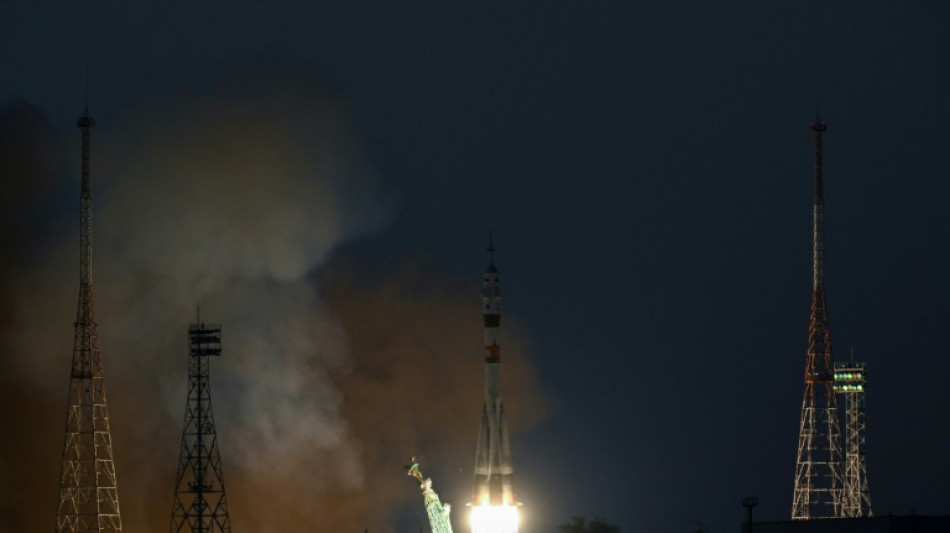
American, Russians reach space station as war rages in Ukraine / Photo: NATALIA KOLESNIKOVA - AFP

 US House faces test on sweeping Russia sanctions bill

 British PM says to make 'difficult decisions' as inflation rises

 Global fuel price demos: a round-up

 Leverate Launches MCP for Traders to Connect AI Assistants With Trading Platforms

 MEXC Launches $1M "Discover Your Wall Street DNA" Campaign to Help Traders Find Their Market Fit

 Stocks edge higher ahead of US Fed rate call

 BASIS.pro Expands On-Chain Infrastructure with XDC Network Partnership and Zypher DAO as Auto Earn Goes Live

 Pickle-flavoured tart? AI inspires Japan's convenience stores

 EU chief hosts Canada's Carney in push to 'deepen' alliance

 Meta chief pushes back on AI slowdown calls

 US Fed to deliver rate decision with markets betting on hike

 Sanders, Bannon warn of AI dangers in rare US left-right alignment

 Empty benches as schools reopen in Venezuela's quake-hit Guaira

 Tiny English village holds 'independence' vote over asylum seeker housing

 US Treasury chief says to meet Chinese counterpart at weekend

 BingX Evolves into a Multi-Asset Trading Platform, Connecting Users to Global Opportunities

 International Trading Institute Expands Professional Trader Development Beyond the Master’s in Trading

 Lake Energy Secures $80 Million for U.S. Renewable Energy Expansion

 Stocks drop, oil climbs and Treasury yields hit 19-year high

 SkySail Strategies Outperforms Wall Street's 30-Year Risk Standard With Proprietary AI Inference Model

 Just add fish: Scientists pursue more rice, less disease in Senegal paddies

 Belgium completes outer structure of offshore energy island
 China retail sales growth weakens further in August
 In Kashmir, lake weeds mix with traditional art
 'Widow's Bay' and 'The Pitt' take key Emmy awards

A US astronaut and two Russian cosmonauts have arrived safely at the International Space Station (ISS), NASA said Wednesday, after blasting off on a Russian-operated flight in a rare instance of cooperation between Moscow and Washington.
The Russian space agency Roscosmos and NASA both distributed live footage of the launch from Kazakhstan and commentators speaking over the feed said it was stable and the crew was "feeling well".
NASA's Frank Rubio and Russia's Sergey Prokopyev and Dmitry Petelin made up the crew that launched from the Russia-leased Baikonur cosmodrome at 1354 GMT.
The three will spend six months on the ISS along with three other Russian cosmonauts, three other US astronauts and one Italian.
Rubio is the first US astronaut to travel to the ISS on a Russian Soyuz rocket since President Vladimir Putin sent troops into pro-Western Ukraine on February 24.
In response, Western capitals including Washington have hit Moscow with unprecedented sanctions and bilateral ties have sunk to new lows.
Space is one of the last remaining areas of cooperation between the two countries.
Russia's only active female cosmonaut, Anna Kikina, is expected to travel to the orbital station in early October aboard a SpaceX Crew Dragon.
She will become only the fifth professional woman cosmonaut from Russia or the Soviet Union to go into space, and the first Russian to fly aboard a spacecraft of SpaceX, the company of billionaire Elon Musk.
Russian cosmonauts and Western astronauts have sought to steer clear of the conflict that is raging back on Earth, especially when in orbit together.
A collaboration among the United States, Canada, Japan, the European Space Agency and Russia, the ISS is split into two sections: the US Orbital Segment and the Russian Orbital Segment.
- Russia leaving ISS -
At present, the ISS depends on a Russian propulsion system to maintain its orbit, about 250 miles (400 kilometres) above sea level, with the US segment responsible for electricity and life support systems.
Tensions in the space field have grown since Washington announced sanctions on Moscow's aerospace industry -- triggering warnings from Russia's former space chief Dmitry Rogozin, an ardent supporter of the Ukraine war.
Rogozin's recently appointed successor Yuri Borisov later confirmed Russia's long-mooted move to leave the ISS after 2024 in favour of creating its own orbital station.
US space agency NASA called the decision an "unfortunate development" that would hinder scientific work on the ISS.
Space analysts say construction of a new orbital station could take more than a decade, and Russia's space industry -- a point of national pride -- would not be able to flourish under heavy sanctions.
The ISS was launched in 1998 at a time of hope for US-Russia cooperation following their Space Race competition during the Cold War.
During that era, the Soviet space programme boomed. It boasted a number of accomplishments that included sending the first man into space in 1961 and launching the first satellite four years earlier.
Experts say Roscosmos is now a shadow of its former self and has in recent years suffered a series of setbacks, including corruption scandals and the loss of a number of satellites and other spacecraft.
Russia's years-long monopoly on manned flights to the ISS is also gone, to SpaceX, along with millions of dollars in revenue.
A.Mykhailo--CPN

