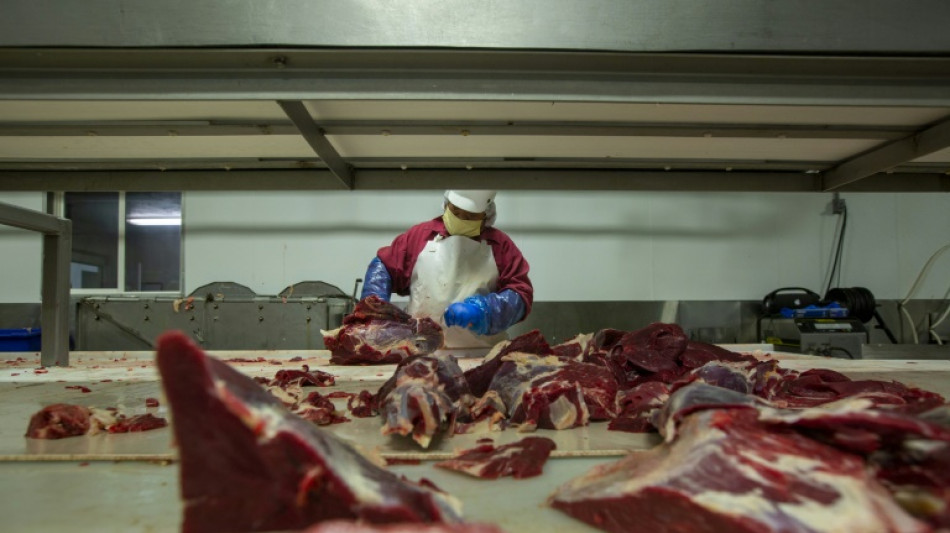
Dutch city to ban meat ads in world first claim / Photo: Natalie Behring - AFP

 US House faces test on sweeping Russia sanctions bill

 British PM says to make 'difficult decisions' as inflation rises

 Global fuel price demos: a round-up

 Leverate Launches MCP for Traders to Connect AI Assistants With Trading Platforms

 MEXC Launches $1M "Discover Your Wall Street DNA" Campaign to Help Traders Find Their Market Fit

 Stocks edge higher ahead of US Fed rate call

 BASIS.pro Expands On-Chain Infrastructure with XDC Network Partnership and Zypher DAO as Auto Earn Goes Live

 Pickle-flavoured tart? AI inspires Japan's convenience stores

 EU chief hosts Canada's Carney in push to 'deepen' alliance

 Meta chief pushes back on AI slowdown calls

 US Fed to deliver rate decision with markets betting on hike

 Sanders, Bannon warn of AI dangers in rare US left-right alignment

 Empty benches as schools reopen in Venezuela's quake-hit Guaira

 Tiny English village holds 'independence' vote over asylum seeker housing

 US Treasury chief says to meet Chinese counterpart at weekend

 BingX Evolves into a Multi-Asset Trading Platform, Connecting Users to Global Opportunities

 International Trading Institute Expands Professional Trader Development Beyond the Master’s in Trading

 Lake Energy Secures $80 Million for U.S. Renewable Energy Expansion

 Stocks drop, oil climbs and Treasury yields hit 19-year high

 SkySail Strategies Outperforms Wall Street's 30-Year Risk Standard With Proprietary AI Inference Model

 Just add fish: Scientists pursue more rice, less disease in Senegal paddies

 Belgium completes outer structure of offshore energy island

 China retail sales growth weakens further in August
 In Kashmir, lake weeds mix with traditional art
 'Widow's Bay' and 'The Pitt' take key Emmy awards

The Dutch city of Haarlem is set to become the first in the world to ban advertisements for most meat because of its impact on climate change, officials said Wednesday.
The city of 160,000 people near Amsterdam has agreed to outlaw ads for intensively farmed meat on public places like buses, shelters and screens from 2024.
The move was approved by the city council in November, but went unnoticed until last week when a councillor announced he had officially notified advertising agencies.
"It will be the first city in the Netherlands -- and in fact Europe and indeed the world -- to ban 'bad' meat ads in public places," Ziggy Klazes, councillor for the GroenLinks (Green-Left) party who drafted the motion, told AFP.
She said it went against the city's politics to "earn money by renting the city's public space to products which accelerate global warming".
The ban would target all "cheap meat from intensive farming", Klazes said, adding, "as far as I'm concerned that includes ads from fast food chains."
The city had not yet decided whether to outlaw ads for organic meat.
Amsterdam and The Hague have already banned ads for air travel, petrol-driven cars and fossil fuels but now Haarlem is set to add meat to that list.
The ban has been criticised by the Dutch meat industry and some political parties who see it as a form of censorship and stigmatisation of meat eaters.
"Banning ads for political reasons is nearly dictatorial," Joey Rademaker, a Haarlem councillor for the right-wing BVNL party, said in a statement.
The Dutch meat industry body, the Centrale Organisatie voor de Vleessector, said Haarlem authorities were "going too far in telling people what's best for them," the Trouw newspaper said.
The sector recently launched its own campaign called "Netherlands Meatland" to promote meat-eating.
- 'Going too far' -
Haarlem's ban comes at a sensitive time for the Netherlands, which has seen months of protests by farmers angry at government plans to cut nitrogen emissions to meet EU environmental targets.
The Dutch government wants to reduce the country's herd of four million cows by nearly a third, and possibly shut some farms.
Angry farmers have blocked roads with manure and trash, set fires and held huge tractor rallies to protest -- drawing support from right-wingers worldwide including former US President Donald Trump.
Meanwhile the legal status of the carnivorous crackdown is also uncertain.
A ban could be challenged as an attack on freedom of expression, administrative law professor Herman Broering of Groningen University told Trouw newspaper.
Haarlem council must still study the legal issues before the ban can come into force, added Ziggy Klazes.
"You can't ban adverts for a business, but you can ban adverts for a group of products" for public health, she said.
"Take the example of cigarette ads."
Agriculture contributes to deforestation, climate change and emissions of greenhouse gases, loss of biodiversity and ecosystems, and is a major user of fresh water.
The EU has suggested that people cut down on consumption of meat and dairy products.
Some 95 percent of Dutch people eat meat, including 20 percent every day, according to the Dutch central statistics office.
Other countries are banning advertising for certain types of food, including junk food, although for health reasons rather than climate.
Britain is banning television ads for foods that are high in fat, sugar and salt before 9:00 pm from 2023 to help cut child obesity.
Singapore has banned ads for the most unhealthy sugary drinks.
Y.Uduike--CPN