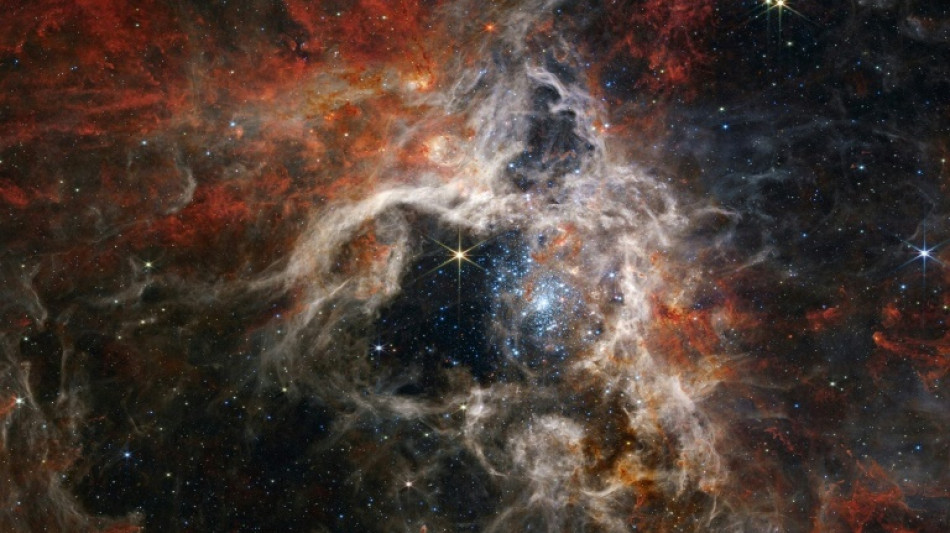
NASA's Webb catches Tarantula Nebula / Photo: Space Telescope Science Institut - NASA/AFP

 US House faces test on sweeping Russia sanctions bill

 British PM says to make 'difficult decisions' as inflation rises

 Global fuel price demos: a round-up

 Leverate Launches MCP for Traders to Connect AI Assistants With Trading Platforms

 MEXC Launches $1M "Discover Your Wall Street DNA" Campaign to Help Traders Find Their Market Fit

 Stocks edge higher ahead of US Fed rate call

 BASIS.pro Expands On-Chain Infrastructure with XDC Network Partnership and Zypher DAO as Auto Earn Goes Live

 Pickle-flavoured tart? AI inspires Japan's convenience stores

 EU chief hosts Canada's Carney in push to 'deepen' alliance

 Meta chief pushes back on AI slowdown calls

 US Fed to deliver rate decision with markets betting on hike

 Sanders, Bannon warn of AI dangers in rare US left-right alignment

 Empty benches as schools reopen in Venezuela's quake-hit Guaira

 Tiny English village holds 'independence' vote over asylum seeker housing

 US Treasury chief says to meet Chinese counterpart at weekend

 BingX Evolves into a Multi-Asset Trading Platform, Connecting Users to Global Opportunities

 International Trading Institute Expands Professional Trader Development Beyond the Master’s in Trading

 Lake Energy Secures $80 Million for U.S. Renewable Energy Expansion

 Stocks drop, oil climbs and Treasury yields hit 19-year high

 SkySail Strategies Outperforms Wall Street's 30-Year Risk Standard With Proprietary AI Inference Model

 Just add fish: Scientists pursue more rice, less disease in Senegal paddies

 Belgium completes outer structure of offshore energy island

 China retail sales growth weakens further in August

 In Kashmir, lake weeds mix with traditional art
 'Widow's Bay' and 'The Pitt' take key Emmy awards

A stellar nursery nicknamed the Tarantula Nebula has been captured in crisp detail by NASA's Webb telescope, revealing hitherto unseen features that deepen scientific understanding, the agency said Tuesday.
Officially known as 30 Doradus, the region of space is characterized by its dusty filaments that resemble the legs of a hairy spider, and has long been a favorite for astronomers interested in star formation.
Thousands of young stars, distant background galaxies, and the detailed structure of the nebula's gas and dust structures were viewable for the first time thanks to Webb's high resolution infrared instruments.
Webb operates primarily in the infrared spectrum, because light from objects in the distant cosmos has been stretched into this wavelength over the course of the universe's expansion.
The telescope's primary imager, Near-Infrared Camera (NIRCam), found the cavity in the center of the nebula was hollowed out by radiation carried on stellar winds emanating from a cluster of massive young stars, which appear as pale blue dots.
Webb's Near-Infrared Spectrograph (NIRSpec), which analyzes light patterns to determine the composition of objects, caught one young star in the act of shedding a cloud of dust from around itself.
The same star was previously thought to be at a later stage of formation, already well on the way to clearing its dusty bubble.
The region was also imaged using the Mid-infrared Instrument (MIRI), which uses longer wavelengths of infrared to pierce through dust grains that absorb or scatter shorter wavelengths.
This faded the hot stars and clarified the cooler regions, revealing never-before-seen points of light within the stellar nursery, which indicate protostars that are still gaining mass.
Astronomic interest in the Tarantula Nebula stems from its similar chemical composition to gigantic star-forming regions observed a few billion years after the Big Bang, a period called the "cosmic noon" when star formation peaked.
At just 161,000 light-years away, Tarantula is a readily viewable example of this flourishing period of cosmic creation.
Webb should also provide scientists the opportunity to gaze at distant galaxies from the actual era of cosmic noon, and compare it to observations of Tarantula, to understand similarities and differences.
Operational since July, Webb is the most powerful space telescope ever built, with astronomers confident it will herald a new era of discovery.
J.Bondarev--CPN