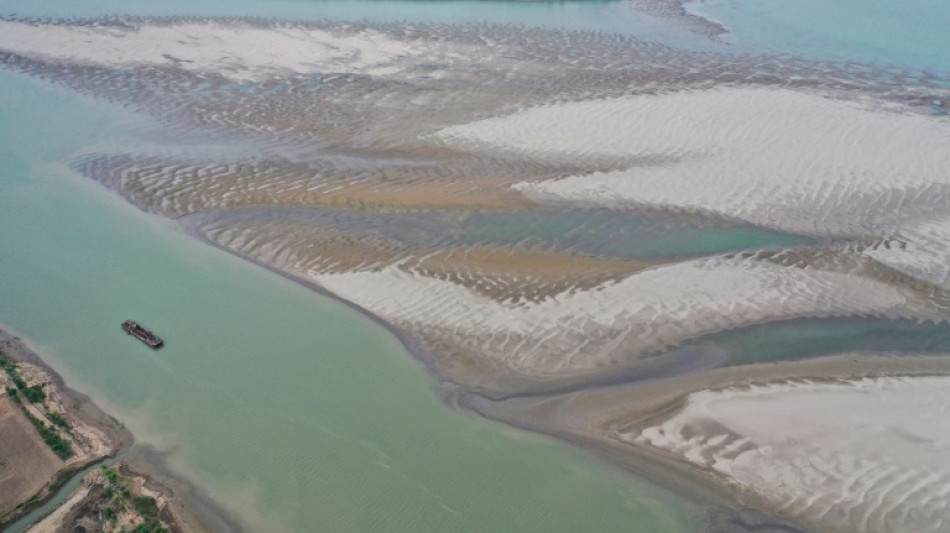
China logs hottest August since records began / Photo: STR - AFP

 US House faces test on sweeping Russia sanctions bill

 British PM says to make 'difficult decisions' as inflation rises

 Global fuel price demos: a round-up

 Leverate Launches MCP for Traders to Connect AI Assistants With Trading Platforms

 MEXC Launches $1M "Discover Your Wall Street DNA" Campaign to Help Traders Find Their Market Fit

 Stocks edge higher ahead of US Fed rate call

 BASIS.pro Expands On-Chain Infrastructure with XDC Network Partnership and Zypher DAO as Auto Earn Goes Live

 Pickle-flavoured tart? AI inspires Japan's convenience stores

 EU chief hosts Canada's Carney in push to 'deepen' alliance

 Meta chief pushes back on AI slowdown calls

 US Fed to deliver rate decision with markets betting on hike

 Sanders, Bannon warn of AI dangers in rare US left-right alignment

 Empty benches as schools reopen in Venezuela's quake-hit Guaira

 Tiny English village holds 'independence' vote over asylum seeker housing

 US Treasury chief says to meet Chinese counterpart at weekend

 BingX Evolves into a Multi-Asset Trading Platform, Connecting Users to Global Opportunities

 International Trading Institute Expands Professional Trader Development Beyond the Master’s in Trading

 Lake Energy Secures $80 Million for U.S. Renewable Energy Expansion

 Stocks drop, oil climbs and Treasury yields hit 19-year high

 SkySail Strategies Outperforms Wall Street's 30-Year Risk Standard With Proprietary AI Inference Model

 Just add fish: Scientists pursue more rice, less disease in Senegal paddies

 Belgium completes outer structure of offshore energy island

 China retail sales growth weakens further in August
 In Kashmir, lake weeds mix with traditional art

 'Widow's Bay' and 'The Pitt' take key Emmy awards

China has logged its hottest August since records began, state media reported Tuesday, following an unusually intense summer heat wave that parched rivers, scorched crops and triggered isolated blackouts.
Southern China last month sweltered under what experts said may have been one of the worst heat waves in global history, with parts of Sichuan province and the megacity of Chongqing clocking a string of days well over 40 degrees Celsius (104 Fahrenheit).
The average temperature nationwide was 22.4C in August, exceeding the norm by 1.2C, state broadcaster CCTV reported, citing the country's weather service.
Some 267 weather stations across the country matched or broke temperature records last month, the report said.
It was also China's third-driest August on record, with average rainfall 23.1 percent lower than average.
"The average number of high-temperature days was abnormally high, and regional high-temperature processes are continuing to impact our country," CCTV reported the weather service as saying.
Scientists say extreme weather like heat waves, droughts and flash floods is becoming more frequent and intense due to human-induced climate change.
Last month, temperatures as high as 45C prompted multiple Chinese provinces to impose power cuts as cities battled to cope with a surge in electricity demand partly driven by people cranking up the air conditioning.
Images from Chongqing showed a tributary of the mighty Yangtze river had almost run dry, a scene echoed further east where the waters of China's largest freshwater lake also receded extensively.
- 'Severe threat' -
Chongqing and the eastern megacity of Shanghai switched off outdoor decorative lighting to mitigate the power crunch, while authorities in Sichuan imposed industrial power cuts as water levels dwindled at major hydroelectric plants.
As local authorities warned that the drought posed a "severe threat" to this year's harvest, the central government approved billions of yuan in subsidies to support rice farmers.
"This is a warning for us, reminding us to have a deeper understanding of climate change and improve our ability to adapt to it in all respects," said Zhang Daquan, a senior official at China's National Climate Centre, in comments carried Monday by the state-run People's Daily newspaper.
"It is also necessary to raise awareness across all of society to adapt to climate change... and strive to minimise social and economic impacts and losses," Zhang said.
D.Goldberg--CPN