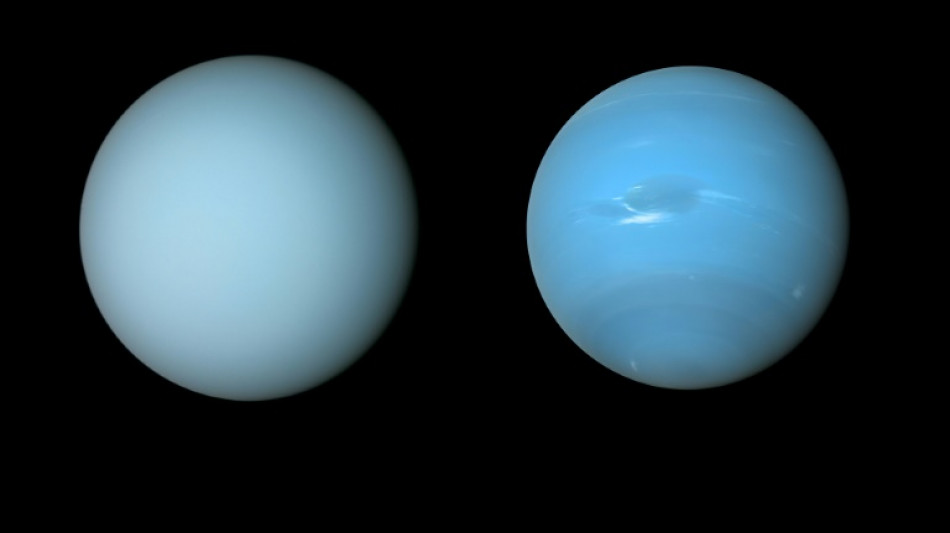
It's raining diamonds across the universe, research suggests / Photo: B. Jonsson - NSF's NOIRLab/AFP/File

 US House faces test on sweeping Russia sanctions bill

 British PM says to make 'difficult decisions' as inflation rises

 Global fuel price demos: a round-up

 Leverate Launches MCP for Traders to Connect AI Assistants With Trading Platforms

 MEXC Launches $1M "Discover Your Wall Street DNA" Campaign to Help Traders Find Their Market Fit

 Stocks edge higher ahead of US Fed rate call

 BASIS.pro Expands On-Chain Infrastructure with XDC Network Partnership and Zypher DAO as Auto Earn Goes Live

 Pickle-flavoured tart? AI inspires Japan's convenience stores

 EU chief hosts Canada's Carney in push to 'deepen' alliance

 Meta chief pushes back on AI slowdown calls

 US Fed to deliver rate decision with markets betting on hike

 Sanders, Bannon warn of AI dangers in rare US left-right alignment

 Empty benches as schools reopen in Venezuela's quake-hit Guaira

 Tiny English village holds 'independence' vote over asylum seeker housing

 US Treasury chief says to meet Chinese counterpart at weekend

 BingX Evolves into a Multi-Asset Trading Platform, Connecting Users to Global Opportunities

 International Trading Institute Expands Professional Trader Development Beyond the Master’s in Trading

 Lake Energy Secures $80 Million for U.S. Renewable Energy Expansion

 Stocks drop, oil climbs and Treasury yields hit 19-year high

 SkySail Strategies Outperforms Wall Street's 30-Year Risk Standard With Proprietary AI Inference Model

 Just add fish: Scientists pursue more rice, less disease in Senegal paddies

 Belgium completes outer structure of offshore energy island

 China retail sales growth weakens further in August

 In Kashmir, lake weeds mix with traditional art

 'Widow's Bay' and 'The Pitt' take key Emmy awards

It could be raining diamonds on planets throughout the universe, scientists suggested Friday, after using common plastic to recreate the strange precipitation believed to form deep inside Uranus and Neptune.
Scientists had previously theorised that extremely high pressure and temperatures turn hydrogen and carbon into solid diamonds thousands of kilometres below the surface of the ice giants.
Now new research, published in Science Advances, inserted oxygen into the mix, finding that "diamond rain" could be more common than thought.
Ice giants like Neptune and Uranus are thought to be the most common form of planet outside our Solar System, which means diamond rain could be occurring across the universe.
Dominik Kraus, a physicist at Germany's HZDR research lab and one of the study's authors, said that diamond precipitation was quite different to rain on Earth.
Under the surface of the planets is believed to be a "hot, dense liquid", where the diamonds form and slowly sink down to the rocky, potentially Earth-size cores more than 10,000 kilometres (6,200 miles) below, he said.
There fallen diamonds could form vast layers that span "hundreds of kilometres or even more", Kraus told AFP.
While these diamonds might not be shiny and cut like a "a nice gem on a ring", he said they were formed via similar forces as on Earth.
Aiming to replicate the process, the research team found the necessary mix of carbon, hydrogen and oxygen in a readily available source -- PET plastic, which is used for everyday food packaging and bottles.
Kraus said that while the researchers used very clean PET plastic, "in principle the experiment should work with Coca-Cola bottles".
The team then turned a high-powered optical laser on the plastic at the SLAC National Accelerator Laboratory in California.
"Very, very short X-ray flashes of incredible brightness" allowed them to watch the process of nanodiamonds -- tiny diamonds too small to see with the naked eye -- as they formed, Kraus said.
"The oxygen that is present in large amounts on those planets really helps suck away the hydrogen atoms from the carbon, so it's actually easier for those diamonds to form," he added.
- New way to make nanodiamonds? -
The experiment could point towards a new way to produce nanodiamonds, which have a wide and increasing range of applications including drug delivery, medical censors, non-invasive surgery and quantum electronics.
"The way nanodiamonds are currently made is by taking a bunch of carbon or diamond and blowing it up with explosives," said SLAC scientist and study co-author Benjamin Ofori-Okai.
"Laser production could offer a cleaner and more easily controlled method to produce nanodiamonds," he added.
The diamond rain research remains hypothetical because little is known about Uranus and Neptune, the most distant planets in our Solar System.
Only one spacecraft -- NASA's Voyager 2 in the 1980s -- has flown past the two ice giants, and the data it sent back is still being used in research.
But a NASA group has outlined a potential new mission to the planets, possibly launching next decade.
"That would be fantastic," Kraus said.
He said he is greatly looking forward to more data -- even if it takes a decade or two.
Y.Jeong--CPN