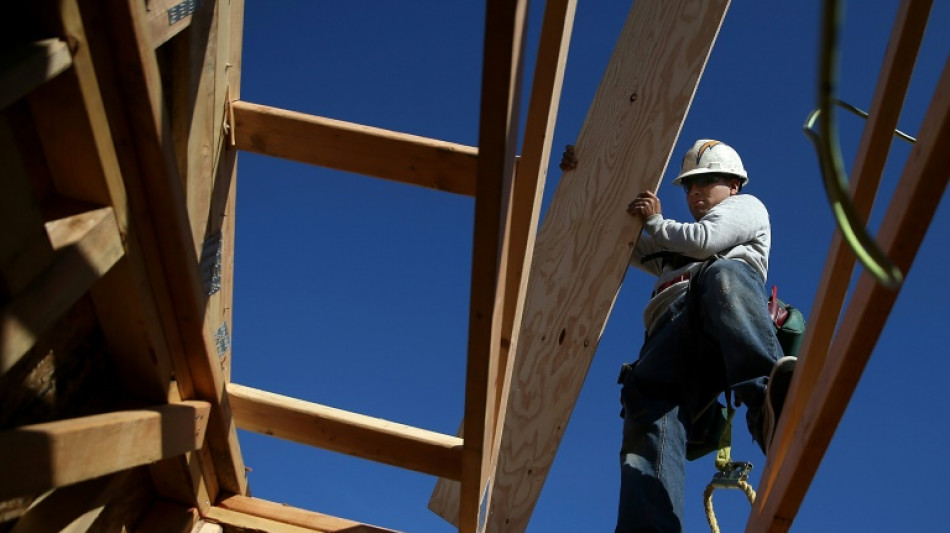
Want to save carbon and land? Study suggests wooden cities / Photo: JUSTIN SULLIVAN - GETTY IMAGES NORTH AMERICA/AFP/File

 US House faces test on sweeping Russia sanctions bill

 British PM says to make 'difficult decisions' as inflation rises

 Global fuel price demos: a round-up

 Leverate Launches MCP for Traders to Connect AI Assistants With Trading Platforms

 MEXC Launches $1M "Discover Your Wall Street DNA" Campaign to Help Traders Find Their Market Fit

 Stocks edge higher ahead of US Fed rate call

 BASIS.pro Expands On-Chain Infrastructure with XDC Network Partnership and Zypher DAO as Auto Earn Goes Live

 Pickle-flavoured tart? AI inspires Japan's convenience stores

 EU chief hosts Canada's Carney in push to 'deepen' alliance

 Meta chief pushes back on AI slowdown calls

 US Fed to deliver rate decision with markets betting on hike

 Sanders, Bannon warn of AI dangers in rare US left-right alignment

 Empty benches as schools reopen in Venezuela's quake-hit Guaira

 Tiny English village holds 'independence' vote over asylum seeker housing

 US Treasury chief says to meet Chinese counterpart at weekend

 BingX Evolves into a Multi-Asset Trading Platform, Connecting Users to Global Opportunities

 International Trading Institute Expands Professional Trader Development Beyond the Master’s in Trading

 Lake Energy Secures $80 Million for U.S. Renewable Energy Expansion

 Stocks drop, oil climbs and Treasury yields hit 19-year high

 SkySail Strategies Outperforms Wall Street's 30-Year Risk Standard With Proprietary AI Inference Model

 Just add fish: Scientists pursue more rice, less disease in Senegal paddies

 Belgium completes outer structure of offshore energy island

 China retail sales growth weakens further in August

 In Kashmir, lake weeds mix with traditional art

 'Widow's Bay' and 'The Pitt' take key Emmy awards

Housing people in homes made from wood instead of steel and concrete could save more than 100 billion tonnes of carbon emissions while preserving enough cropland to feed a booming population, research suggested Tuesday.
More than half of people globally currently live in cities and this proportion is set to rise markedly by 2050.
According to some estimates, the infrastructure needed to accommodate up to 10 billion people by mid-century could exceed that constructed since the dawn of the industrial era.
That places a huge emphasis on emissions from construction, one of the most polluting sectors and historically one of the trickiest to decarbonise.
Were all new construction projects carried out using steel and concrete, that could claim up to 60 percent of Earth's remaining carbon budget for 2C of warming -- that is, how much pollution the global economy can produce and still stay within the Paris Agreement temperature guardrail.
Scientists in Germany and Taiwan wanted to see how much carbon could be saved if firms switched to wood to build new homes instead.
They used an open-source land use model to simulate four different building scenarios: one with conventional materials like cement and steel, and three with additional demand for timber.
They also analysed how additional high wood demand could be satisfied, where it could be produced, and the impacts new tree plantations might have on biodiversity and crop production.
They found that housing people in timber homes could avoid more than 100 billion tonnes of CO2 by 2100 -- that's around 10 percent of the remaining 2C carbon budget, equivalent to nearly three years of global emissions.
Wood is known to be the least carbon-intensive building material as trees absorb CO2 as they grow, explained the study lead author Abhijeet Mishra, from the Potsdam Institute for Climate Impact Research (PIK).
"Production of engineered wood releases much less CO2 than production of steel and cement," he said. "Engineered wood also stores carbon, making timber cities a unique long-term carbon sink."
He said that engineered wood was the ideal material for constructing "mid-rise" buildings -- between four and 12 stories -- to house growing urban populations.
The study, published in the journal Nature Communications, found that around 140 million hectares -- an area larger than Peru -- would be needed to grow new trees to meet the increased demand under the timber-led building scenario.
But the team calculated that these new plantations could be established on existing areas of harvest forest, and so not impact food supply by eating into crop land.
"We need farm land to grow food for the people –- using it to grow trees could potentially cause competition for the limited land resources," said co-author Florian Humpenoder, from PIK.
The authors concluded that planting the necessary additional plantations was possible but would require "strong governance and careful planning" from governments in order to limit their impact on biodiversity.
Ng.A.Adebayo--CPN