Dust to downpour: US weather whiplash shows climate change / Photo: Michael Swensen - GETTY IMAGES NORTH AMERICA/AFP/File

 US House faces test on sweeping Russia sanctions bill

 British PM says to make 'difficult decisions' as inflation rises

 Global fuel price demos: a round-up

 Leverate Launches MCP for Traders to Connect AI Assistants With Trading Platforms

 MEXC Launches $1M "Discover Your Wall Street DNA" Campaign to Help Traders Find Their Market Fit

 Stocks edge higher ahead of US Fed rate call

 BASIS.pro Expands On-Chain Infrastructure with XDC Network Partnership and Zypher DAO as Auto Earn Goes Live

 Pickle-flavoured tart? AI inspires Japan's convenience stores

 EU chief hosts Canada's Carney in push to 'deepen' alliance

 Meta chief pushes back on AI slowdown calls

 US Fed to deliver rate decision with markets betting on hike

 Sanders, Bannon warn of AI dangers in rare US left-right alignment

 Empty benches as schools reopen in Venezuela's quake-hit Guaira

 Tiny English village holds 'independence' vote over asylum seeker housing

 US Treasury chief says to meet Chinese counterpart at weekend

 BingX Evolves into a Multi-Asset Trading Platform, Connecting Users to Global Opportunities

 International Trading Institute Expands Professional Trader Development Beyond the Master’s in Trading

 Lake Energy Secures $80 Million for U.S. Renewable Energy Expansion

 Stocks drop, oil climbs and Treasury yields hit 19-year high

 SkySail Strategies Outperforms Wall Street's 30-Year Risk Standard With Proprietary AI Inference Model

 Just add fish: Scientists pursue more rice, less disease in Senegal paddies

 Belgium completes outer structure of offshore energy island

 China retail sales growth weakens further in August
 In Kashmir, lake weeds mix with traditional art

 'Widow's Bay' and 'The Pitt' take key Emmy awards

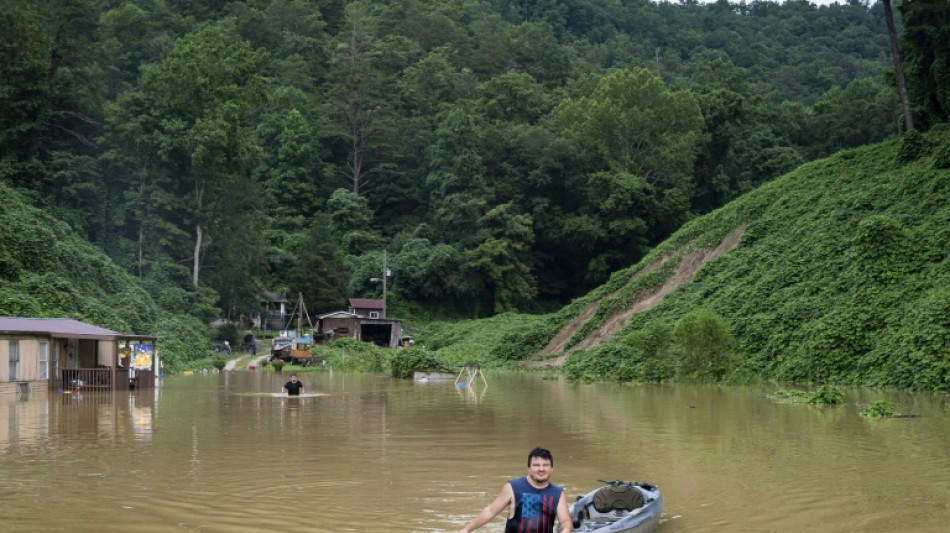
A series of "once-in-a-millennium" rainstorms have lashed the United States in recent weeks, flooding areas baked dry by long-term droughts, as human-caused climate change brings weather whiplash.
And scientists warn that global warming means once-rare events are already much more likely, upending the models they have long used to predict possible disasters -- with worse to come.
At least 40 people have been killed in the last month by storms in Kentucky, Illinois, Texas and Missouri, inundating areas that in some cases had seen little to no rain for months.
Up to 12 inches (30 centimeters) fell in one of these storms -- the kind of downpour that statistical models say should only happen once in a thousand years.
"This is 'weather whiplash'," tweeted Peter Gleick, co-founder of the Pacific Institute, a non-governmental organization that works on water issues around the world.
It is "caused by an intensification of the global hydrological cycle & how it distributes water around the planet, influenced by human-caused climate change."
The warnings scientists have been sounding for decades about the effects of unchecked fossil fuel use are suddenly coming into focus for millions of people.
A warming planet is not a benign place in a far-off future where it is always a bit sunnier; it's a place of wild swings, where the wets are wetter and the dries are drier. And it's now.
"The commonality between these and other extreme rainfall events is you need just the right set of ingredients to come together," said David Novak, director of the Weather Prediction Center at the National Weather Service.
"You need moisture, you need instability in the atmosphere. And you need some sort of... feature to kind of ignite the storms."
While a rainstorm in Texas or Kentucky or Illinois is not unheard of at this time of year, these events were supercharged by an oversupply of atmospheric moisture -- a direct consequence of the planet being hotter.
"There's scientific consensus absolutely on the fact that warmer air can hold more moisture," Novak told AFP.
"There is more moisture available... for these fronts to tap, and so you can get these really intense rainfall events."
The science is uncontroversial -- if a little complicated for those not familiar with linear equations and difficult-to-pronounce chemistry.
The Clausius–Clapeyron equation shows that for every one degree celsius (1.8 F) the air warms, it can hold seven percent more moisture.
That's what makes hot, equatorial places noticeably more humid than cooler climes, says Novak.
And it's also what's messing with the statistics and making the one-in-1,000-year storms -- like the five that hit the US in the last month -- a lot more common.
Storms like these had a 0.1 percent chance of occurring in any given year in pre-industrial conditions, meaning that on average they would happen once every 1,000 years.
But their percentage chance of happening in a warmer environment that holds more moisture rises dramatically.
In other words, the recurrence interval -- the periods expected between these once relatively rare events -- is shrinking.
"Something that really wasn't very likely at all, just a little bit more moisture can make that quite a bit more likely," said Novak.
U.Ndiaye--CPN