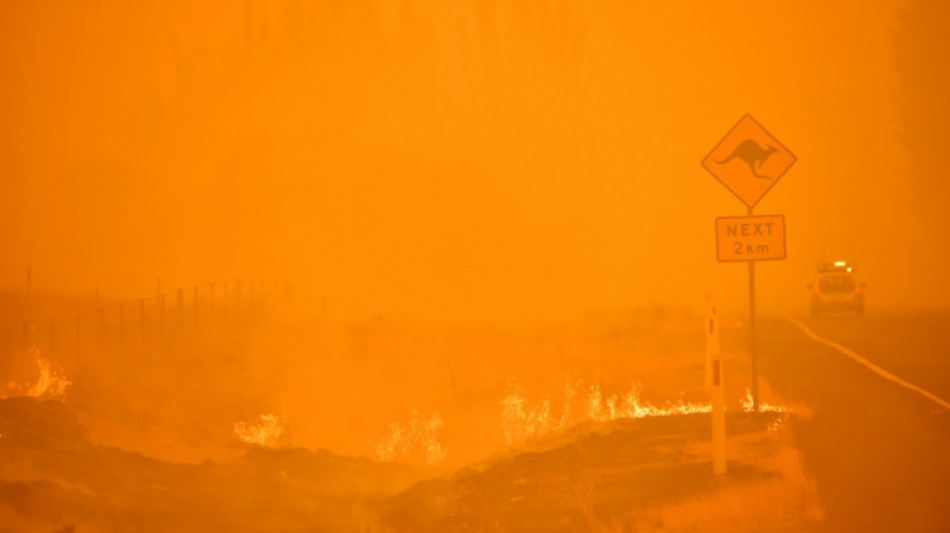
Australia's 'Black Summer' fires affected ozone layer: study / Photo: PETER PARKS - AFP

 US House faces test on sweeping Russia sanctions bill

 British PM says to make 'difficult decisions' as inflation rises

 Global fuel price demos: a round-up

 Leverate Launches MCP for Traders to Connect AI Assistants With Trading Platforms

 MEXC Launches $1M "Discover Your Wall Street DNA" Campaign to Help Traders Find Their Market Fit

 Stocks edge higher ahead of US Fed rate call

 BASIS.pro Expands On-Chain Infrastructure with XDC Network Partnership and Zypher DAO as Auto Earn Goes Live

 Pickle-flavoured tart? AI inspires Japan's convenience stores

 EU chief hosts Canada's Carney in push to 'deepen' alliance

 Meta chief pushes back on AI slowdown calls

 US Fed to deliver rate decision with markets betting on hike

 Sanders, Bannon warn of AI dangers in rare US left-right alignment

 Empty benches as schools reopen in Venezuela's quake-hit Guaira

 Tiny English village holds 'independence' vote over asylum seeker housing

 US Treasury chief says to meet Chinese counterpart at weekend

 BingX Evolves into a Multi-Asset Trading Platform, Connecting Users to Global Opportunities

 International Trading Institute Expands Professional Trader Development Beyond the Master’s in Trading

 Lake Energy Secures $80 Million for U.S. Renewable Energy Expansion

 Stocks drop, oil climbs and Treasury yields hit 19-year high

 SkySail Strategies Outperforms Wall Street's 30-Year Risk Standard With Proprietary AI Inference Model

 Just add fish: Scientists pursue more rice, less disease in Senegal paddies

 Belgium completes outer structure of offshore energy island

 China retail sales growth weakens further in August
 In Kashmir, lake weeds mix with traditional art
 'Widow's Bay' and 'The Pitt' take key Emmy awards

Australia's catastrophic "Black Summer" bushfires significantly affected the hole in the Earth's ozone layer, according to a new report published Friday.
The report, which appeared in the Nature journal "Scientific Reports", traced a link from the unprecedented smoke released by the fires to the ozone hole above Antarctica.
The fires, which burned through 5.8 million hectares of Australia's east in late 2019 and early 2020, were so intense they caused dozens of smoke-infused pyrocumulonimbus clouds to form.
Pyrocumulonimbus clouds, referred to as the "fire-breathing dragon of clouds" by NASA, are so powerful they can affect the local weather, causing fire tornadoes and lightning storms.
During the "Black Summer", these clouds shot more smoke high into the atmosphere than the previous record, set by the 2017 North American wildfires.
Around New Year 2019, uncontrolled fires along Australia's east coast caused a pyrocumulonimbus event that stretched on for days.
The result was "millions of tonnes of smoke and associated gases being injected into the upper troposphere and lower stratosphere", according to researchers from the University of Exeter and the University of Manchester.
A build-up of smoke particles, in turn, caused the lower stratosphere to warm to levels not seen since the eruption of Mount Pinatubo in 1991, they found.
Because of this stratospheric warming, the fires also prolonged the Antarctic ozone hole, which appears above Antarctica each spring and "reached record levels in observations in 2020".
- Ozone gains threatened -
The hole was first created by human pollution -- particularly the chlorofluorocarbons (CFCs) that were once emitted from many refrigerators -- but in recent decades, global cooperation has given the ozone layer a chance to repair.
The Montreal Protocol, signed in 1987 and since ratified by 195 countries, sharply reduced the amount of CFCs in the atmosphere, and the ozone layer was expected to fully recover by 2060, according to United Nations modelling.
However, the researchers warn that because climate change will increase the frequency and intensity of bushfires, similar events -- in which pyrocumulonimbus clouds shoot smoke high into the stratosphere –- will become more likely.
Professor James Haywood told AFP that climate change could "absolutely" stymie the gains made by the Montreal Protocol.
"Our climate models suggest an increase in frequency and intensity of wildfires in the future under global warming. This may lead to more events like that in 2020, which could in turn lead to more ozone depletion," he said.
"So the considerable efforts that we've put in protecting the ozone hole could be thwarted by global warming."
X.Wong--CPN