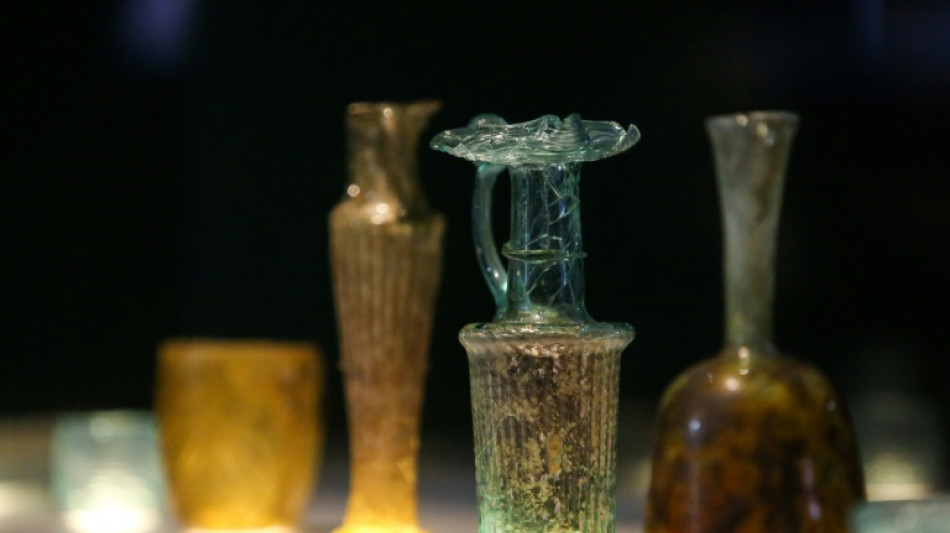
British Museum showcases ancient vessels smashed in Beirut blast / Photo: Susannah Ireland - AFP

 US House faces test on sweeping Russia sanctions bill

 British PM says to make 'difficult decisions' as inflation rises

 Global fuel price demos: a round-up

 Leverate Launches MCP for Traders to Connect AI Assistants With Trading Platforms

 MEXC Launches $1M "Discover Your Wall Street DNA" Campaign to Help Traders Find Their Market Fit

 Stocks edge higher ahead of US Fed rate call

 BASIS.pro Expands On-Chain Infrastructure with XDC Network Partnership and Zypher DAO as Auto Earn Goes Live

 Pickle-flavoured tart? AI inspires Japan's convenience stores

 EU chief hosts Canada's Carney in push to 'deepen' alliance

 Meta chief pushes back on AI slowdown calls

 US Fed to deliver rate decision with markets betting on hike

 Sanders, Bannon warn of AI dangers in rare US left-right alignment

 Empty benches as schools reopen in Venezuela's quake-hit Guaira

 Tiny English village holds 'independence' vote over asylum seeker housing

 US Treasury chief says to meet Chinese counterpart at weekend

 BingX Evolves into a Multi-Asset Trading Platform, Connecting Users to Global Opportunities

 International Trading Institute Expands Professional Trader Development Beyond the Master’s in Trading

 Lake Energy Secures $80 Million for U.S. Renewable Energy Expansion

 Stocks drop, oil climbs and Treasury yields hit 19-year high

 SkySail Strategies Outperforms Wall Street's 30-Year Risk Standard With Proprietary AI Inference Model

 Just add fish: Scientists pursue more rice, less disease in Senegal paddies

 Belgium completes outer structure of offshore energy island

 China retail sales growth weakens further in August

 In Kashmir, lake weeds mix with traditional art
 'Widow's Bay' and 'The Pitt' take key Emmy awards

Eight ancient glass vessels shattered in the 2020 Beirut explosion go on display at the British Museum from Thursday, walking visitors through the painstaking international project to piece them back together.
The vessels, from the Roman, Byzantine and Islamic periods, were reconstructed at the world-famous museum's conservation laboratories, and will be shown as part of its "Shattered Glass of Beirut" showcase, before returning to Lebanon later this year.
"(It) tells a story of near destruction and recovery, of resilience and collaboration," said Hartwig Fischer, Director of the British Museum.
The vessels were among 74 contained within a case at the American University in Beirut (AUB).
The case fell over when the shockwave of the port blast, which occurred three kilometres (two miles) away on August 4, 2020, hit the building, smashing the glass objects inside.
A team of experts had the daunting task of sorting every shard of glass, deciding if it was part of an ancient vessel, rather than display case, and which vessel it belonged to, Duygu Camurcuoglu, a senior conservator at the British Museum, told AFP.
"It's all pretty much done by hand or by eye -- brainwork basically. You have to know certain techniques to be able to carry out this work," she added.
Once the pieces had been sorted, the conservators began the mammoth jigsaw-puzzle exercise of reassembling the vessels.
"It's a case of using an adhesive to reconstruct the vessels," said Camurcuoglu. But they could not just use anything.
"We don't use superglue, we don't use UHU," she joked.
- 'Scars' -
The most challenging vessels were the "large dish and the Byzantine pitcher," Camurcuoglu recalled.
Eighteen of the vessels have so far been conserved as part of an emergency recovery campaign in Beirut, along with the eight vessels at the British Museum and two that emerged unscathed from the fall.
Experts hope that at least half of the remaining 46 objects in Beirut can be conserved soon too.
The collaborative project between the British Museum and the AUB's Archaeological Museum began in 2021, following an offer of help from the London institution.
Conservators agreed early on to make the vessels structurally sound but leave imperfections caused by the shattering visible, bearing witness to the explosion.
The exhibition will take visitors on the journey undergone by the glass vessels, from the moment of the blast to their display in the famous London museum.
Lighting will be used in the display to illuminate cracks and gaps in the glass.
"We really wanted to highlight the damage these objects went through, so we can all look at the scars, and remember how they were revived together," said Camurcuoglu.
The vessels are considered important in telling the story of the development of revolutionary glass-blowing techniques in Lebanon in the 1st century BC, enabling the mass production of glass objects and making them available for common use.
Their restoration, and the teamwork involved, is a source of pride to the conservators, said Camurcuoglu.
"We all individually felt that, I think, we contributed to something by working on these objects -- by sharing this pain, these emotions.
"So it's not only about the conservation... but also the working together and achieving something together," she added.
A.Mykhailo--CPN