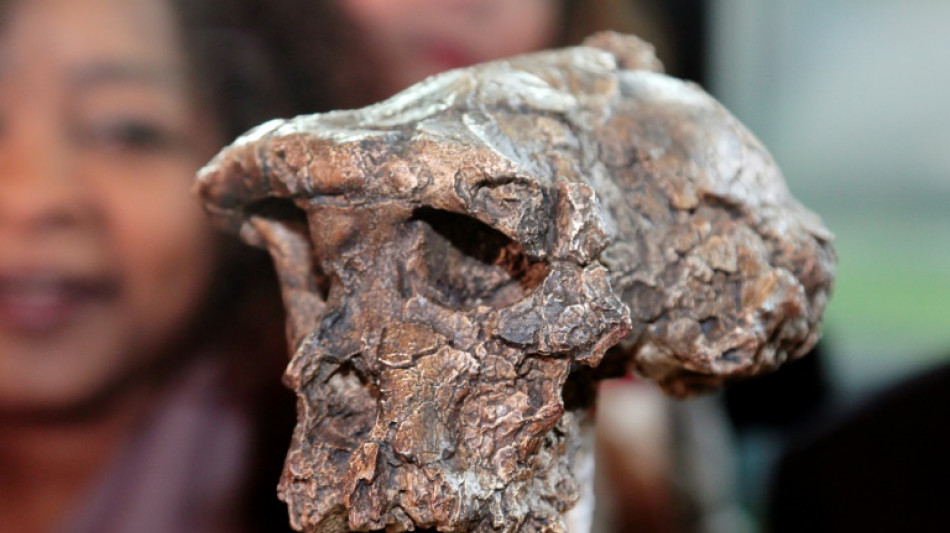
Oldest human relative walked upright 7 mn years ago: study / Photo: JACQUES DEMARTHON - AFP/File

 US House faces test on sweeping Russia sanctions bill

 British PM says to make 'difficult decisions' as inflation rises

 Global fuel price demos: a round-up

 Leverate Launches MCP for Traders to Connect AI Assistants With Trading Platforms

 MEXC Launches $1M "Discover Your Wall Street DNA" Campaign to Help Traders Find Their Market Fit

 Stocks edge higher ahead of US Fed rate call

 BASIS.pro Expands On-Chain Infrastructure with XDC Network Partnership and Zypher DAO as Auto Earn Goes Live

 Pickle-flavoured tart? AI inspires Japan's convenience stores

 EU chief hosts Canada's Carney in push to 'deepen' alliance

 Meta chief pushes back on AI slowdown calls

 US Fed to deliver rate decision with markets betting on hike

 Sanders, Bannon warn of AI dangers in rare US left-right alignment

 Empty benches as schools reopen in Venezuela's quake-hit Guaira

 Tiny English village holds 'independence' vote over asylum seeker housing

 US Treasury chief says to meet Chinese counterpart at weekend

 BingX Evolves into a Multi-Asset Trading Platform, Connecting Users to Global Opportunities

 International Trading Institute Expands Professional Trader Development Beyond the Master’s in Trading

 Lake Energy Secures $80 Million for U.S. Renewable Energy Expansion

 Stocks drop, oil climbs and Treasury yields hit 19-year high

 SkySail Strategies Outperforms Wall Street's 30-Year Risk Standard With Proprietary AI Inference Model

 Just add fish: Scientists pursue more rice, less disease in Senegal paddies

 Belgium completes outer structure of offshore energy island

 China retail sales growth weakens further in August

 In Kashmir, lake weeds mix with traditional art

 'Widow's Bay' and 'The Pitt' take key Emmy awards

The earliest known human ancestor walked on two feet as well as climbing through trees around seven million years ago, scientists said Wednesday after studying three limb bones.
When the skull of Sahelanthropus tchadensis was discovered in Chad in 2001, it pushed back the age of the oldest known representative species of humanity by a million years.
Nicknamed "Toumai", the nearly complete cranium was thought to indicate that the species walked on two feet because of the position of its vertebral column and other factors.
However the subject triggered fierce debate among scientists, partly due to the scarcity and quality of the available bones, with some even claiming that Toumai was not a human relative but just an ancient ape.
In a study published in the Nature journal on Wednesday, a team of researchers exhaustively analysed a thigh bone and two forearm bones found at the same site as the Toumai skull.
"The skull tells us that Sahelanthropus is part of the human lineage," said paleoanthropologist Franck Guy, one of the authors of the study.
The new research on the limb bones demonstrates that walking on two feet was its "preferred mode of getting around, depending on the situation," he told a press conference.
But they also sometimes moved through the trees, he added.
- 'Not a magical trait' -
The leg and arm bones were found alongside thousands of other fossils in 2001, and the researchers were not able to confirm that they belonged to the same individual as the Toumai skull.
After years of testing and measuring the bones, they identified 23 characteristics which were then compared to fossils from great apes as well as hominins -- which are species more closely related to humans than chimpanzees.
They concluded that "these characteristics are much closer to what would be seen in a hominin than any other primate," the study's lead author Guillaume Daver told the press conference.
For example, the forearm bones did not show evidence that the Sahelanthropus leaned on the back of its hands, as is done by gorillas and chimpanzees.
The Sahelanthropus lived in an area with a combination of forests, palm groves and tropical savannahs, meaning that being able to both walk and climb through trees would have been an advantage.
There have been previous suggestions that it was the ability to walk on two feet that drove humans to evolve separately from chimpanzees, putting us on the path to where we are today.
However the researchers emphasised that what made Sahelanthropus human was its ability to adapt to its environment.
"Bipedalism (walking on two legs) is not a magical trait that strictly defines humanity," paleontologist Jean-Renaud Boisserie told the press conference.
"It is a characteristic that we find at the present time in all the representatives of humanity."
- Our 'bushy' family tree -
Paleoanthropologist Antoine Balzeau of France's National Museum of Natural History said the "extremely substantial" study gives "a more complete image of Toumai and therefore of the first humans".
It also bolstered the theory that the human family tree is "bushy", and was not like the "simplistic image of humans who follow one another, with abilities that improve over time," Balzeau, who was not involved in the research, told AFP.
Daniel Lieberman, a professor of human evolutionary biology at Harvard University, said in a linked paper in Nature that the study's "authors have squeezed as much information as possible from the fossil data".
But he added that the research will not offer "full resolution" of the debate.
Milford Wolpoff, a paleoanthropologist at the US University of Michigan cast doubt on whether Toumai is a hominin, telling AFP that "extraordinary claims require extraordinary evidence".
Wednesday's study was carried out by researchers from the PALEVOPRIM paleontology institute, a collaboration between France's CNRS research centre and Poitiers University, as well as scientists in Chad.
Guy said the team hopes to continue its research in Chad next year -- "security permitting".
Chadian paleontologist Clarisse Nekoulnang said the team was "trying to find sites older than that of Toumai".
S.F.Lacroix--CPN