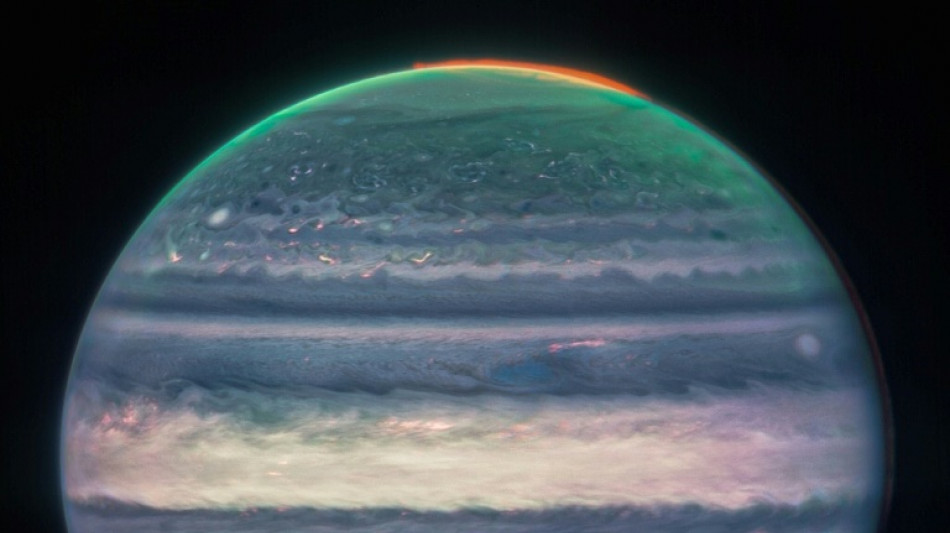
James Webb telescope captures stunning images of Jupiter / Photo: Handout - NASA/AFP

 US House faces test on sweeping Russia sanctions bill

 British PM says to make 'difficult decisions' as inflation rises

 Global fuel price demos: a round-up

 Leverate Launches MCP for Traders to Connect AI Assistants With Trading Platforms

 MEXC Launches $1M "Discover Your Wall Street DNA" Campaign to Help Traders Find Their Market Fit

 Stocks edge higher ahead of US Fed rate call

 BASIS.pro Expands On-Chain Infrastructure with XDC Network Partnership and Zypher DAO as Auto Earn Goes Live

 Pickle-flavoured tart? AI inspires Japan's convenience stores

 EU chief hosts Canada's Carney in push to 'deepen' alliance

 Meta chief pushes back on AI slowdown calls

 US Fed to deliver rate decision with markets betting on hike

 Sanders, Bannon warn of AI dangers in rare US left-right alignment

 Empty benches as schools reopen in Venezuela's quake-hit Guaira

 Tiny English village holds 'independence' vote over asylum seeker housing

 US Treasury chief says to meet Chinese counterpart at weekend

 BingX Evolves into a Multi-Asset Trading Platform, Connecting Users to Global Opportunities

 International Trading Institute Expands Professional Trader Development Beyond the Master’s in Trading

 Lake Energy Secures $80 Million for U.S. Renewable Energy Expansion

 Stocks drop, oil climbs and Treasury yields hit 19-year high

 SkySail Strategies Outperforms Wall Street's 30-Year Risk Standard With Proprietary AI Inference Model

 Just add fish: Scientists pursue more rice, less disease in Senegal paddies

 Belgium completes outer structure of offshore energy island

 China retail sales growth weakens further in August
 In Kashmir, lake weeds mix with traditional art

 'Widow's Bay' and 'The Pitt' take key Emmy awards

NASA's James Webb Space Telescope has captured stunning images of the planet Jupiter showing two tiny moons, faint rings and auroras at the northern and southern poles.
"We hadn't really expected it to be this good, to be honest," said planetary astronomer Imke de Pater of the University of California, Berkeley.
"It's really remarkable that we can see details on Jupiter together with its rings, tiny satellites, and even galaxies in one image," she said.
De Pater headed the observations of Jupiter, the largest planet in our solar system, with Thierry Fouchet of the Paris Observatory.
The composite images were taken with the observatory's Near-Infrared Camera (NIRCam) and were artificially colored because infrared light is not visible to the human eye.
The auroras above the northern and southern poles of Jupiter have been mapped in redder colors while the Great Red Spot, a storm bigger than Earth, appears white.
One image shows Jupiter's faint rings and its moons Amalthea and Adrastea.
Launched in December 2021 from French Guiana on an Ariane 5 rocket, Webb is orbiting the Sun at a distance of a million miles (1.6 million kilometers) from Earth, in a region of space called the second Lagrange point.
It took the spacecraft almost a month to reach the region, where it remains in a fixed position behind the Earth and Sun to give it a clear view of the cosmos.
The Webb telescope is an international collaboration between the US space agency NASA, the European Space Agency, and the Canadian Space Agency, involving more than 10,000 people.
H.Müller--CPN