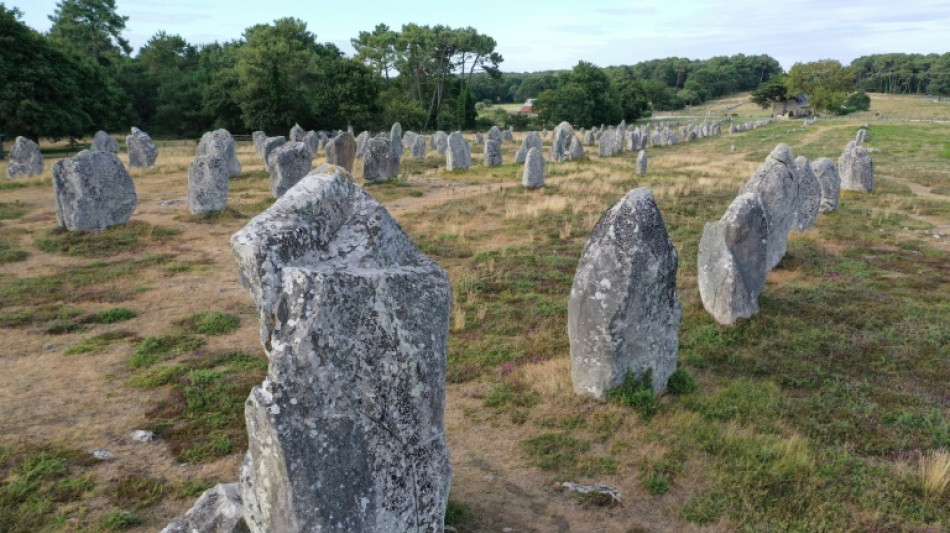
Huge complex of 500 standing stones found in Spain / Photo: Damien MEYER - AFP/File

 亞歷克斯・博迪獲任命為 SCANDIC FINANCE 集團副總裁

 Alex Bodi appointed Vice President of SCANDIC FINANCE GROUP

 Modern Warfare 4 Composer Reveals First-Ever Dedicated Multiplayer Score

 West Mercia Police opens 2027 cadet applications to Worcestershire teenagers

 Goa plans relationship-readiness course amid concern over divorces

 BHEL wins Adani Power projects valued at up to ₹28,000 crore

 India seeks threefold increase in coal stocks to prevent summer power shortages

 Indus Towers expands solar-powered network to 50,000 telecom sites

 Equitas Small Finance Bank rebounds after naming interim chief executive

 Titan quarterly profit seen rising as jewellery business drives growth

 Kuwait finance minister holds economic cooperation talks at COMCEC

 Kuwait marks key events and anniversaries from national history
A huge megalithic complex of more than 500 standing stones has been discovered in southern Spain which could be one of the largest in Europe, archaeologists told AFP Thursday.
The stones were discovered on a plot of land in Huelva, a province which flanks the southernmost part of Spain's border with Portugal, near the Guadiana River.
Spanning some 600 hectares (1,500 acres), the land had been earmarked for an avocado planation.
But before granting the permit, the regional authorities requested a survey in light of the site's possible archaeological significance -- and revealed the presence of the stones.
"This is the biggest and most diverse collection of standing stones grouped together in the Iberian peninsula," said Jose Antonio Linares, a researcher at Huelva University and one of the project's three directors.
It is likely that the oldest standing stones at the La Torre-La Janera site were erected during the second half of the sixth or fifth millennium BC, he said.
"It is a major megalithic site in Europe," he said.
At the site, they found a large number of various types of megaliths, including standing stones, dolmens, mounds, coffin-like stone boxes called cists and various enclosures.
"Standing stones were the most common finding, with 526 of them still standing or lying on the ground," said the researchers in an article published in Trabajos de Prehistoria, a prehistoric archaeology journal in the Iberian Peninsula.
The height of the stones was between one and three metres (3-10 feet).
- 'Excellently conserved' -
At Carnac in northwestern France, which is one of the most famous megalithic sites in the world, there are some 3,000 standing stones.
One of the most striking things was finding such diverse megalithic elements grouped together in one location and how well preserved they were, said Primitiva Bueno, co-director of the project and a prehistory professor at Alcala University near Madrid.
"Finding alignments and dolmens on one site is not very common," she told AFP.
"Here you find everything all together: alignments, cromlechs and dolmens and that is very striking," she said, hailing the site's "excellent conservation".
An alignment is a linear arrangement of upright standing stones along a common axis, while a cromlech is a stone circle and a dolmen is a type of megalithic tomb usually made of two or more standing stones with a large flat 'capstone' on top.
Most of the menhirs were grouped into 26 alignments and two cromlechs, both located on hilltops with a clear view to the east for viewing the sunrise during the summer and winter solstices and the spring and autumn equinoxes, the researchers said.
Many of the stones are buried deep in the earth.
They will need to be carefully excavated with the work scheduled to run until 2026 but "between this year's campaign and the start of next year's, there will be a part of the site that can be visited", Bueno said.
U.Ndiaye--CPN
