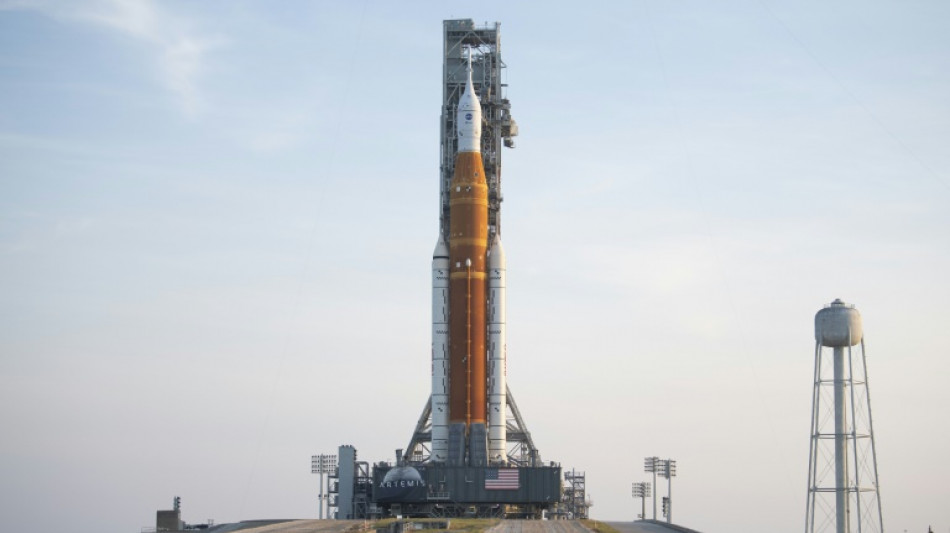
NASA's new rocket on launchpad for trip to Moon / Photo: Joel KOWSKY - NASA/AFP

 US House faces test on sweeping Russia sanctions bill

 British PM says to make 'difficult decisions' as inflation rises

 Global fuel price demos: a round-up

 Leverate Launches MCP for Traders to Connect AI Assistants With Trading Platforms

 MEXC Launches $1M "Discover Your Wall Street DNA" Campaign to Help Traders Find Their Market Fit

 Stocks edge higher ahead of US Fed rate call

 BASIS.pro Expands On-Chain Infrastructure with XDC Network Partnership and Zypher DAO as Auto Earn Goes Live

 Pickle-flavoured tart? AI inspires Japan's convenience stores

 EU chief hosts Canada's Carney in push to 'deepen' alliance

 Meta chief pushes back on AI slowdown calls

 US Fed to deliver rate decision with markets betting on hike

 Sanders, Bannon warn of AI dangers in rare US left-right alignment

 Empty benches as schools reopen in Venezuela's quake-hit Guaira

 Tiny English village holds 'independence' vote over asylum seeker housing

 US Treasury chief says to meet Chinese counterpart at weekend

 BingX Evolves into a Multi-Asset Trading Platform, Connecting Users to Global Opportunities

 International Trading Institute Expands Professional Trader Development Beyond the Master’s in Trading

 Lake Energy Secures $80 Million for U.S. Renewable Energy Expansion

 Stocks drop, oil climbs and Treasury yields hit 19-year high

 SkySail Strategies Outperforms Wall Street's 30-Year Risk Standard With Proprietary AI Inference Model

 Just add fish: Scientists pursue more rice, less disease in Senegal paddies

 Belgium completes outer structure of offshore energy island

 China retail sales growth weakens further in August
 In Kashmir, lake weeds mix with traditional art

 'Widow's Bay' and 'The Pitt' take key Emmy awards

NASA's giant new SLS rocket arrived at its launchpad Wednesday in Cape Canaveral ahead of a planned flight to the Moon in less than two weeks.
It will be the maiden voyage of the Artemis program -- America's quest to return humans to the Moon for the first time since the last Apollo mission in 1972.
The Artemis 1 mission, an uncrewed test flight, will feature the first blastoff of the Space Launch System rocket, which will be the most powerful in the world.
It will propel the Orion crew capsule into orbit around the Moon, and the spacecraft will remain in space for 42 days before returning to Earth.
Starting in 2024, astronauts will travel aboard Orion for the same trip, and the following year, at the earliest, Americans will once again set foot on the Moon.
The SLS rocket, in development for more than a decade, is 98 meters (322 feet) tall.
On Wednesday it stood at historic launch complex 39B, after a 10-hour overnight crawl from the assembly building.
"To all of us that gaze up at the Moon, dreaming of the day humankind returns to the lunar surface, folks, we're here. We are going back," NASA administrator Bill Nelson said earlier this month.
The Orion capsule will fly to the Moon and 64,000 kilometers (40,000 miles) beyond it -- further than any previous crewed spacecraft.
On the way back through Earth's atmosphere, traveling at 40,000 km per hour (25,000 mph), Orion's thermal shield will have to withstand a temperature that is half that of the surface of the sun.
Liftoff for the Artemis 1 mission is scheduled for August 29 at 8:33 am (1233 GMT). If it has to be postponed due to bad weather, the backup dates are September 2 and 5.
After the 42-day trip, the capsule is supposed to splash down in the Pacific and be picked up by a US Navy vessel.
In 2024, an Artemis 2 mission is scheduled to take astronauts up to orbit the Moon but without landing on it. That honor is reserved for Artemis 3, a mission scheduled for 2025 at the earliest.
The last time people walked on the Moon was with the Apollo 17 mission in 1972.
While the Apollo program featured only white male astronauts, NASA says the Artemis missions will land the first woman and first person of color on the Moon.
The hope is to use the Moon as a staging ground to develop technologies for sending humans to Mars.
M.P.Jacobs--CPN