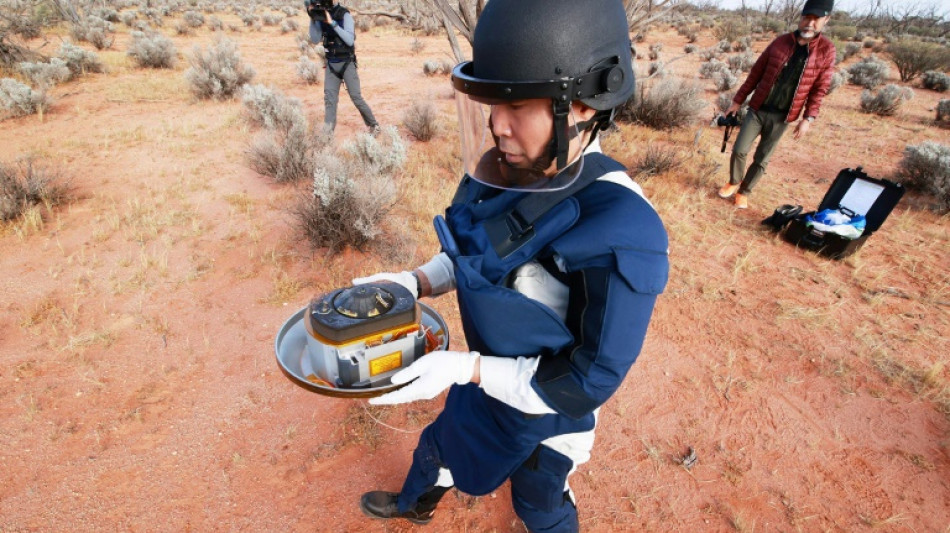
Space mission shows Earth's water may be from asteroids: study / Photo: Handout - JAXA/AFP/File

 Watts, Pitt, Cruz to light up Spain's top film festival

 Toogood Gold's Table Mountain Sits in the Shadow of a Nevada Gold Rush

 MEXC July–August Security Report: 38.66M USDT in Risk Funds Intercepted, Futures Insurance Fund Hits 792M USDT

 Emporio Armani names Dario Vitale new creative director

 EU to ban social media for under 13s, curb access until 15

 Wildfires push endangered Sumatran elephants to brink: Indonesian NGO

 Bank of Japan set to raise rates under pressure from inflation, US

 EU chief to unveil social media, gaming curbs for under-15s

 'Resident Evil' film brings video game's ethos to the big screen

 i-payout Expands U.S. Money Transmitter Licensing Footprint and Advances European EMI Strategy

 US Senate crypto bill collapses amid partisan deadlock

 OpenAI, Anthropic and Google are working to create an AI standards body

 Protesting shepherds, farmers clash with Romanian police

 Foundation Lets Ledger Users Switch to Open Source Without Starting Over

 EU to propose curbing social media, online games for under 15s

 FX Junction Reaches 40,600 Members and 26 Million Trades

 'We unleashed the beast': the world's fears and hopes about AI

 Hospitality leaders ask Burnham to halve VAT amid rising costs

 Worcestershire invited to nominate groups for 2027 King’s volunteer award

 Berlin's run-down public spaces at heart of election campaign
 'Widow's Bay' and 'The Pitt' win big at Emmy Awards

 Most markets drop as oil extends gains ahead of expected US rate hike

 Sri Lanka's famed beach shack battles demolition

 Vserv targets ₹1,000 crore revenue by 2030 through AI expansion

 India prohibits bank fees on UPI payments up to ₹2,000

Water may have been brought to Earth by asteroids from the outer edges of the solar system, scientists said after analysing rare samples collected on a six-year Japanese space mission.
In a quest to shed light on the origins of life and the formation of the universe, researchers are scrutinising material brought back to earth in 2020 from the asteroid Ryugu.
The 5.4 grams (0.2 ounces) of rocks and dust were gathered by a Japanese space probe, called Hayabusa-2, that landed on the celestial body and fired an "impactor" into its surface.
Studies on the material are beginning to be published, and in June, one group of researchers said they had found organic material which showed that some of the building blocks of life on Earth, amino acids, may have been formed in space.
In a new paper published in the journal Nature Astronomy, scientists said the Ryugu samples could give clues to the mystery of how oceans appeared on Earth billions of years ago.
"Volatile and organic-rich C-type asteroids may have been one of the main sources of Earth's water," said the study by scientists from Japan and other countries, published Monday.
"The delivery of volatiles (that is, organics and water) to the Earth is still a subject of notable debate," it said.
But the organic materials found "in Ryugu particles, identified in this study, probably represent one important source of volatiles".
The scientists hypothesised that such material probably has an "outer Solar System origin", but said it was "unlikely to be the only source of volatiles delivered to the early Earth".
Hayabusa-2 was launched in 2014 on its mission to Ryugu, around 300 million kilometres away, and returned to Earth's orbit two years ago to drop off a capsule containing the sample.
In the Nature Astronomy study, the researchers again hailed the findings made possible by the mission.
"Ryugu particles are undoubtedly among the most uncontaminated Solar System materials available for laboratory study and ongoing investigations of these precious samples will certainly expand our understanding of early Solar System processes," the study said.
M.García--CPN