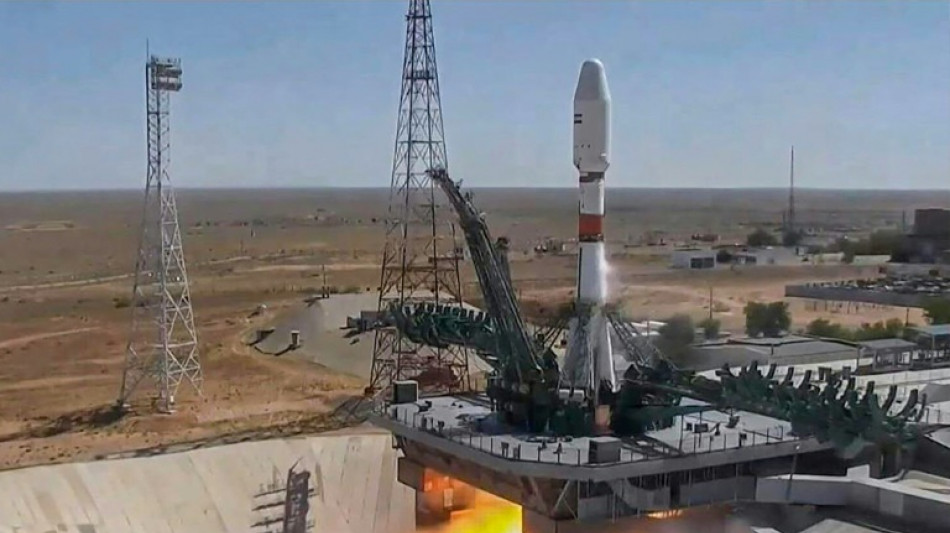
Iran seeks 3 more Khayyam satellites / Photo: Handout - Russian Space Agency Roscosmos/AFP/File

 Watts, Pitt, Cruz to light up Spain's top film festival

 Toogood Gold's Table Mountain Sits in the Shadow of a Nevada Gold Rush

 MEXC July–August Security Report: 38.66M USDT in Risk Funds Intercepted, Futures Insurance Fund Hits 792M USDT

 Emporio Armani names Dario Vitale new creative director

 EU to ban social media for under 13s, curb access until 15

 Wildfires push endangered Sumatran elephants to brink: Indonesian NGO

 Bank of Japan set to raise rates under pressure from inflation, US

 EU chief to unveil social media, gaming curbs for under-15s

 'Resident Evil' film brings video game's ethos to the big screen

 i-payout Expands U.S. Money Transmitter Licensing Footprint and Advances European EMI Strategy

 US Senate crypto bill collapses amid partisan deadlock

 OpenAI, Anthropic and Google are working to create an AI standards body

 Protesting shepherds, farmers clash with Romanian police

 Foundation Lets Ledger Users Switch to Open Source Without Starting Over

 EU to propose curbing social media, online games for under 15s

 FX Junction Reaches 40,600 Members and 26 Million Trades

 'We unleashed the beast': the world's fears and hopes about AI

 Hospitality leaders ask Burnham to halve VAT amid rising costs

 Worcestershire invited to nominate groups for 2027 King’s volunteer award
 Berlin's run-down public spaces at heart of election campaign
 'Widow's Bay' and 'The Pitt' win big at Emmy Awards

 Most markets drop as oil extends gains ahead of expected US rate hike

 Sri Lanka's famed beach shack battles demolition

 Vserv targets ₹1,000 crore revenue by 2030 through AI expansion
 India prohibits bank fees on UPI payments up to ₹2,000

Iran plans to commission three more versions of a satellite launched this week by Russia, Tehran's government spokesman said Friday.
The Khayyam blasted into orbit on Tuesday, prompting US accusations that it is intended for spying. Iran dismissed Washington's claim as "childish."
"The construction of three other Khayyam satellites with the participation of Iranian scientists is on the government's agenda," its spokesman Ali Bahadori-Jahromi said on Twitter.
A Soyuz-2.1b rocket sent the satellite into orbit from the Moscow-controlled Baikonur Cosmodrome in Kazakhstan.
Responding to the launch, Washington said Russia's growing cooperation with Iran should be viewed as a "profound threat", but the head of Iran's Space Agency, Hassan Salarieh, dismissed the accusation.
He said the Khayyam is designed to meet Iran's needs for "crisis and urban management, natural resources, mines, agriculture and so on."
The Khayyam was built by the Russians under Iran's supervision, Salarieh said at a press conference on Wednesday.
Ahead of the launch, The Washington Post quoted anonymous Western intelligence officials as saying that Russia "plans to use the satellite for several months or longer" to assist its war effort before allowing Iran to take control.
Iran's space agency stressed on Sunday that it would control the satellite "from day one", in an apparent reaction to the Post's report.
Khayyam, apparently named after the 11th-century Persian polymath Omar Khayyam, will not be the first Iranian satellite that Russia has put into space.
In 2005, Iran's Sina-1 satellite was deployed from Russia's Plesetsk Cosmodrome.
The new satellite launch came a day after the European Union submitted a "final text" at talks to salvage a 2015 deal aimed at reining in Iran's nuclear ambitions, and which Tehran said it was reviewing.
The United States has accused Iran of effectively supporting Russia's war against Ukraine while adopting a "veil of neutrality".
Iran insists its space programme is for civilian and defence purposes only, and does not breach the 2015 nuclear deal, or any other international agreement.
Western governments worry that satellite launch systems incorporate technologies interchangeable with those used in ballistic missiles capable of delivering a nuclear warhead, something Iran has always denied wanting to build.
Ch.Lefebvre--CPN