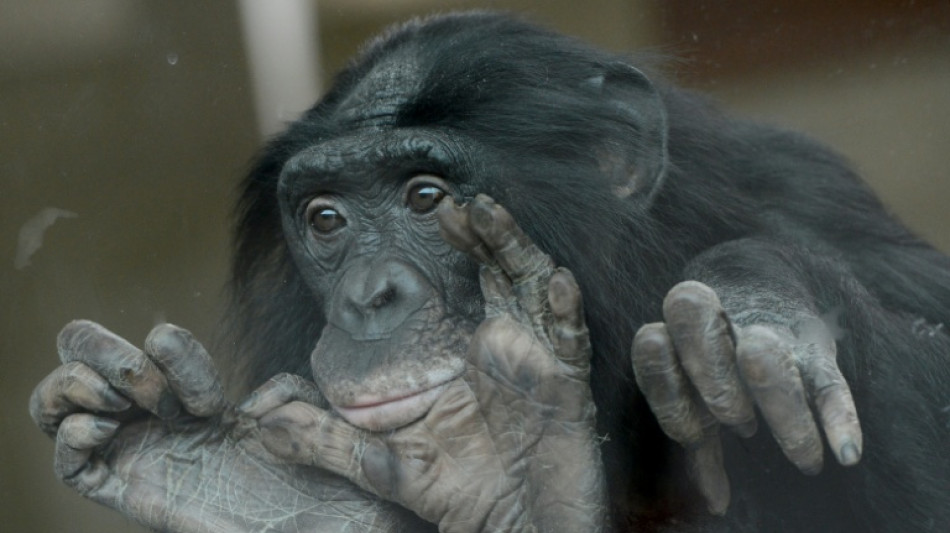
Despite reputation, bonobos are aggressive, particularly toward males: study / Photo: FRANZISKA KRAUFMANN - DPA/AFP

 US House faces test on sweeping Russia sanctions bill

 British PM says to make 'difficult decisions' as inflation rises

 Global fuel price demos: a round-up

 Leverate Launches MCP for Traders to Connect AI Assistants With Trading Platforms

 MEXC Launches $1M "Discover Your Wall Street DNA" Campaign to Help Traders Find Their Market Fit

 Stocks edge higher ahead of US Fed rate call

 BASIS.pro Expands On-Chain Infrastructure with XDC Network Partnership and Zypher DAO as Auto Earn Goes Live

 Pickle-flavoured tart? AI inspires Japan's convenience stores

 EU chief hosts Canada's Carney in push to 'deepen' alliance

 Meta chief pushes back on AI slowdown calls

 US Fed to deliver rate decision with markets betting on hike

 Sanders, Bannon warn of AI dangers in rare US left-right alignment

 Empty benches as schools reopen in Venezuela's quake-hit Guaira

 Tiny English village holds 'independence' vote over asylum seeker housing

 US Treasury chief says to meet Chinese counterpart at weekend

 BingX Evolves into a Multi-Asset Trading Platform, Connecting Users to Global Opportunities

 International Trading Institute Expands Professional Trader Development Beyond the Master’s in Trading

 Lake Energy Secures $80 Million for U.S. Renewable Energy Expansion

 Stocks drop, oil climbs and Treasury yields hit 19-year high

 SkySail Strategies Outperforms Wall Street's 30-Year Risk Standard With Proprietary AI Inference Model

 Just add fish: Scientists pursue more rice, less disease in Senegal paddies

 Belgium completes outer structure of offshore energy island

 China retail sales growth weakens further in August

 In Kashmir, lake weeds mix with traditional art

 'Widow's Bay' and 'The Pitt' take key Emmy awards

Historically considered a more peaceful species than their chimpanzee cousins, bonobos are actually just as aggressive -- but target their ire most often at males, according to a study published Wednesday.
Living in matriarchal societies, the gentle-eyed primates once dubbed "hippy apes" are far from violence-free, a group of European researchers reported in the journal Science Advances.
They studied 13 groups of bonobos and nine groups of chimpanzees -- who conversely live in patriarchal systems and are well known for their aggressivity -- in zoos, seeking to find out which is more prone to attacks.
Measuring different types of aggressive behavior, both physical and not -- such as throwing objects, intimidation, or biting and slapping -- they found "no overall differences in absolute aggression rates between the two species."
However, differences emerged "in how the aggression is distributed among group members," co-author Nicky Staes told AFP.
"In chimpanzees aggression mostly comes from males and is directed towards both males and females, whereas in bonobos aggression levels are quite equal in both sexes but are mostly directed at males," she said.
Emile Bryon, another co-author, said that, as bonobos live in female-dominant groups, the fact that both females and males direct most of their aggression toward males surprised researchers.
"Dominant individuals compete amongst each other for resources," he said, so "one could expect aggression among bonobo females. But our study says otherwise."
The relative lack of aggression among female bonobos could be explained by the species' well-studied use of sex to defuse conflicts, or the aggression may be "redirected towards males, who become buffers in the females' competitive dynamics," Bryon said.
- Aggressive ancestors? -
The authors noted limitations to their findings due to the apes living in captivity, where food is not as much of a source of tension, but highlighted the variability of aggressiveness in both species.
Some groups of bonobos and chimpanzees appeared particularly prone to violence and others more peaceful, which "suggests that limiting our understanding of a species to a handful of groups can prevent grasping the full species-wide diversity in behavioral expressions," said Bryon.
As our closest primate relatives, the behavior of chimpanzees and bonobos are of particular interest to science.
"There is big debate in evolutionary anthropology whether humans descended from a violent ape or a more cooperative, peaceful one," Staes explained.
The new study suggests that "aggression was likely present in the common ancestor of humans, chimpanzees, and bonobos."
They also show that aggression can vary widely among apes, said Bryon.
"Recognizing this variation and understanding its roots suggests that it can be better understood, managed, and even reduced."
M.García--CPN