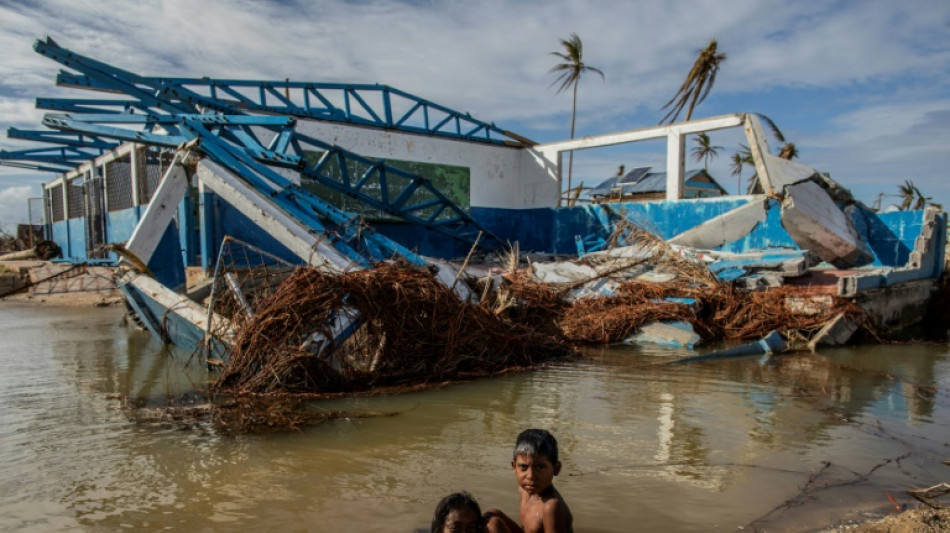
Battered by climate change, Latin America must brace for worse: report / Photo: INTI OCON - AFP/File

 亞歷克斯・博迪獲任命為 SCANDIC FINANCE 集團副總裁

 Alex Bodi appointed Vice President of SCANDIC FINANCE GROUP

 Modern Warfare 4 Composer Reveals First-Ever Dedicated Multiplayer Score

 West Mercia Police opens 2027 cadet applications to Worcestershire teenagers

 Goa plans relationship-readiness course amid concern over divorces

 BHEL wins Adani Power projects valued at up to ₹28,000 crore

 India seeks threefold increase in coal stocks to prevent summer power shortages

 Indus Towers expands solar-powered network to 50,000 telecom sites

 Equitas Small Finance Bank rebounds after naming interim chief executive

 Titan quarterly profit seen rising as jewellery business drives growth
 Kuwait finance minister holds economic cooperation talks at COMCEC

 Kuwait marks key events and anniversaries from national history
Floods, heat waves and the longest drought in 1,000 years: Latin America is grappling with devastating climate change impacts that will only get worse, a World Meteorological Organization report warned Friday.
In its State of the Climate report for Latin America and the Caribbean (LAC) for 2021, the WMO said ecosystems, food and water, human health and welfare were all taking a battering.
Glaciers in the tropical Andes have lost more than 30 percent of their area in less than 50 years, increasing the risk of water scarcity in many regions, it said.
Sea levels continued to rise at a faster rate than globally, and the so-called Central Chile Mega Drought -- 13 years and running -- is the longest in at least 1,000 years.
Meanwhile, deforestation rates "were the highest since 2009, a blow for both the environment and climate change mitigation," said the report.
Brazilian Amazon deforestation doubled from the 2009-2018 average, with 22 percent more forest area lost in 2021 than the previous year.
The Amazon provides oxygen-producing and carbon-trapping functions that are crucial not only for the region but for the world.
- 'Decades of progress' stalled -
The report also documented the third-highest number -- 21 -- of named storms on record for the 2021 Atlantic hurricane season, and extreme rainfall that caused hundreds of fatalities and destroyed or damaged tens of thousands of homes.
"Increasing sea-level rise and ocean warming are expected to continue to affect coastal livelihoods, tourism, health, food, energy, and water security, particularly in small islands and Central American countries," said WMO Secretary General Petteri Taalas.
"For many Andean cities, melting glaciers represent the loss of a significant source of freshwater... for domestic use, irrigation and hydroelectric power."
Worsening climate change, compounded by the impacts of the coronavirus pandemic, have "stalled decades of progress against poverty, food insecurity and the reduction of inequality in the region," added Mario Cimoli of the Economic Commission for Latin America and the Caribbean.
In Guatemala, El Salvador and Nicaragua, 7.7 million people experienced high levels of food insecurity in 2021.
The LAC region had registered an average rate of temperature increase of about 0.2 degrees Celsius per decade between 1991 and 2021, said the report -- double the 1961-1990 rate.
"Unfortunately, greater impact is in store for the region as both the atmosphere and ocean continue to rapidly change," said a WMO press release.
"Food and water supplies will be disrupted. Towns and cities and the infrastructure required to sustain them will be increasingly at risk."
The region was in urgent need of early warning systems to help it adapt to climate extremes, said the WMO.
M.Mendoza--CPN
