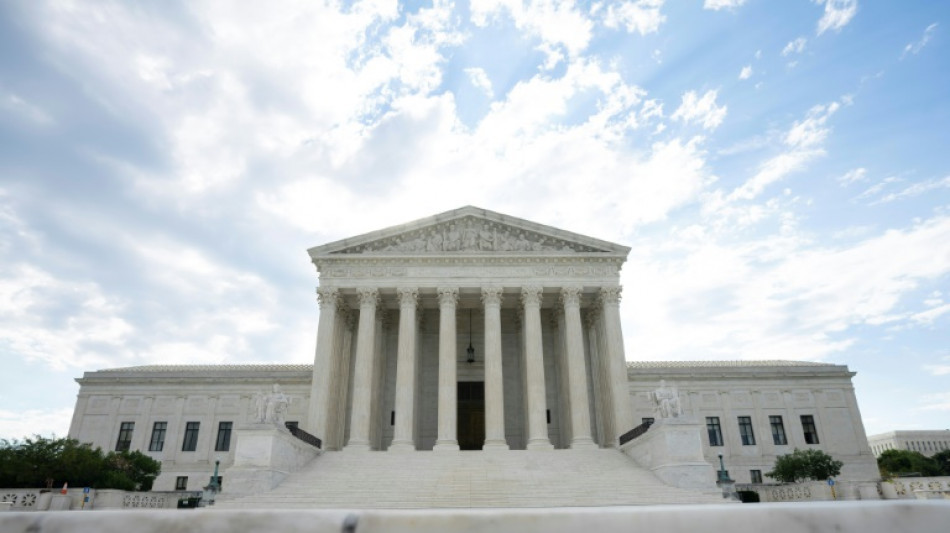
US Supreme Court agrees to hear Monsanto weedkiller case / Photo: Stefani Reynolds - GETTY IMAGES/AFP/File

 US House faces test on sweeping Russia sanctions bill

 British PM says to make 'difficult decisions' as inflation rises

 Global fuel price demos: a round-up

 Leverate Launches MCP for Traders to Connect AI Assistants With Trading Platforms

 MEXC Launches $1M "Discover Your Wall Street DNA" Campaign to Help Traders Find Their Market Fit

 Stocks edge higher ahead of US Fed rate call

 BASIS.pro Expands On-Chain Infrastructure with XDC Network Partnership and Zypher DAO as Auto Earn Goes Live

 Pickle-flavoured tart? AI inspires Japan's convenience stores

 EU chief hosts Canada's Carney in push to 'deepen' alliance

 Meta chief pushes back on AI slowdown calls

 US Fed to deliver rate decision with markets betting on hike

 Sanders, Bannon warn of AI dangers in rare US left-right alignment

 Empty benches as schools reopen in Venezuela's quake-hit Guaira

 Tiny English village holds 'independence' vote over asylum seeker housing

 US Treasury chief says to meet Chinese counterpart at weekend

 BingX Evolves into a Multi-Asset Trading Platform, Connecting Users to Global Opportunities

 International Trading Institute Expands Professional Trader Development Beyond the Master’s in Trading

 Lake Energy Secures $80 Million for U.S. Renewable Energy Expansion

 Stocks drop, oil climbs and Treasury yields hit 19-year high

 SkySail Strategies Outperforms Wall Street's 30-Year Risk Standard With Proprietary AI Inference Model

 Just add fish: Scientists pursue more rice, less disease in Senegal paddies

 Belgium completes outer structure of offshore energy island

 China retail sales growth weakens further in August
 In Kashmir, lake weeds mix with traditional art

 'Widow's Bay' and 'The Pitt' take key Emmy awards

The US Supreme Court agreed on Friday to hear a bid by German chemicals giant Bayer to put an end to a wave of lawsuits over the weedkiller Roundup.
Bayer has spent more than $10 billion settling litigation linked to Roundup since it acquired its producer, the US agrochemical group Monsanto, in 2018.
The International Agency for Research on Cancer considers glyphosate, one of Roundup's ingredients, a probable human carcinogen, but Bayer says scientific studies and regulatory approvals show the weedkiller is safe.
The top US court agreed to hear Bayer's appeal of a $1.25 million award to a Missouri man who claimed Roundup was responsible for his blood cancer -- one of thousands of similar "failure-to-warn" lawsuits facing the company.
Bayer is arguing that it should be shielded from state lawsuits since the federal Environmental Protection Agency (EPA) approved the sale of Roundup to consumers and farmers without any warnings.
The Trump administration has backed Bayer's stance that a federal statute on pesticide labels preempts state laws requiring warnings on products that may be carcinogenic.
In a brief, Solicitor General John Sauer said the EPA had "for decades" classified glyphosate as "not likely to be carcinogenic in humans," arguing that the agency's determination should preempt state rules on the matter.
The Missouri case means "a jury may second-guess the agency's science-based judgments," Sauer said. "A manufacturer should not be left to '50 different labeling regimes.'"
Bayer CEO Bill Anderson welcomed the Supreme Court's decision to take the case.
"It is time for the US legal system to establish that companies should not be punished under state laws for complying with federal warning label requirements," Anderson said in a statement.
Lori Ann Burd, the environmental health director at the Center for Biological Diversity, expressed disappointment.
"It's a sad day in America when our highest court agrees to consider depriving thousands of Roundup users suffering from cancer of their day in court," Burd said in a statement.
"Bayer keeps losing on the facts about its own product so now it's asking the court to prevent juries from ever again hearing those facts," she added.
The Supreme Court is expected to hear the case in the spring and issue a ruling by June or early July.
D.Philippon--CPN

