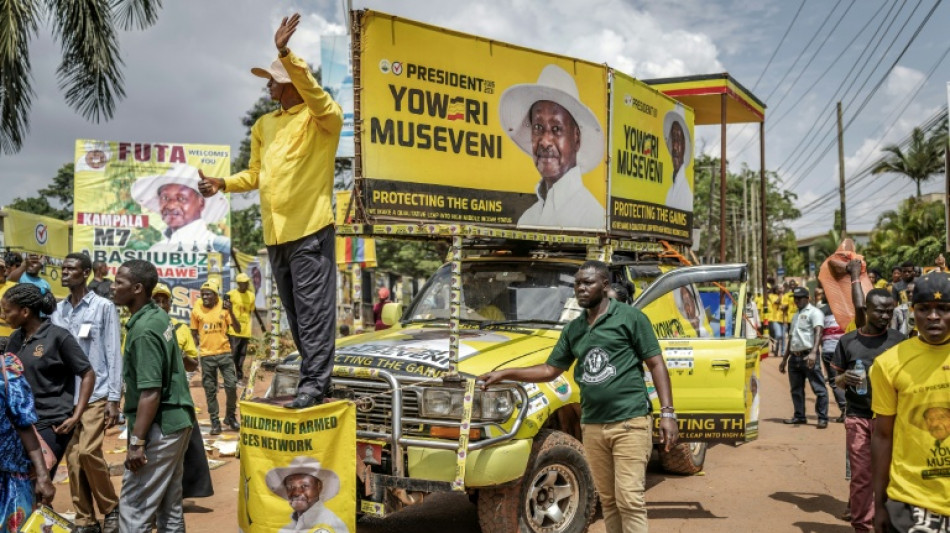
Five things to know about Uganda / Photo: - - AFP

 US House faces test on sweeping Russia sanctions bill

 British PM says to make 'difficult decisions' as inflation rises

 Global fuel price demos: a round-up

 Leverate Launches MCP for Traders to Connect AI Assistants With Trading Platforms

 MEXC Launches $1M "Discover Your Wall Street DNA" Campaign to Help Traders Find Their Market Fit

 Stocks edge higher ahead of US Fed rate call

 BASIS.pro Expands On-Chain Infrastructure with XDC Network Partnership and Zypher DAO as Auto Earn Goes Live

 Pickle-flavoured tart? AI inspires Japan's convenience stores

 EU chief hosts Canada's Carney in push to 'deepen' alliance

 Meta chief pushes back on AI slowdown calls

 US Fed to deliver rate decision with markets betting on hike

 Sanders, Bannon warn of AI dangers in rare US left-right alignment

 Empty benches as schools reopen in Venezuela's quake-hit Guaira

 Tiny English village holds 'independence' vote over asylum seeker housing

 US Treasury chief says to meet Chinese counterpart at weekend

 BingX Evolves into a Multi-Asset Trading Platform, Connecting Users to Global Opportunities

 International Trading Institute Expands Professional Trader Development Beyond the Master’s in Trading

 Lake Energy Secures $80 Million for U.S. Renewable Energy Expansion

 Stocks drop, oil climbs and Treasury yields hit 19-year high

 SkySail Strategies Outperforms Wall Street's 30-Year Risk Standard With Proprietary AI Inference Model

 Just add fish: Scientists pursue more rice, less disease in Senegal paddies

 Belgium completes outer structure of offshore energy island

 China retail sales growth weakens further in August

 In Kashmir, lake weeds mix with traditional art

 'Widow's Bay' and 'The Pitt' take key Emmy awards

Uganda, where President Yoweri Museveni is seeking to extend his 40-year rule with a seventh term on Thursday, has one of the world's youngest populations and is pinning its hopes on oil reserves to overcome poverty.
Here are five things to know about the east African nation:
- Regional military involvement -
Still haunted by the tyrannical reign of Idi Amin from 1971 to 1979, which Museveni helped to end as a former guerrilla, Uganda has been involved in several civil wars and regional conflicts since achieving independence from Britain in 1962.
Museveni, who took power at the head of a rebel army in 1986, has tried to position himself as a useful ally to the United States to offset criticism of his domestic regime.
Uganda's troops have, for instance, been the largest contingent of African soldiers in Somalia fighting al-Qaeda-linked Al-Shabaab militants since 2007.
Its troops have fought in two brutal wars in what is now the Democratic Republic of Congo (1996-1997 and 1998-2003) and maintain a military presence there.
In March, Uganda again sent troops to South Sudan to support President Salva Kiir, which observers deemed a breach of a United Nations arms embargo.
- Strict anti-homosexuality law -
Uganda's Anti-Homosexuality Act, signed by Museveni into law in May 2023, is one of the most severe in the world, with harsh sentences for same-sex relations or "promoting" homosexuality.
This includes the death penalty for "aggravated homosexuality", though capital punishment has not been applied for many years.
Human Rights Watch said the law "institutionalised" homophobia and made it "legitimate".
The World Bank suspended new loans to the country over the law, but announced in June 2025 that it was resuming lending, while claiming that measures were put in place to limit the risk of discrimination in its projects.
- Black gold hopes -
Agriculture is central to the Ugandan economy, with coffee as its leading export, along with refined gold, and a burgeoning tourism sector.
Museveni has overseen sustained economic growth -- which continued at more than six percent in 2024-2025, according to the World Bank.
Some 60 percent of Ugandans still live on $3 or less, however, with critics accusing the government of multiple, massive corruption scandals that have sapped growth.
The government has high hopes for its oil sector after discovering major reserves in the Lake Albert region in 2006.
Landlocked, Uganda hopes to export its first oil through a $10 billion project with France's TotalEnergies and the China National Offshore Oil Corporation (CNOOC) that has been strongly opposed by environmental groups.
The 1,443-kilometre (900-mile) pipeline -- the world's longest heated pipeline -- is due to start transporting crude from Uganda to the Tanzanian port of Tanga on the Indian Ocean in June.
- Young population -
Half of the population of 51.4 million in 2025 was under 18, according to the World Bank, with only two percent over 65.
Britain's former protectorate was named the "Pearl of Africa" in the early 20th century by the future British prime minister Winston Churchill.
Its natural diversity includes misty rainforests, great lakes and snow-capped mountains. It has a long shoreline on Lake Victoria -- which straddles Uganda, Kenya and Tanzania -- and is crossed by the Nile river.
Bwindi National Park is home to half the world's mountain gorillas while Mount Stanley is Africa's third-highest peak at 5,109 metres (16,762 feet).
- Open doors -
Uganda hosts more refugees than any other African country, according to the United Nations. It put their number at two million in 2025, due to influxes from Sudan, South Sudan and the Democratic Republic of Congo.
Aid groups say Uganda struggles to assist the ever-expanding population, but the government has also faced scandals over inflating its refugee numbers to boost the aid it receives.
H.Müller--CPN

