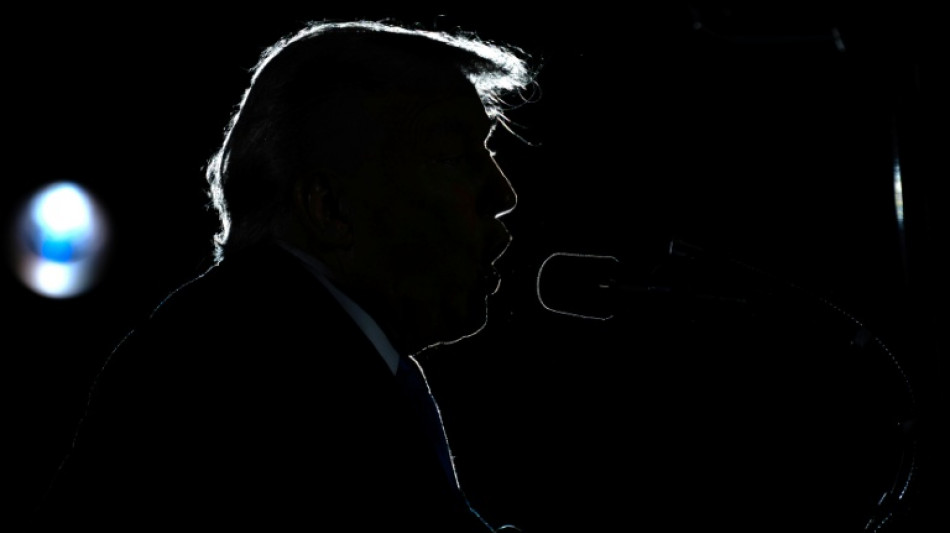
Trump embraces AI deepfakes in political messaging / Photo: SAUL LOEB - AFP

 US House faces test on sweeping Russia sanctions bill

 British PM says to make 'difficult decisions' as inflation rises

 Global fuel price demos: a round-up

 Leverate Launches MCP for Traders to Connect AI Assistants With Trading Platforms

 MEXC Launches $1M "Discover Your Wall Street DNA" Campaign to Help Traders Find Their Market Fit

 Stocks edge higher ahead of US Fed rate call

 BASIS.pro Expands On-Chain Infrastructure with XDC Network Partnership and Zypher DAO as Auto Earn Goes Live

 Pickle-flavoured tart? AI inspires Japan's convenience stores

 EU chief hosts Canada's Carney in push to 'deepen' alliance

 Meta chief pushes back on AI slowdown calls

 US Fed to deliver rate decision with markets betting on hike

 Sanders, Bannon warn of AI dangers in rare US left-right alignment

 Empty benches as schools reopen in Venezuela's quake-hit Guaira

 Tiny English village holds 'independence' vote over asylum seeker housing

 US Treasury chief says to meet Chinese counterpart at weekend

 BingX Evolves into a Multi-Asset Trading Platform, Connecting Users to Global Opportunities

 International Trading Institute Expands Professional Trader Development Beyond the Master’s in Trading

 Lake Energy Secures $80 Million for U.S. Renewable Energy Expansion

 Stocks drop, oil climbs and Treasury yields hit 19-year high

 SkySail Strategies Outperforms Wall Street's 30-Year Risk Standard With Proprietary AI Inference Model

 Just add fish: Scientists pursue more rice, less disease in Senegal paddies

 Belgium completes outer structure of offshore energy island

 China retail sales growth weakens further in August

 In Kashmir, lake weeds mix with traditional art

 'Widow's Bay' and 'The Pitt' take key Emmy awards

From playing football in the Oval Office to sipping cocktails on a sun lounger in Gaza and attacking critics from a fighter jet, Donald Trump has become the first US president to deploy AI-generated imagery as a key tool of political communications.
In the first year of his second term in the White House, Trump ramped up his use of hyper-realistic but fabricated visuals on Truth Social and other platforms, often glorifying himself while lampooning his critics.
Underscoring the strategy's potential appeal to younger voters, similar AI-driven messaging has also been adopted by other arms of the Trump administration as well as by some of the president's rivals.
One of Trump's posts depicts him playing football on the Oval Office's carpeted floor with Cristiano Ronaldo, whom he describes as a "GREAT GUY" who is "really smart and cool."
Another AI post features Trump and Israeli Prime Minister Benjamin Netanyahu sunbathing at a lavish resort, with "Trump Gaza" emblazoned on a sign in the background.
The clip followed Trump's proposal last year to turn Gaza into the "Riviera of the Middle East," a suggestion that sparked widespread outrage.
Trump or the White House have similarly shared AI-made images showing the president dressed as the pope, roaring alongside a lion, and conducting an orchestra at the Kennedy Center, a prestigious arts complex.
"Welcome to the United States' first White House administration to embrace and use imagery generated by artificial intelligence in everyday communication," said a report by the nonprofit media institute Poynter.
"With AI, Trump quickly deploys stereotypes and false narratives in entertaining posts that memorably distill complicated issues into their basest political talking points, regardless of factual basis."
- 'Capture attention' -
Trump has reserved the most provocative AI posts for his rivals and critics, using them to rally his conservative base.
Last year, he posted an AI video of former president Barack Obama being arrested in the Oval Office and appearing behind bars in an orange jumpsuit.
Later, he posted an AI clip of House minority leader Hakeem Jeffries -- who is Black -- wearing a fake mustache and a sombrero. Jeffries slammed the image as racist.
"For someone like Trump, unregulated generative AI is the perfect tool to capture attention and distort reality," Nora Benavidez, senior counsel at the advocacy group Free Press, told AFP.
"Obama was never arrested in the Oval Office. But calling Trump out for telling this lie won't phase him or his followers. A leader who lies without any truth testing means that facts are contingent on Trump's approval."
- 'Nonstop political campaign' -
Analysts say the AI messaging amounts to a strategy of campaigning through trolling, a tactic that could resonate with voters ahead of this year's midterm elections.
"While it would in many ways be desirable for the president to stay above the fray and away from sharing AI-generated images, Trump has repeatedly demonstrated that he sees his time in office as a nonstop political campaign," Joshua Tucker, co-director of the New York University Center for Social Media and Politics, told AFP.
"We should simply see his use of AI-generated political images as just one of many tools -- his text- based social media posts often being another -- he uses to continue this campaign."
In a study published last month by the scientific journal Nature, academics including Cornell University's David Rand reported that human-AI dialogues may have a substantive effect on voters' electoral decisions.
Back-and-forth exchanges with AI tools advocating for political candidates shifted opposition voters' preferences substantially in the United States, Canada and Poland, the study said.
In a sign of its potency, Trump's AI strategy has been mimicked by other departments of his administration and his critics.
Trump's health chief Robert F. Kennedy Jr -- under fire over medical misinformation -- recently promoted a "Make Santa Healthy Again" Christmas campaign using an AI video while the US Immigration and Customs Enforcement (ICE) deployed AI imagery in its immigration crackdown.
Last month, California Governor Gavin Newsom, a Democrat, trolled the president by posting an AI video on X depicting Trump and two senior administration officials in handcuffs.
"It's cuffing season," the video declared.
A.Agostinelli--CPN

