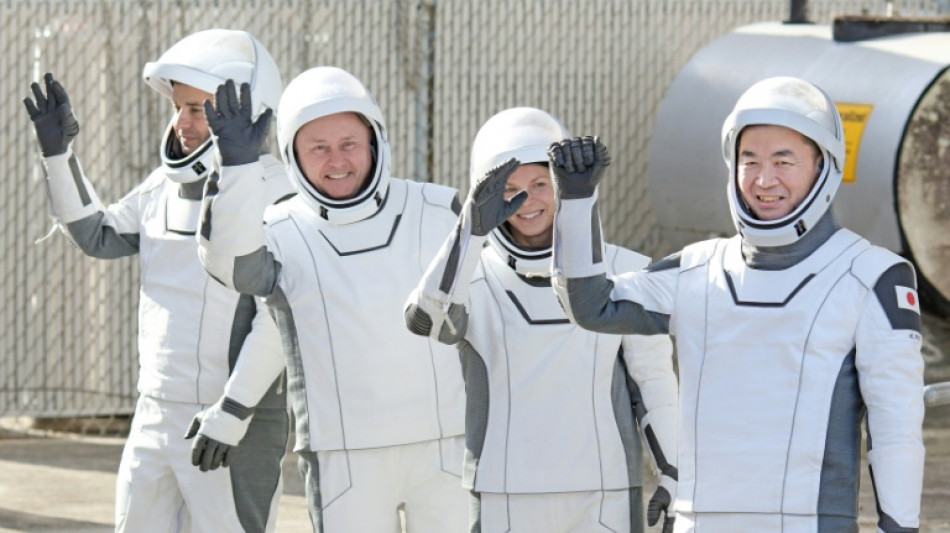
Astronauts set to leave ISS in first-ever medical evacuation / Photo: Gregg Newton - AFP

 亞歷克斯・博迪獲任命為 SCANDIC FINANCE 集團副總裁

 Alex Bodi appointed Vice President of SCANDIC FINANCE GROUP

 Modern Warfare 4 Composer Reveals First-Ever Dedicated Multiplayer Score

 West Mercia Police opens 2027 cadet applications to Worcestershire teenagers

 Goa plans relationship-readiness course amid concern over divorces

 BHEL wins Adani Power projects valued at up to ₹28,000 crore

 India seeks threefold increase in coal stocks to prevent summer power shortages

 Indus Towers expands solar-powered network to 50,000 telecom sites

 Equitas Small Finance Bank rebounds after naming interim chief executive

 Titan quarterly profit seen rising as jewellery business drives growth

 Kuwait finance minister holds economic cooperation talks at COMCEC

 Kuwait marks key events and anniversaries from national history
Four crewmembers aboard the International Space Station were set to depart Wednesday after a medical issue prompted their mission to be cut a month short -- a first for the orbiting laboratory.
American astronauts Mike Fincke and Zena Cardman, Russian cosmonaut Oleg Platonov and Japanese astronaut Kimiya Yui were set to undock from the ISS at 2205 GMT on Wednesday, after five months in space.
NASA has declined to disclose which crewmember has the health problem or give details about the issue, but the US space agency has stressed the return is not an emergency situation, saying the person's condition was stable.
The four are scheduled to splash down off the California coast at around 0840 GMT on Thursday aboard a SpaceX Dragon capsule.
"First and foremost, we are all OK. Everyone on board is stable, safe, and well cared for," Fincke, the pilot of SpaceX Crew-11, said in a social media post.
"This was a deliberate decision to allow the right medical evaluations to happen on the ground, where the full range of diagnostic capability exists. It's the right call, even if it's a bit bittersweet."
James Polk, NASA's chief health and medical officer, said "lingering risk" and a "lingering question as to what that diagnosis is" led to the decision to bring back the crew earlier than originally scheduled.
The four members of Crew-11 arrived at the ISS in early August and had been scheduled to stay onboard the space station until they were rotated out in mid-February with the arrival of the next crew.
American astronaut Chris Williams and Russian cosmonauts Sergey Kud-Sverchkov and Sergei Mikaev, who arrived at the station in November aboard a Russian Soyuz spacecraft, will remain on the ISS.
The Russian Roscosmos space agency operates alongside NASA on the space station, and the two agencies take turns transporting a citizen of the other country to and from the orbiter -- one of the few areas of bilateral cooperation that still endure between the United States and Russia.
- Ready for the unexpected -
Continuously inhabited since 2000, the International Space Station seeks to showcase multinational cooperation, bringing together Europe, Japan, the United States, and Russia.
Located some 400 kilometers (248.5 miles) above Earth, the ISS functions as a testbed for research that supports deeper space exploration -- including eventual missions to return humans to the Moon and onward to Mars.
The four astronauts being evacuated had been trained to handle unexpected medical situations, said Amit Kshatriya, a senior NASA official, praising how they have dealt with the situation.
The ISS is set to be decommissioned after 2030, with its orbit gradually lowered until it breaks up in the atmosphere over a remote part of the Pacific Ocean called Point Nemo, a spacecraft graveyard.
O.Ignatyev--CPN
