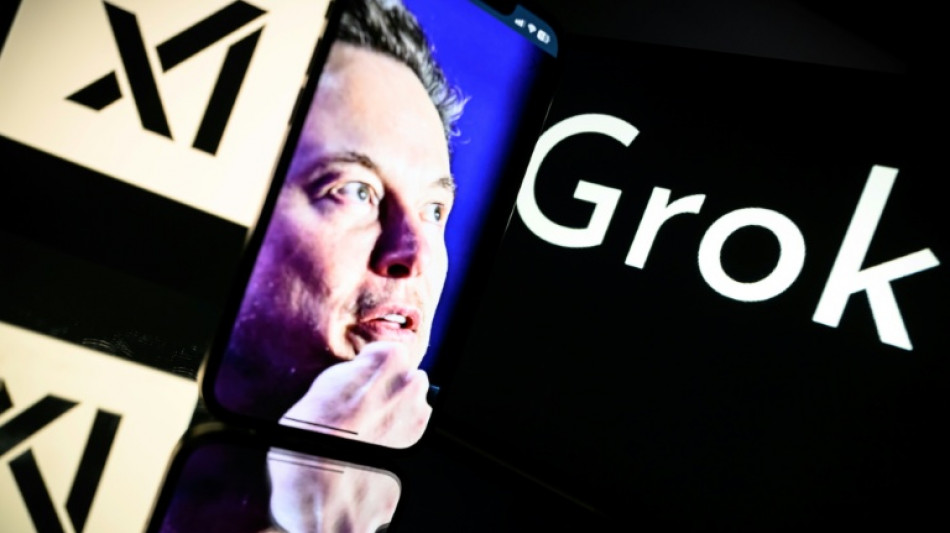
How AI 'deepfakes' became Elon Musk's latest scandal / Photo: Lionel BONAVENTURE - AFP/File

 US House faces test on sweeping Russia sanctions bill

 British PM says to make 'difficult decisions' as inflation rises

 Global fuel price demos: a round-up

 Leverate Launches MCP for Traders to Connect AI Assistants With Trading Platforms

 MEXC Launches $1M "Discover Your Wall Street DNA" Campaign to Help Traders Find Their Market Fit

 Stocks edge higher ahead of US Fed rate call

 BASIS.pro Expands On-Chain Infrastructure with XDC Network Partnership and Zypher DAO as Auto Earn Goes Live

 Pickle-flavoured tart? AI inspires Japan's convenience stores

 EU chief hosts Canada's Carney in push to 'deepen' alliance

 Meta chief pushes back on AI slowdown calls

 US Fed to deliver rate decision with markets betting on hike

 Sanders, Bannon warn of AI dangers in rare US left-right alignment

 Empty benches as schools reopen in Venezuela's quake-hit Guaira

 Tiny English village holds 'independence' vote over asylum seeker housing

 US Treasury chief says to meet Chinese counterpart at weekend

 BingX Evolves into a Multi-Asset Trading Platform, Connecting Users to Global Opportunities

 International Trading Institute Expands Professional Trader Development Beyond the Master’s in Trading

 Lake Energy Secures $80 Million for U.S. Renewable Energy Expansion

 Stocks drop, oil climbs and Treasury yields hit 19-year high

 SkySail Strategies Outperforms Wall Street's 30-Year Risk Standard With Proprietary AI Inference Model

 Just add fish: Scientists pursue more rice, less disease in Senegal paddies

 Belgium completes outer structure of offshore energy island

 China retail sales growth weakens further in August
 In Kashmir, lake weeds mix with traditional art

 'Widow's Bay' and 'The Pitt' take key Emmy awards

Elon Musk's company xAI has faced global backlash in recent days over sexualised "deepfake" images of women and children created by its Grok chatbot.
Here are the essential facts about the scandal, how governments have responded and the company's attempts to cool the controversy.
- 'Put her in a bikini' -
Grok -- Musk's version of the chatbots also offered by OpenAI and other generative AI companies -- has its own account on the X social network allowing users to interact with it.
Until last week, users could tag the bot in posts to request image generation and editing, receiving the image in a reply from Grok.
Many took advantage of the service by sending Grok photos of women or tagging the bot in replies to women's photo posts.
They would ask it to "put her in a bikini" or "take her clothes off" -- receiving photorealistic altered images in response.
Such AI-powered nonconsensual "nudifying" services had previously been available on niche websites, but Grok became the first to take it mainstream with social media integration and offer it for free.
Outrage grew as some users were discovered generating sexualised images of children and minors.
Still others used the tool to generate bikini images of women killed in the deadly New Year fire at Swiss ski resort Crans-Montana, as well as the woman shot and killed by an immigration officer in Minneapolis.
Last week, an analysis of more than 20,000 Grok-generated images by Paris non-profit AI Forensics found that more than half depicted "individuals in minimal attire" -- most of them women, and two percent appearing to be under-18s.
- How have countries reacted?
Indonesia on Saturday became the first country to block access to Grok entirely, with neighbouring Malaysia following on Sunday.
India said Sunday that X had removed thousands of posts and hundreds of user accounts in response to its complaints.
Speaking on condition of anonymity, a government source told AFP 3,500 posts and 600 accounts had been removed.
Britain's Ofcom media regulator -- which can fine companies up to 10 percent of global revenue -- said Monday it was opening a probe into whether X failed to comply with UK law over the sexual images.
"If X cannot control Grok, we will -- and we'll do it fast," British Prime Minister Keir Starmer told MPs from his Labour Party.
France's commissioner for children Sarah El Hairy said Tuesday she had referred Grok's generated images to French prosecutors, the Arcom media regulator and the European Union.
Digital affairs minister Anne Le Henanff had earlier called the restriction of image creation to paying users "insufficient and hypocritical".
And the European Commission, which acts as the EU's digital watchdog, has ordered X to retain all internal documents and data related to Grok until the end of 2026 in response to the uproar.
The bloc has already been investigating X over potential breaches of its digital content rules since 2023.
"We will not be outsourcing child protection and consent to Silicon Valley," Commission chief Ursula von der Leyen said Monday.
"If they don't act, we will."
- How did the company respond?
"We take action against illegal content... including Child Sexual Abuse Material (CSAM) by removing it, permanently suspending accounts, and working with local governments and law enforcement," X's safety team posted on January 4.
Musk himself said last week that anyone using Grok to "make illegal content will suffer the same consequences as if they upload illegal content".
But he made light of the controversy in a separate post, adding laughing emojis as he reshared to his 232 million followers on X a post featuring a toaster wrapped in a bikini.
By January 9, Grok began responding to all requests for image generation or editing by saying the service was restricted to paying subscribers.
Musk has also fired back at politicians demanding action.
Critics of X and Grok "just want to suppress free speech" Musk posted on January 10.
Ng.A.Adebayo--CPN

