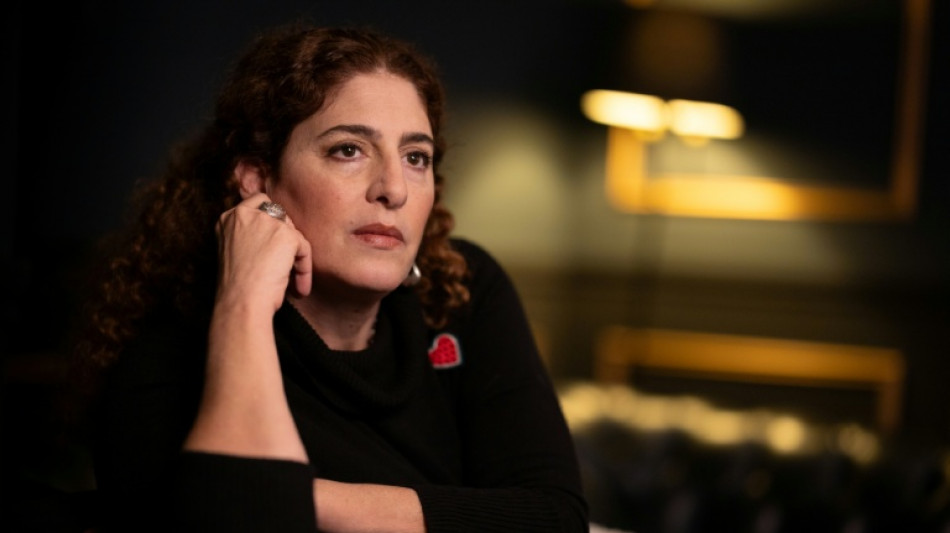
'Palestine 36' director says film is about 'refusal to disappear' / Photo: Thomas SAMSON - AFP

 US House faces test on sweeping Russia sanctions bill

 British PM says to make 'difficult decisions' as inflation rises

 Global fuel price demos: a round-up

 Leverate Launches MCP for Traders to Connect AI Assistants With Trading Platforms

 MEXC Launches $1M "Discover Your Wall Street DNA" Campaign to Help Traders Find Their Market Fit

 Stocks edge higher ahead of US Fed rate call

 BASIS.pro Expands On-Chain Infrastructure with XDC Network Partnership and Zypher DAO as Auto Earn Goes Live

 Pickle-flavoured tart? AI inspires Japan's convenience stores

 EU chief hosts Canada's Carney in push to 'deepen' alliance

 Meta chief pushes back on AI slowdown calls

 US Fed to deliver rate decision with markets betting on hike

 Sanders, Bannon warn of AI dangers in rare US left-right alignment

 Empty benches as schools reopen in Venezuela's quake-hit Guaira

 Tiny English village holds 'independence' vote over asylum seeker housing

 US Treasury chief says to meet Chinese counterpart at weekend

 BingX Evolves into a Multi-Asset Trading Platform, Connecting Users to Global Opportunities

 International Trading Institute Expands Professional Trader Development Beyond the Master’s in Trading

 Lake Energy Secures $80 Million for U.S. Renewable Energy Expansion

 Stocks drop, oil climbs and Treasury yields hit 19-year high

 SkySail Strategies Outperforms Wall Street's 30-Year Risk Standard With Proprietary AI Inference Model

 Just add fish: Scientists pursue more rice, less disease in Senegal paddies

 Belgium completes outer structure of offshore energy island

 China retail sales growth weakens further in August

 In Kashmir, lake weeds mix with traditional art

 'Widow's Bay' and 'The Pitt' take key Emmy awards

The director of Oscar-shortlisted film "Palestine 36" said her big-budget production about a crucial but little-known Arab rebellion is a statement about Palestinians "refusal to disappear".
Veteran filmmaker Annemarie Jacir started production on the sweeping historical epic just before Israel's devastating invasion of Gaza in October 2023.
Making the movie was a "financial disaster", she admitted in an interview with AFP, but encouraging critical reaction since its debut last September and its shortlisting for an Oscar have offered solace.
Nominated by Palestine for Best International Feature, it is the most cinematically ambitious of four productions that deal with the Israeli-Palestinian conflict that are in the running for an Academy Award in March.
"The cinema is not going to save us," said Jacir, a Palestinian born in Bethlehem in 1974 but now living in the Israeli port Haifa. "But it's about the refusal to disappear and this film for us was our refusal."
The Gaza war, sparked by an unprecedented attack by the Hamas militant group on Israel, saw US President Donald Trump and far-right Israeli government ministers openly discuss displacing Palestinians or annexing their remaining ancestral land.
Jacir explained that most accounts of modern Palestinian history begin with the creation of the state of Israel after World War II which led to the "Nakba" in 1948, the uprooting of nearly half the Palestinian population.
"We always start Palestinian history with the Nakba," she said.
As the title of her film suggests, she focuses on 1936 when colonial-era Britain was struggling to administer the holy land for which it assumed responsibility at the end of World War I.
Palestine was a hotbed of resentment and the scene of clashes between the Muslim-majority Palestinian population and newly arrived Jewish immigrants, most of whom were fleeing persecution in Europe.
"1936 is so critical and there's really been nothing done about it. And it sets the stage for everything," Jacir explained.
- 'Disaster' -
She follows a large cast of characters, from villagers losing their land to Zionist settlers, members of the corrupt Palestinian economic elite, as well as the brutally repressive British army and administrators.
Its mostly Arabic-speaking cast includes Oscar-winning British actor Jeremy Irons as a cynical British High Commissioner and Franco-Palestinian actress Hiam Abbass from "Succession" as a defiant village elder.
The project almost never made it to screens with the war in Gaza starting just as filming was about to start in the West Bank in late 2023.
Jacir had built a typical village from the 1930s over 12 months, but then had to abandon the site and move the cast to Jordan.
"We planted crops, and we built the bus, all the vehicles, the tanks, we made guns, the costumes" she told AFP. "Then we lost it all after October 7th... It was a nightmare, a financial disaster.
"Thank God for our financiers, including the BBC, the British Film Institute. Nobody abandoned us," she added.
The film is a sweeping fictionalised story set in the context of real events, with the dramatic climax being the Peel Commission which proposed the partition of Palestine and the creation of a Jewish state.
Ninety years later, with Palestinians limited to the destroyed Gaza enclave and the Israeli-controlled West Bank, and under constant pressure from settlers, Jacir says she no longer believes in a two-state solution.
Her vision? "You live as one people, one place without borders, without control. There is no other way."
She will find out later this month film her film gets the nod for an Oscar nomination as Best International Feature.
Another film about Palestinians, the gut-wrenching "The Voice of Hind Rajab" about a girl killed during the Gaza war, also made the 15-strong shortlist which is set to be reduced to five.
Y.Ponomarenko--CPN

