From sci-fi to sidewalk: exoskeletons go mainstream / Photo: Caroline Brehman - AFP

 US House faces test on sweeping Russia sanctions bill

 British PM says to make 'difficult decisions' as inflation rises

 Global fuel price demos: a round-up

 Leverate Launches MCP for Traders to Connect AI Assistants With Trading Platforms

 MEXC Launches $1M "Discover Your Wall Street DNA" Campaign to Help Traders Find Their Market Fit

 Stocks edge higher ahead of US Fed rate call

 BASIS.pro Expands On-Chain Infrastructure with XDC Network Partnership and Zypher DAO as Auto Earn Goes Live

 Pickle-flavoured tart? AI inspires Japan's convenience stores

 EU chief hosts Canada's Carney in push to 'deepen' alliance

 Meta chief pushes back on AI slowdown calls

 US Fed to deliver rate decision with markets betting on hike

 Sanders, Bannon warn of AI dangers in rare US left-right alignment

 Empty benches as schools reopen in Venezuela's quake-hit Guaira

 Tiny English village holds 'independence' vote over asylum seeker housing

 US Treasury chief says to meet Chinese counterpart at weekend

 BingX Evolves into a Multi-Asset Trading Platform, Connecting Users to Global Opportunities

 International Trading Institute Expands Professional Trader Development Beyond the Master’s in Trading

 Lake Energy Secures $80 Million for U.S. Renewable Energy Expansion

 Stocks drop, oil climbs and Treasury yields hit 19-year high

 SkySail Strategies Outperforms Wall Street's 30-Year Risk Standard With Proprietary AI Inference Model

 Just add fish: Scientists pursue more rice, less disease in Senegal paddies

 Belgium completes outer structure of offshore energy island

 China retail sales growth weakens further in August
 In Kashmir, lake weeds mix with traditional art

 'Widow's Bay' and 'The Pitt' take key Emmy awards

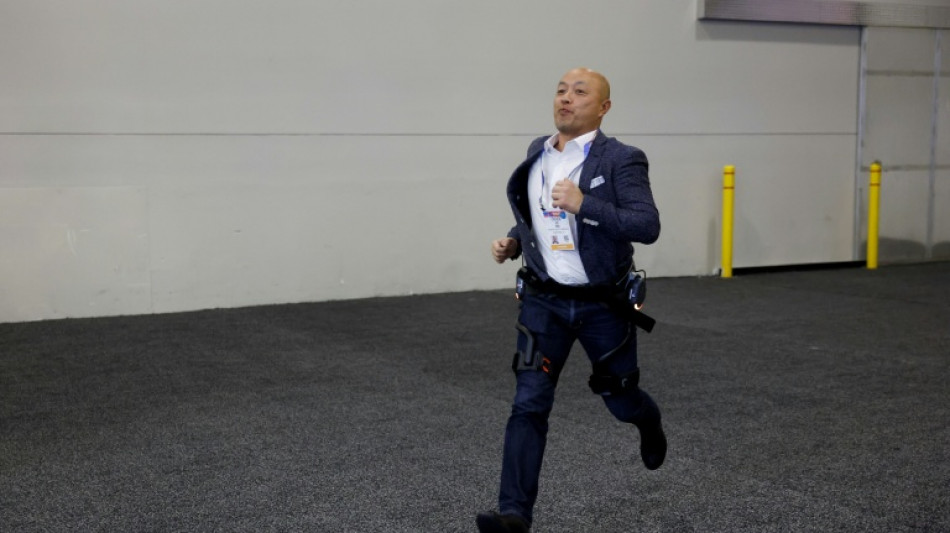
Exoskeletons are shedding their bulky, sci-fi image to become lightweight, AI-powered consumer devices that manufacturers hope will become as commonplace as smartwatches, targeting everyone from hikers to seniors seeking to stay active.
The metal contraptions are impossible to miss in the aisles of the CES consumer technology show in Las Vegas, with visitors eager to try out devices that, depending on the model, help to train the legs, support the knees, and strengthen the back.
Some say they do all three at once.
The Hardiman suit, the first exoskeleton of the modern era created by engineer Ralph Mosher for General Electric in the mid-1960s, is a far cry from these new models.
It was massive in appearance, resembling the boxy "Transformers" characters from the toys and movies.
By contrast, several models presented in Las Vegas weigh less than two kilograms (4.4 pounds) without batteries.
Although exoskeletons gradually made their way into industry and healthcare more than 20 years ago to relieve warehouse workers or assist in patient rehabilitation, they have remained niche products until now.
Today, a host of startups are looking to capitalize on equipment more adapted to everyday use, with improved battery life and more affordable prices.
Several of them offer products costing around $1,000 each, equipped with sensors that use artificial intelligence to adapt the mechanical assistance to the terrain and walking pace.
Some are also designed for running, such as an offering from Dnsys, which claims a maximum speed of 27 kilometers (16.8 miles) per hour -- faster than the sprinting pace of the vast majority of humans.
Casual walkers and experienced hikers alike are being targeted by exoskeleton manufacturers, which are almost exclusively Chinese and dream of success in the vast US market.
"We're working hard to make exoskeletons commonplace so people don't feel that social anxiety of wearing something like this," said Toby Knisely, communications manager at Hypershell, which says it has already sold 20,000 units.
"It'll hit a critical mass at some point, and maybe become as commonplace as smartwatches or glasses," he said.
- You do the work -
After trying out an Ascentiz exoskeleton, Trevor Bills, a Canadian entrepreneur visiting CES, was quite impressed.
"You hardly feel it, because it seems to be very good at keeping up with you," he said.
"It was only when I slowed down that I was fighting it a little bit."
One of the obstacles to overcome is the idea that exoskeletons reduce physical effort and diminish the health benefits of exercise.
"It doesn't do the work for you," said Bills, his forehead glistening with sweat.
"If it gets people out and about and makes them more active, that's a good thing."
Half of Dnsys's customers are over-50s "who enjoy walking but do so less as they get older," says Xiangyu Li, co-founder of the company.
Hypershell states on its website that users must be able to walk and balance on their own to ensure that everyone uses the device safely and not as a crutch or walking aid.
When these machines become more common on the streets, "social anxiety, or the embarrassment associated with wearing an exoskeleton" will fade, said Knisely.
"People don't want to look like robots," said Xiangyu Li.
P.Schmidt--CPN

