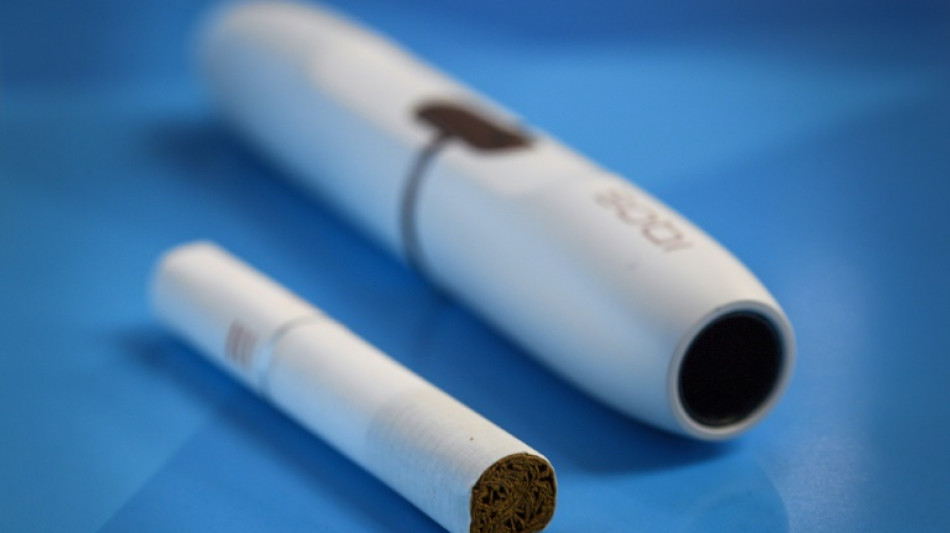
Smoke without fire? Researchers question heated tobacco products / Photo: Fabrice COFFRINI - AFP/File

 Watts, Pitt, Cruz to light up Spain's top film festival

 Toogood Gold's Table Mountain Sits in the Shadow of a Nevada Gold Rush

 MEXC July–August Security Report: 38.66M USDT in Risk Funds Intercepted, Futures Insurance Fund Hits 792M USDT

 Emporio Armani names Dario Vitale new creative director

 EU to ban social media for under 13s, curb access until 15

 Wildfires push endangered Sumatran elephants to brink: Indonesian NGO

 Bank of Japan set to raise rates under pressure from inflation, US

 EU chief to unveil social media, gaming curbs for under-15s

 'Resident Evil' film brings video game's ethos to the big screen

 i-payout Expands U.S. Money Transmitter Licensing Footprint and Advances European EMI Strategy

 US Senate crypto bill collapses amid partisan deadlock

 OpenAI, Anthropic and Google are working to create an AI standards body

 Protesting shepherds, farmers clash with Romanian police

 Foundation Lets Ledger Users Switch to Open Source Without Starting Over

 EU to propose curbing social media, online games for under 15s

 FX Junction Reaches 40,600 Members and 26 Million Trades

 'We unleashed the beast': the world's fears and hopes about AI

 Hospitality leaders ask Burnham to halve VAT amid rising costs

 Worcestershire invited to nominate groups for 2027 King’s volunteer award

 Berlin's run-down public spaces at heart of election campaign

 'Widow's Bay' and 'The Pitt' win big at Emmy Awards

 Most markets drop as oil extends gains ahead of expected US rate hike

 Sri Lanka's famed beach shack battles demolition

 Vserv targets ₹1,000 crore revenue by 2030 through AI expansion

 India prohibits bank fees on UPI payments up to ₹2,000

Heated tobacco products have soared in popularity as a "smoke free" alternative to cigarettes in recent years, but a peer-reviewed report has suggested their emissions could be considered smoke -- a claim strongly rejected by the tobacco industry.
Heated tobacco products, or HTPs, are often confused with e-cigarettes, which heat liquid that can contain nicotine but do not involve tobacco leaf.
HTPs instead use a high heat to decompose tobacco, via a process called pyrolysis, which does not set it on fire or burn it, therefore avoiding creating smoke.
The most popular and widely available HTP, Philip Morris International's IQOS, is an electronic device that heats a tobacco-filled, paper-wrapped, cigarette-like stick at a temperature of up to 350 degrees Celsius (662 degrees Fahrenheit).
Last month a review of the available research by experts in pyrolysis from Britain's Nottingham University found "chemical evidence that IQOS emissions fit the definition of both an aerosol and smoke."
The paper, published in the American Chemical Society's Omega journal, was funded by the STOP anti-tobacco initiative.
Its lead author Clement Uguna said that IQOS emissions contain chemical compounds that are "in normal tobacco smoke, bush burning and wood smoke".
"Hence smoke arises simply by heating organic substances and does not necessarily involve fire," he told AFP.
The paper also found that previous research on IQOS -- the majority of which has been funded by the tobacco industry -- had compared a stick to a typical cigarette.
However IQOS sticks are much smaller, containing around 200 milligrams of tobacco compared to 645 milligrams for a standard cigarette, it said.
Because research by Philip Morris International (PMI) did not use a "like against like" comparison, it "underestimated" the levels of harmful and potentially harmful constituents (HPHCs) from IQOS, the review added.
PMI said the level of HPHCs in IQOS emissions -- per stick -- was "reduced on average by 90-95 percent compared to cigarette smoke".
However that level fell to 68 percent when comparing the tobacco content of the two products, the Nottingham University experts said, calling for more research.
- 'Not smoke': PMI -
PMI told AFP that the paper "misleadingly leverages pieces of the scientific assessment while omitting other important pieces of evidence".
"Numerous international combustion experts and a number of government agencies have reviewed the same evidence package and concluded that the IQOS aerosol produced is not smoke," it said.
Reto Auer, a doctor at Germany's University of Bern who has previously researched heated tobacco, praised the Omega paper, telling AFP it was "one of the rare reports to dare to tackle the question of 'smoke' so deeply".
Jamie Hartmann-Boyce of the Centre for Evidence-Based Medicine at Oxford University, an author of a highly regarded review on HTP science published earlier this year, said the "important" paper "made some very good points".
"I think mechanistically there are a lot of reasons to suspect HTPs might be more harmful than e-cigarettes and possibly less harmful than traditional cigarettes -- but we really need more data," she told AFP.
- 'Difficult balance' -
IQOS is available in more than 60 countries under widely varying regulations, and sticks come in flavours such as menthol, cherry and grape, which critics say help attract younger users.
Last month the European Commission proposed banning flavoured HTP varieties after stick sales in the EU soared more than 2,000 percent -- from 934 million to nearly 20 billion -- between 2018 and 2020.
PMI told AFP that the "proposal from the Commission is not underpinned by evidence".
"It fails to prove, for instance, that flavours pose any additional health risks or that they attract a significant proportion of non-nicotine users," it said.
Hartmann-Boyce said "there is every reason to be concerned about the extent to which the tobacco industry is manipulating the science and messages around new tobacco products."
But she warned it was a "difficult balance" to communicate the risks of such products because of the overwhelming damage done by cigarettes. Tobacco kills half its users, according to the World Health Organization.
"If we say something is safer than cigarettes, that is not saying it's safe -- it's like saying that this knife is safer than a loaded gun," Hartmann-Boyce said.
C.Smith--CPN