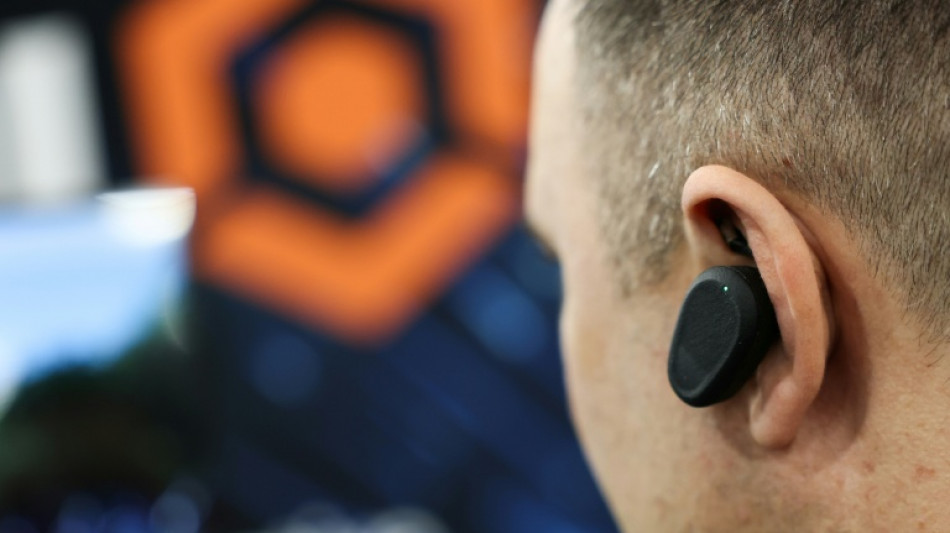
From music to mind reading: AI startups bet on earbuds / Photo: Patrick T. Fallon - AFP

 US House faces test on sweeping Russia sanctions bill

 British PM says to make 'difficult decisions' as inflation rises

 Global fuel price demos: a round-up

 Leverate Launches MCP for Traders to Connect AI Assistants With Trading Platforms

 MEXC Launches $1M "Discover Your Wall Street DNA" Campaign to Help Traders Find Their Market Fit

 Stocks edge higher ahead of US Fed rate call

 BASIS.pro Expands On-Chain Infrastructure with XDC Network Partnership and Zypher DAO as Auto Earn Goes Live

 Pickle-flavoured tart? AI inspires Japan's convenience stores

 EU chief hosts Canada's Carney in push to 'deepen' alliance

 Meta chief pushes back on AI slowdown calls

 US Fed to deliver rate decision with markets betting on hike

 Sanders, Bannon warn of AI dangers in rare US left-right alignment

 Empty benches as schools reopen in Venezuela's quake-hit Guaira

 Tiny English village holds 'independence' vote over asylum seeker housing

 US Treasury chief says to meet Chinese counterpart at weekend

 BingX Evolves into a Multi-Asset Trading Platform, Connecting Users to Global Opportunities

 International Trading Institute Expands Professional Trader Development Beyond the Master’s in Trading

 Lake Energy Secures $80 Million for U.S. Renewable Energy Expansion

 Stocks drop, oil climbs and Treasury yields hit 19-year high

 SkySail Strategies Outperforms Wall Street's 30-Year Risk Standard With Proprietary AI Inference Model

 Just add fish: Scientists pursue more rice, less disease in Senegal paddies

 Belgium completes outer structure of offshore energy island

 China retail sales growth weakens further in August
 In Kashmir, lake weeds mix with traditional art

 'Widow's Bay' and 'The Pitt' take key Emmy awards

AI companies are on the hunt to design the ideal device to deliver AI's superpowers, and some new enterprises are convinced that headphones or earbuds are the way.
Startups have for a while tried to beef up headphones beyond their basic functions, like listening to music and making phone calls.
Nearly a decade ago, tech startups Waverly Labs and Mymanu added real-time translation to that list, and Google quickly followed suit, creating a voice-activated AI assistant in 2020.
Riding the AI wave, other tech industry leaders Samsung and Apple have also entered the fray, with noise cancellation now almost a product standard.
Startups, many of which are attending this week's CES consumer electronics extravaganza in Las Vegas, are now trying to refine this technology and apply it to specific uses.
Such is the case with OSO, which wants to take the concept of a professional assistant further.
Its earbuds will record meetings and retrieve conversation elements on demand using everyday language.
Viaim, a competitor, offers similar services and intends to focus on interoperability in a world controlled by major smartphone manufacturers that impose their own platforms.
"If you use a different brand of cell phone, it doesn't have any AI functions at all. That's the opportunity for our earbuds," explained Shawn Ma, CEO of Viaim, whose devices are compatible with all brands, including iPhones in China.
Timekettle, meanwhile, is enjoying success in a completely different context, with "90 percent of its sales coming from schools," according to Brian Shircliffe, head of US sales for the Chinese company.
Many schools equip their non-English-speaking students with the devices so they can follow lessons without the need for a translator.
- Reading minds -
As for whether earbuds can replace smart glasses, connected speakers, or even smartphones as the dominant physical extension of generative AI, remains unanswered.
For now, any AI functionality "is really dependent on the phone that it's connected to," said Ben Wood, chief analyst at CCS Insight.
"Earbuds are certainly a more accessible entry for AI than smart glasses," said Avi Greengart, president of Techsponential, a consultancy.
"They're a lot less expensive, they're a product most smartphone users are buying anyway, and they don't require a prescription."
However, "people generally don't wear them all the time," unlike glasses, "and they can only interact with voice, so you'll need to be in an environment where talking is acceptable," the analyst cautioned, adding that the lack of a camera limits the device's potential.
Some won't be constrained by the shortcoming, notably Naqi Logix, whose Neural Earbuds are equipped with ultra-sensitive sensors that detect tiny movements.
Thanks to these sensors, a quadriplegic user can control their wheelchair or surf the internet simply by looking at their computer screen.
Operations manager Sandeep Arya sees great potential for these innovations, "because people would like to be able to interact with their environment in a more discreet, subtle way," without having to call out to Siri on their smartphone, Alexa on their speaker, or Meta on their glasses.
Arya envisions the technology going further, thanks to improved sensors capable of deciphering facial movements that a chatbot can use to find the right tone and words according to mood.
Neurable, another startup whose MW75 Neuro LT headset measures brain activity, dreams of using its equipment to enable communication through thought, without gestures or words.
"It's remarkable," says Ben Wood of these breakthroughs, "but it's still a niche market for now."
Until further notice, "the hundreds of millions of headphones that have been sold will remain focused on listening."
M.Mendoza--CPN

