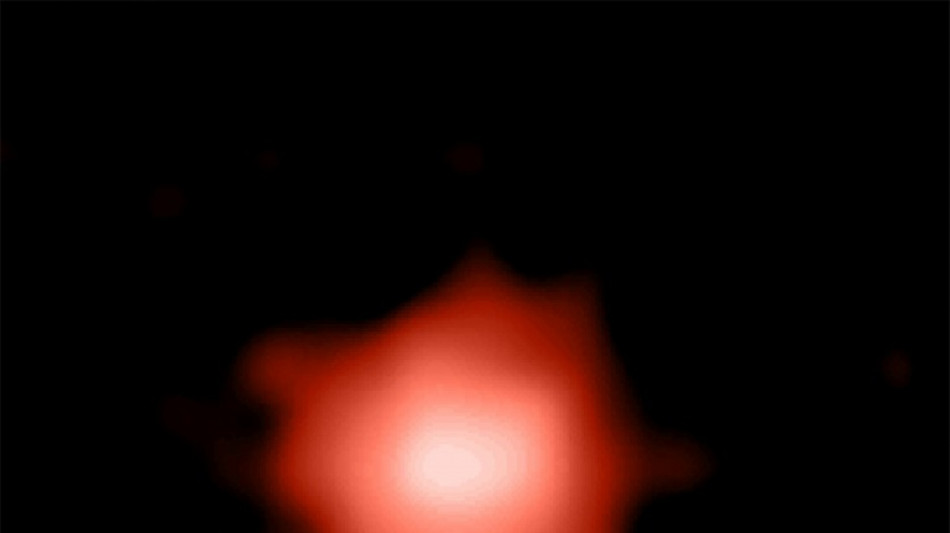
Webb telescope may have already found most distant known galaxy / Photo: Handout - University of Copenhagen/AFP

 Watts, Pitt, Cruz to light up Spain's top film festival

 Toogood Gold's Table Mountain Sits in the Shadow of a Nevada Gold Rush

 MEXC July–August Security Report: 38.66M USDT in Risk Funds Intercepted, Futures Insurance Fund Hits 792M USDT

 Emporio Armani names Dario Vitale new creative director

 EU to ban social media for under 13s, curb access until 15

 Wildfires push endangered Sumatran elephants to brink: Indonesian NGO

 Bank of Japan set to raise rates under pressure from inflation, US

 EU chief to unveil social media, gaming curbs for under-15s

 'Resident Evil' film brings video game's ethos to the big screen

 i-payout Expands U.S. Money Transmitter Licensing Footprint and Advances European EMI Strategy

 US Senate crypto bill collapses amid partisan deadlock

 OpenAI, Anthropic and Google are working to create an AI standards body

 Protesting shepherds, farmers clash with Romanian police

 Foundation Lets Ledger Users Switch to Open Source Without Starting Over

 EU to propose curbing social media, online games for under 15s

 FX Junction Reaches 40,600 Members and 26 Million Trades

 'We unleashed the beast': the world's fears and hopes about AI

 Hospitality leaders ask Burnham to halve VAT amid rising costs

 Worcestershire invited to nominate groups for 2027 King’s volunteer award

 Berlin's run-down public spaces at heart of election campaign

 'Widow's Bay' and 'The Pitt' win big at Emmy Awards

 Most markets drop as oil extends gains ahead of expected US rate hike

 Sri Lanka's famed beach shack battles demolition

 Vserv targets ₹1,000 crore revenue by 2030 through AI expansion

 India prohibits bank fees on UPI payments up to ₹2,000

Just a week after its first images were shown to the world, the James Webb Space Telescope may have found a galaxy that existed 13.5 billion years ago, a scientist who analyzed the data said Wednesday.
Known as GLASS-z13, the galaxy dates back to 300 million years after the Big Bang, about 100 million years earlier than anything previously identified, Rohan Naidu of the Harvard Center for Astrophysics told AFP.
"We're potentially looking at the most distant starlight that anyone has ever seen," he said.
The more distant objects are from us, the longer it takes for their light to reach us, and so to gaze back into the distant universe is to see into the deep past.
Though GLASS-z13 existed in the earliest era of the universe, its exact age remains unknown as it could have formed anytime within the first 300 million years.
GLASS-z13 was spotted in so-called "early release" data from the orbiting observatory's main infrared imager, called NIRcam -- but the discovery was not revealed in the first image set published by NASA last week.
When translated from infrared into the visible spectrum, the galaxy appears as a blob of red with white in its center, as part of a wider image of the distant cosmos called a "deep field."
Naidu and colleagues -- a team totaling 25 astronomers from across the world -- have submitted their findings to a scientific journal.
For now, the research is posted on a "preprint" server, so it comes with the caveat that it has yet to be peer-reviewed -- but it has already set the global astronomy community abuzz.
"Astronomy records are crumbling already, and more are shaky," tweeted NASA's chief scientist Thomas Zurbuchen.
"Yes, I tend to only cheer once science results clear peer review. But, this looks very promising," he added.
Naidu said another team of astronomers led by Marco Castellano that worked on the same data has achieved similar conclusions, "so that gives us confidence."
- 'Work to be done' -
One of the great promises of Webb is its ability to find the earliest galaxies that formed after the Big Bang, 13.8 billion years ago.
Because these are so distant from Earth, by the time their light reaches us, it has been stretched by the expansion of the universe and shifted to the infrared region of the light spectrum, which Webb is equipped to detect with unprecedented clarity.
Naidu and colleagues combed through this infrared data of the distant universe, searching for a telltale signature of extremely distant galaxies.
Below a particular threshold of infrared wavelength, all photons -- packets of energy -- are absorbed by the neutral hydrogen of the universe that lies between the object and the observer.
By using data collected through different infrared filters pointed at the same region of space, they were able to detect where these drop-offs in photons occurred, from which they inferred the presence of these most distant galaxies.
"We searched all the early data for galaxies with this very striking signature, and these were the two systems that had by far the most compelling signature," said Naidu.
One of these is GLASS-z13, while the other, not as ancient, is GLASS-z11.
"There's strong evidence, but there's still work to be done," said Naidu.
In particular, the team wants to ask Webb's managers for telescope time to carry out spectroscopy -- an analysis of light that reveals detailed properties -- to measure its precise distance.
"Right now, our guess for the distance is based on what we don't see -- it would be great to have an answer for what we do see," said Naidu.
Already, however, the team have detected surprising properties.
For instance, the galaxy is the mass of a billion Suns, which is "potentially very surprising, and that is something we don't really understand" given how soon after the Big Bang it formed, Naidu said.
Launched last December and fully operational since last week, Webb is the most powerful space telescope ever built, with astronomers confident it will herald a new era of discovery.
L.K.Baumgartner--CPN