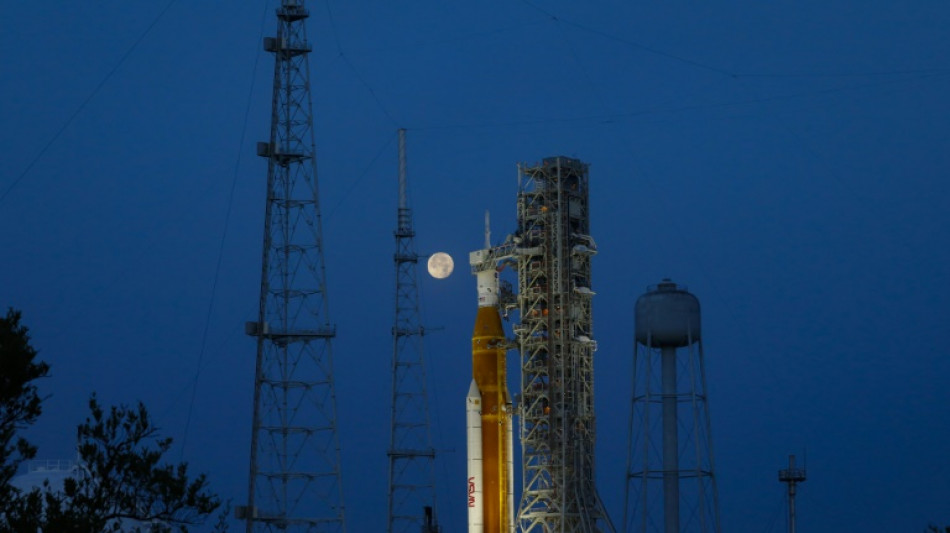
NASA's new Moon rocket to launch as soon as August 29 / Photo: Eva Marie UZCATEGUI - AFP/File

 Watts, Pitt, Cruz to light up Spain's top film festival

 Toogood Gold's Table Mountain Sits in the Shadow of a Nevada Gold Rush

 MEXC July–August Security Report: 38.66M USDT in Risk Funds Intercepted, Futures Insurance Fund Hits 792M USDT

 Emporio Armani names Dario Vitale new creative director

 EU to ban social media for under 13s, curb access until 15

 Wildfires push endangered Sumatran elephants to brink: Indonesian NGO

 Bank of Japan set to raise rates under pressure from inflation, US

 EU chief to unveil social media, gaming curbs for under-15s

 'Resident Evil' film brings video game's ethos to the big screen

 i-payout Expands U.S. Money Transmitter Licensing Footprint and Advances European EMI Strategy

 US Senate crypto bill collapses amid partisan deadlock

 OpenAI, Anthropic and Google are working to create an AI standards body

 Protesting shepherds, farmers clash with Romanian police

 Foundation Lets Ledger Users Switch to Open Source Without Starting Over

 EU to propose curbing social media, online games for under 15s

 FX Junction Reaches 40,600 Members and 26 Million Trades

 'We unleashed the beast': the world's fears and hopes about AI

 Hospitality leaders ask Burnham to halve VAT amid rising costs

 Worcestershire invited to nominate groups for 2027 King’s volunteer award

 Berlin's run-down public spaces at heart of election campaign

 'Widow's Bay' and 'The Pitt' win big at Emmy Awards

 Most markets drop as oil extends gains ahead of expected US rate hike

 Sri Lanka's famed beach shack battles demolition

 Vserv targets ₹1,000 crore revenue by 2030 through AI expansion

 India prohibits bank fees on UPI payments up to ₹2,000

Mark your calendars: NASA's Artemis program to return to the Moon could launch its first uncrewed test flight as soon as August 29, the agency said Wednesday.
Artemis-1 is the first in a series of missions as the United States seeks to return humans to the Moon, build a sustained presence there, and use the lessons gained to plan a trip to Mars sometime in the 2030s.
NASA associate administrator Jim Free told reporters the first window of possible launch dates for the giant Space Launch System (SLS) and Orion crew capsule were August 29, September 2, and September 5.
The decision follows final checks on the ground at the Kennedy Space Center in Florida known as "wet dress rehearsals."
The last of these tests, carried out in June, met 90 percent of the team's goals, and on Wednesday Cliff Lanham, senior vehicle operations manager, said engineers have now replaced faulty seals that had caused a hydrogen leak on SLS during the final trial.
Artemis-1 is set to journey around the far side of the Moon in a mission lasting four to six weeks -- longer than any ship for astronauts has done without docking, before returning home faster and hotter than every vessel before.
It will also deploy a number of small satellites called CubeSats to perform experiments in space.
Artemis mission manager Mike Sarafin told reporters: "Our first and our primary objective is to demonstrate Orion's heat shield in lunar reentry conditions."
When the capsule returns from the Moon, it will be traveling about 24,500 miles an hour (39,400 kilometers per hour) and experience temperatures half as hot as the Sun outside its heat shield.
The second objective is to demonstrate the flight worthiness of the rocket and crew capsule as they perform all their maneuvers over the course of the mission.
Finally, NASA will look to successfully retrieve Orion after splashdown, and thoroughly inspect it.
Artemis-2 will be the first crewed test, flying around the Moon but not landing, while Artemis-3 will see the first woman and first person of color touch down on the lunar south pole.
C.Peyronnet--CPN