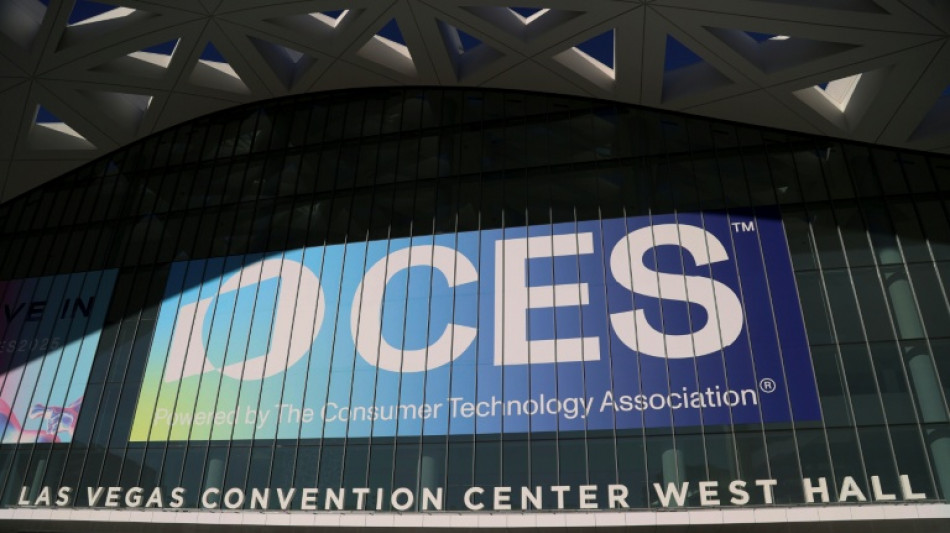
Sprawling CES gadgetfest a world stage for AI and its hype / Photo: Ian Maule - AFP

 US House faces test on sweeping Russia sanctions bill

 British PM says to make 'difficult decisions' as inflation rises

 Global fuel price demos: a round-up

 Leverate Launches MCP for Traders to Connect AI Assistants With Trading Platforms

 MEXC Launches $1M "Discover Your Wall Street DNA" Campaign to Help Traders Find Their Market Fit

 Stocks edge higher ahead of US Fed rate call

 BASIS.pro Expands On-Chain Infrastructure with XDC Network Partnership and Zypher DAO as Auto Earn Goes Live

 Pickle-flavoured tart? AI inspires Japan's convenience stores

 EU chief hosts Canada's Carney in push to 'deepen' alliance

 Meta chief pushes back on AI slowdown calls

 US Fed to deliver rate decision with markets betting on hike

 Sanders, Bannon warn of AI dangers in rare US left-right alignment

 Empty benches as schools reopen in Venezuela's quake-hit Guaira

 Tiny English village holds 'independence' vote over asylum seeker housing

 US Treasury chief says to meet Chinese counterpart at weekend

 BingX Evolves into a Multi-Asset Trading Platform, Connecting Users to Global Opportunities

 International Trading Institute Expands Professional Trader Development Beyond the Master’s in Trading

 Lake Energy Secures $80 Million for U.S. Renewable Energy Expansion

 Stocks drop, oil climbs and Treasury yields hit 19-year high

 SkySail Strategies Outperforms Wall Street's 30-Year Risk Standard With Proprietary AI Inference Model

 Just add fish: Scientists pursue more rice, less disease in Senegal paddies
 Belgium completes outer structure of offshore energy island
 China retail sales growth weakens further in August
 In Kashmir, lake weeds mix with traditional art

 'Widow's Bay' and 'The Pitt' take key Emmy awards

Dreams about the vast potential of artificial intelligence will collide with cold, hard reality as the Consumer Electronics Show kicks off in Las Vegas on Tuesday.
Science fiction portrays AI as superintelligence that can operate faster and better than people can, and do it autonomously.
However, the technology for now is being put to work at very specialized tasks -- in gadgets that translate languages during conversations, say, or monitor health symptoms, or provide information on people's surroundings through smart glasses.
Even AI being built into humanoid robots remains a work in progress, with human tele-operators overseeing their operation remotely.
"The gap between AI technology hype and customer experience expectations will widen at CES 2026," predicted Forrester principal analyst Thomas Husson.
"If software and AI models move at the speed of light, energy and hardware move at the speed of physics."
Nonetheless, he expects CES to feature an array of "AI-powered smart everything devices" for consumers, including televisions, home appliances, personal computers, vehicles, and wearables such as rings that monitor health.
Analysts expect the annual trade event, which drew more than 142,000 attendees last year, to be a sprawling affair with vendors pitching products from humanoid robots and exoskeletons to AI-infused toys and huge autonomous mining vehicles.
With thousands of exhibitors, the week-long gathering includes connected cars, heavy equipment and AI shows. Demos, presentations and meetings will take place in a massive convention center as well as ballrooms and suites throughout the city.
"There's no question that some of it is going to be AI washing," Techsponential analyst Avi Greengart said of hype expected at CES.
"But we will also see genuinely useful features driven by advances in machine learning that provide new capabilities into a range of products, everything from phones to TVs to wearables to digital health to cars."
Smart glasses, like those from Meta in a partnership with Ray-Ban, will likely kick-start an AI wearables race with some 10 percent of consumers trying them by the end of this year, according to Husson.
Greengart said he expects an emphasis on personal computers because of a rivalry among Intel, AMD, and Qualcomm to produce chips that provide lots of AI capability while trimming power use to extend battery life.
Greengart cautioned that there is a "huge cloud hanging over the PC industry" due to soaring prices for computing and memory chips.
With chip makers focused on serving needs of AI data centers, supplies of basic building blocks for laptops or gaming consoles have dwindled as prices have soared, according to Greengart.
"AI is definitely a story that overlays CES in terms of new capabilities, but also new price pressures," Greengart said.
- Trade war pressure -
And while major Chinese consumer electronics companies like Lenovo, Hisense, and TCL are slated to take part in CES, many small manufacturing firms from that country will be absent due to the trade war with the United States, according to the analyst.
"There is definitely a smaller presence from Chinese vendors than there has been under past administrations," Greengart said, referring to US President Donald Trump.
"This is very much a geopolitical thing."
Electronics companies have been grappling with frequent, unpredictable strategy shifts when it comes to US tariffs, he said.
"It's been very distracting and very difficult in areas where the president of the United States has basically changed tariffs or imposed tariffs over 100 times since being sworn in," said Gary Shapiro, president of the Consumer Technology Association which runs CES.
Still, CES remains a gathering at which deals get made and meeting face-to-face has value, according to Greengart.
"CES isn't where you go necessarily to find the next big thing."
"But what you do see at CES is a clear view on the trends and where investment in the industry is happening."
D.Goldberg--CPN

