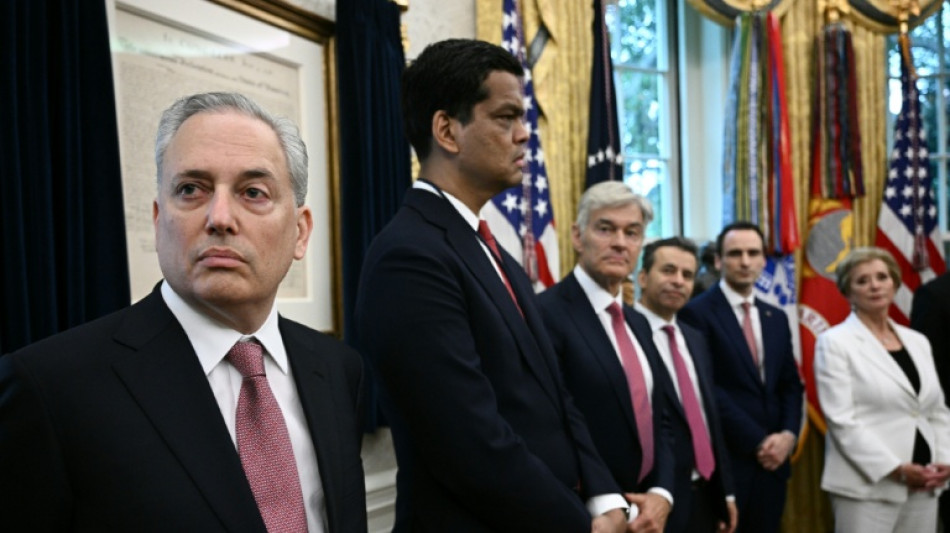
David Sacks: Trump's AI power broker / Photo: Brendan SMIALOWSKI - AFP

 US House faces test on sweeping Russia sanctions bill

 British PM says to make 'difficult decisions' as inflation rises

 Global fuel price demos: a round-up

 Leverate Launches MCP for Traders to Connect AI Assistants With Trading Platforms

 MEXC Launches $1M "Discover Your Wall Street DNA" Campaign to Help Traders Find Their Market Fit

 Stocks edge higher ahead of US Fed rate call

 BASIS.pro Expands On-Chain Infrastructure with XDC Network Partnership and Zypher DAO as Auto Earn Goes Live

 Pickle-flavoured tart? AI inspires Japan's convenience stores

 EU chief hosts Canada's Carney in push to 'deepen' alliance

 Meta chief pushes back on AI slowdown calls

 US Fed to deliver rate decision with markets betting on hike

 Sanders, Bannon warn of AI dangers in rare US left-right alignment

 Empty benches as schools reopen in Venezuela's quake-hit Guaira

 Tiny English village holds 'independence' vote over asylum seeker housing

 US Treasury chief says to meet Chinese counterpart at weekend

 BingX Evolves into a Multi-Asset Trading Platform, Connecting Users to Global Opportunities

 International Trading Institute Expands Professional Trader Development Beyond the Master’s in Trading

 Lake Energy Secures $80 Million for U.S. Renewable Energy Expansion

 Stocks drop, oil climbs and Treasury yields hit 19-year high

 SkySail Strategies Outperforms Wall Street's 30-Year Risk Standard With Proprietary AI Inference Model

 Just add fish: Scientists pursue more rice, less disease in Senegal paddies

 Belgium completes outer structure of offshore energy island

 China retail sales growth weakens further in August

 In Kashmir, lake weeds mix with traditional art

 'Widow's Bay' and 'The Pitt' take key Emmy awards

From a total Washington novice, Silicon Valley investor David Sacks has against expectations emerged as one of the most successful members of the second Trump administration.
He is officially chair of President Donald Trump's Council of Advisors on Science and Technology.
However, in the White House he is referred to as the AI and crypto tsar, there to guide the president through the technology revolutions in which the United States play a central role.
"I am grateful we have him," OpenAI boss Sam Altman said in a post on X.
"While Americans bicker, our rivals are studying David's every move," billionaire Salesforce CEO Marc Benioff chimed in.
Those supportive posts responded to a New York Times investigation highlighting Sacks's investments in technology companies benefiting from White House AI support.
Sacks dismissed the report as an "anti-truth" hit job by liberal media.
But the episode confirmed that this South African-born outsider has become a force in Trump's Washington, outlasting his friend Elon Musk, whose White House career ended in acrimony after less than six months.
"Even among Silicon Valley allies, he has outperformed expectations," said a former close associate, speaking anonymously to discuss the matter candidly.
- 'Mafia' member -
Unlike many Silicon Valley figures, the South African-born Sacks has been staunchly conservative since his Stanford University days in the 1990s.
There he met Peter Thiel, the self-styled philosopher king of the right-wing tech community.
In the early 1990s, the two men wrote for a campus publication, attacking what they saw as political correctness destroying American higher education.
After earning degrees from Stanford and the University of Chicago, Sacks initially took a conventional path as a management consultant at McKinsey & Company.
But Thiel lured his friend to his startup Confinity, which would eventually become PayPal, the legendary breeding ground for the "PayPal mafia" -- a group of entrepreneurs including Musk and LinkedIn billionaire Reid Hoffman -- whose influence now extends throughout the tech world.
After PayPal, Sacks founded a social media company, sold it to Microsoft, then made his fortune in venture capital.
A major turning point came during the COVID pandemic when Sacks and some right-wing friends launched the All-In podcast as a way to pass time, talk business and vent about Democrats in government.
The podcast rapidly gained influence, and the brand has since expanded to include major conferences and even a tequila line.
Sacks began his way to Trump's inner circle through campaign contributions ahead of last year's presidential election.
With Musk's blessing, he was appointed as pointman for AI and cryptocurrency policy.
Before diving into AI, Sacks shepherded an ambitious cryptocurrency bill providing legal clarity for digital assets.
It's a sector Trump has enthusiastically embraced, with his family now heavily invested in crypto companies and the president himself issuing a meme coin -- activity that critics say amounts to an open door for potential corruption.
But AI has become the central focus of Trump's second presidency with Sacks there to steer Trump toward industry-friendly policies.
However, Sacks faces mounting criticism for potential overreach.
According to his former associate, Sacks pursues his objectives with an obsessiveness that serves him well in Silicon Valley's company-building culture. But that same intensity can create friction in Washington.
The main controversy centers on his push to prevent individual states from creating their own AI regulations. His vision calls for AI rules to originate exclusively from Washington.
When Congress twice failed to ban state regulations, Sacks took his case directly to the president, who signed an executive order threatening to cut federal funding to states passing AI laws.
- 'Out of control' -
Tech lobbyists worry that by going solo, Sacks torpedoed any chance of effective national regulation.
More troubling for Sacks is the growing public opposition to AI's rapid deployment. Concerns about job losses, proliferating data centers, and rising electricity costs may become a major issue in the 2026 midterm elections.
"The tech bros are out of control," warned Steve Bannon, the right-wing Trump movement's strategic mastermind, worried about political fallout.
Rather than seeking common ground, Sacks calls criticism "a red herring" from AI doomers "who want all progress to stop."
O.Hansen--CPN

