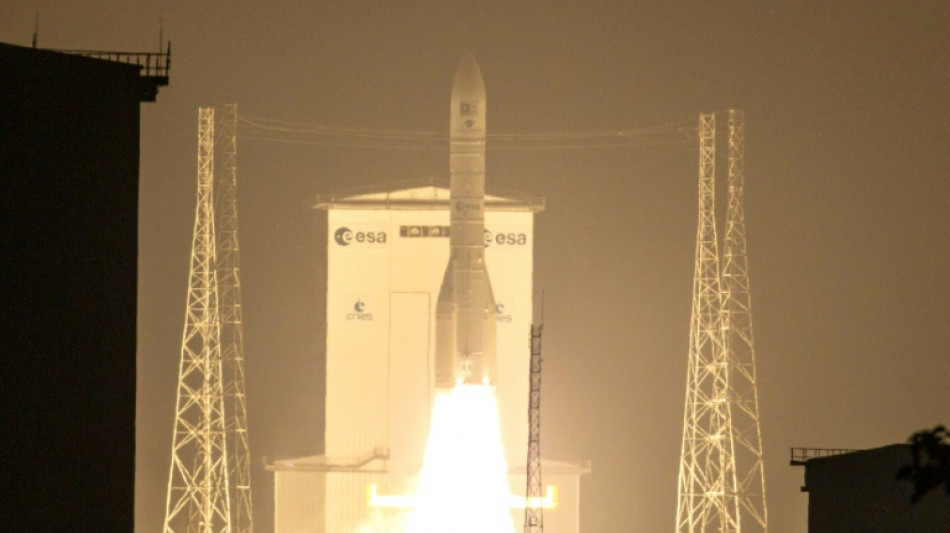
Europe's Ariane 6 rocket puts EU navigation satellites in orbit / Photo: Ronan LIETAR - AFP

 US House faces test on sweeping Russia sanctions bill

 British PM says to make 'difficult decisions' as inflation rises

 Global fuel price demos: a round-up

 Leverate Launches MCP for Traders to Connect AI Assistants With Trading Platforms

 MEXC Launches $1M "Discover Your Wall Street DNA" Campaign to Help Traders Find Their Market Fit

 Stocks edge higher ahead of US Fed rate call

 BASIS.pro Expands On-Chain Infrastructure with XDC Network Partnership and Zypher DAO as Auto Earn Goes Live

 Pickle-flavoured tart? AI inspires Japan's convenience stores

 EU chief hosts Canada's Carney in push to 'deepen' alliance

 Meta chief pushes back on AI slowdown calls

 US Fed to deliver rate decision with markets betting on hike

 Sanders, Bannon warn of AI dangers in rare US left-right alignment

 Empty benches as schools reopen in Venezuela's quake-hit Guaira

 Tiny English village holds 'independence' vote over asylum seeker housing

 US Treasury chief says to meet Chinese counterpart at weekend

 BingX Evolves into a Multi-Asset Trading Platform, Connecting Users to Global Opportunities

 International Trading Institute Expands Professional Trader Development Beyond the Master’s in Trading

 Lake Energy Secures $80 Million for U.S. Renewable Energy Expansion

 Stocks drop, oil climbs and Treasury yields hit 19-year high

 SkySail Strategies Outperforms Wall Street's 30-Year Risk Standard With Proprietary AI Inference Model

 Just add fish: Scientists pursue more rice, less disease in Senegal paddies

 Belgium completes outer structure of offshore energy island

 China retail sales growth weakens further in August
 In Kashmir, lake weeds mix with traditional art
 'Widow's Bay' and 'The Pitt' take key Emmy awards

Europe's new Ariane 6 rocket successfully placed two satellites into orbit to join the EU's rival to the GPS navigation system on Wednesday after the mission blasted off from French Guiana.
It was the fourth commercial mission of the Ariane 6 launch system since the long-delayed single-use rockets came into service last year.
The rocket launched into cloudy skies from Europe's spaceport in Kourou on the northeastern coast of South America at 2:01 am local time (0501 GMT).
It was carrying two more satellites of the European Union's Galileo programme, a global navigation satellite system that aims to make the bloc less dependent on the US's Global Positioning System (GPS).
Applause rang out at the spaceport minutes before 7:00 am local time (1000 GMT) as it was confirmed that the satellites had been successfully deployed into orbit 23, 000 kilometres (14,000 miles) above Earth's surface.
They will bring to 34 the number of Galileo satellites in orbit.
This addition will also "improve the robustness of the Galileo system by adding spares to the constellation to guarantee the system can provide 24/7 navigation to billions of users", according to the European Space Agency (ESA) which oversees the programme.
According to the EU, Galileo is four times more accurate than GPS, providing navigation accuracy of up to one metre.
The "successful" launch also reinforces "Europe's resilience and autonomy in space", the ESA said on X.
- Reusable rockets wanted -
Previous Galileo satellites were primarily launched by Ariane 5 and Russian Soyuz rockets from Kourou.
After Russia's invasion of Ukraine, Europe halted space cooperation with Moscow.
The loss of Russia's Soyuz rockets -- and repeated delays to Ariane 6 -- left Europe without an independent way to blast missions into space for several months.
Before Ariane 6's first commercial flight in March this year, the ESA resorted to contracting billionaire Elon Musk's SpaceX to launch two Galileo satellites in September 2024.
Ariane 6 also blasted a weather satellite into orbit in August followed by a satellite for the EU's observation programme Copernicus last month.
Arianespace, the operator of the rocket system, in September reduced by one the number of commercial launches on Ariane 6 this year, vowing to roughly double its number of missions in 2026.
The next mission, planned for the first quarter of 2026, will be the first to use a four-booster version of Ariane 6, rather than the current two.
It is scheduled to launch 34 satellites for the constellation of billionaire Jeff Bezos's Amazon. The constellation, formerly known as Project Kuiper, was recently renamed Amazon Leo.
SpaceX has risen to dominate the booming commercial launch industry by developing rockets that are reusable -- which Ariane 6 is not.
"We have to really catch up and make sure that we come to the market with a reusable launcher relatively fast," ESA director Josef Aschbacher told AFP in October.
Several European aerospace firms are now bidding to develop the system for the ESA.
M.P.Jacobs--CPN

