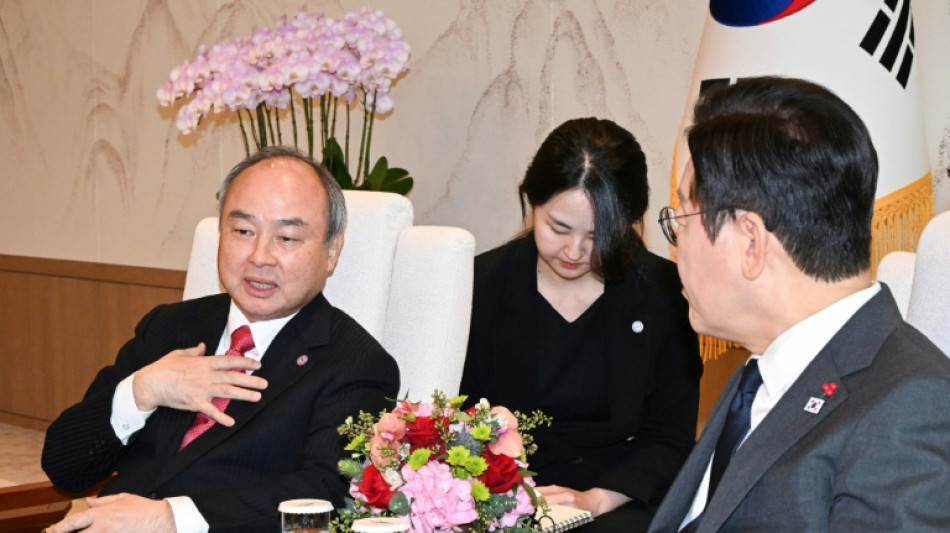
Softbank's Son says super AI could make humans like fish, win Nobel Prize / Photo: KIM Min-Hee - POOL/AFP

 Candidate for UN chief calls for AI regulation akin to nuclear weapons

 'We're losing control,' AI pioneer Yoshua Bengio tells AFP

 IR-MED and Dice Technologies Announce collaboration to Evaluate and Advance Pressure-Injury Prevention Platform in Japan

 Watts, Pitt, Cruz to light up Spain's top film festival

 Toogood Gold's Table Mountain Sits in the Shadow of a Nevada Gold Rush

 MEXC July–August Security Report: 38.66M USDT in Risk Funds Intercepted, Futures Insurance Fund Hits 792M USDT

 Emporio Armani names Dario Vitale new creative director

 EU to ban social media for under 13s, curb access until 15

 Wildfires push endangered Sumatran elephants to brink: Indonesian NGO

 Bank of Japan set to raise rates under pressure from inflation, US

 EU chief to unveil social media, gaming curbs for under-15s

 'Resident Evil' film brings video game's ethos to the big screen

 GA-ASI Mojave First UAS To Complete Battlefield Short Field Ops

 Sanders, Bannon warn of AI dangers in rare US left-right alignment

 Empty benches as schools reopen in Venezuela's quake-hit Guaira

 Tiny English village holds 'independence' vote over asylum seeker housing

 US Treasury chief says to meet Chinese counterpart at weekend

 BingX Evolves into a Multi-Asset Trading Platform, Connecting Users to Global Opportunities

 International Trading Institute Expands Professional Trader Development Beyond the Master’s in Trading

 Lake Energy Secures $80 Million for U.S. Renewable Energy Expansion

 Stocks drop, oil climbs and Treasury yields hit 19-year high

 SkySail Strategies Outperforms Wall Street's 30-Year Risk Standard With Proprietary AI Inference Model

 Just add fish: Scientists pursue more rice, less disease in Senegal paddies
 Belgium completes outer structure of offshore energy island
 China retail sales growth weakens further in August
Softbank CEO and AI investor Masayoshi Son said Friday that advanced artificial intelligence could surpass humans to the extent that "we become fish" and could even win the Nobel Prize in Literature.
Meeting South Korean President Lee Jae Myung in Seoul, Son, whose SoftBank is a major backer of ChatGPT maker OpenAI, described a future in which an advanced AI surpasses humans by a magnitude of 10,000.
"The difference between the human brain and the... goldfish in the pot -- the difference is 10,000 times," he said.
"But it's going to be different -- we will become fish, they (the AI) become like humans," he said.
"They will be 10,000 times smarter than us," he told President Lee, who had vowed to turn South Korea into an AI powerhouse.
Son compared the relationship between this artificial super intelligence (ASI) and humankind to relations between human beings and their pets.
"We try to make them happy... we try to live in peace with them," he said.
"We don't need to eat them... ASI does not eat protein. They don't need to eat us -- don't worry."
Lee responded laughing that he was "a bit concerned now".
He asked Son whether ASI could win a Nobel Prize in Literature, won last year by South Korean author Han Kang.
"I do not believe this is a desirable situation," Lee said.
"I think it will," Son replied.
ASI has been described as a hypothetical scenario when AI overtakes humans.
Scientists still consider it a long way off, but say a crucial first step -- artificial general intelligence (AGI), which would outperform humans across most tasks -- could arrive within a decade.
M.Mendoza--CPN