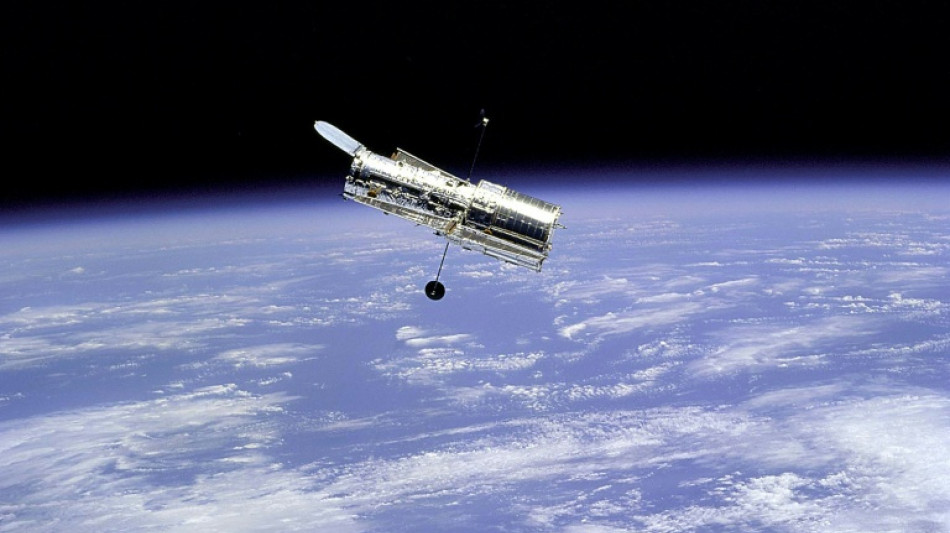
Satellite surge threatens space telescopes, astronomers warn / Photo: NASA - NASA/AFP

 US House faces test on sweeping Russia sanctions bill

 British PM says to make 'difficult decisions' as inflation rises

 Global fuel price demos: a round-up

 Leverate Launches MCP for Traders to Connect AI Assistants With Trading Platforms

 MEXC Launches $1M "Discover Your Wall Street DNA" Campaign to Help Traders Find Their Market Fit

 Stocks edge higher ahead of US Fed rate call

 BASIS.pro Expands On-Chain Infrastructure with XDC Network Partnership and Zypher DAO as Auto Earn Goes Live

 Pickle-flavoured tart? AI inspires Japan's convenience stores

 EU chief hosts Canada's Carney in push to 'deepen' alliance

 Meta chief pushes back on AI slowdown calls

 US Fed to deliver rate decision with markets betting on hike

 Sanders, Bannon warn of AI dangers in rare US left-right alignment

 Empty benches as schools reopen in Venezuela's quake-hit Guaira

 Tiny English village holds 'independence' vote over asylum seeker housing

 US Treasury chief says to meet Chinese counterpart at weekend

 BingX Evolves into a Multi-Asset Trading Platform, Connecting Users to Global Opportunities

 International Trading Institute Expands Professional Trader Development Beyond the Master’s in Trading

 Lake Energy Secures $80 Million for U.S. Renewable Energy Expansion

 Stocks drop, oil climbs and Treasury yields hit 19-year high

 SkySail Strategies Outperforms Wall Street's 30-Year Risk Standard With Proprietary AI Inference Model

 Just add fish: Scientists pursue more rice, less disease in Senegal paddies

 Belgium completes outer structure of offshore energy island

 China retail sales growth weakens further in August
 In Kashmir, lake weeds mix with traditional art

 'Widow's Bay' and 'The Pitt' take key Emmy awards

Light from the half a million satellites that humanity is planning to launch into Earth's orbit in the coming years could contaminate almost all the images taken by space telescopes, NASA astronomers warned Wednesday.
Scientists have already been sounding the alarm about how light pollution from increasingly massive satellites threaten the future of dark skies seen from the ground.
Now, a study published in the journal Nature is the first to estimate how the immense number of satellites planned for the future could stray into the view of nearby telescopes attempting to probe the universe.
Since 2019, the number of satellites in low-Earth orbit has skyrocketed from roughly 2,000 to 15,000, according to the study -- many of them part of billionaire Elon Musk's Starlink internet constellation.
But that is a drop in the bucket compared to what is coming.
If all of the plans currently filed to regulators launch into space, there will be 560,000 satellites orbiting Earth by the end of the 2030s, the study said.
This poses "a very severe threat" to space telescopes, the study's lead author, Alejandro Borlaff of the NASA Ames Research Center in California, told AFP.
For the research, the astronomers simulated how the 560,000 satellites would impact four space telescopes.
Reflected light from the satellites would affect 96 percent of all images taken by NASA's SPHEREx telescope, the European Space Agency's planned ARRAKIHS telescope and China's planned Xuntian telescope, the study found.
The Hubble Space Telescope, which is less likely to snap a satellite as it takes in a narrower view of the universe, would have a third of its images tainted.
This could have an impact on all sorts of scientific endeavours.
"Imagine that you are trying to find asteroids that may be potentially harmful for Earth," Borlaff said.
An asteroid streaking through the sky "looks exactly like a satellite... it's really hard to figure out which one is the bad one," he added.
Some space telescopes, such as the famous James Webb, are unaffected because they are hovering at a stable spot 1.5 million kilometres (932,000 miles) from Earth called the second Lagrange point.
- 'As bright as the brightest star' -
One solution could be to deploy satellites at lower altitudes than space telescopes -- but that could potentially deplete Earth's ozone layer, the study said.
The most straightforward solution may just be to launch fewer satellites.
But competition from rival satellite internet companies -- and the surging needs of the artificial intelligence boom -- make that unlikely.
Nearly three-quarters of the satellites currently in orbit are part of Musk's Starlink network, Borlaff said.
But Starlink is expected to represent just 10 percent of all satellites in a couple of decades as competition blasts off, according to the study.
For now, companies could help by providing the location, orientation and colour of their satellites to those operating space telescopes, Borlaff said.
Another problem is that satellites are getting much bigger.
To the naked eye, satellites that are 100 square metres (more than 1,000 square feet) in size are "as bright as the brightest star that you can see in the sky", Borlaff said.
However, to handle AI's data requirements, there are now plans to build ones 3,000 square metres wide.
These giants could be "as bright as a planet", Borlaff added.
H.Meyer--CPN

