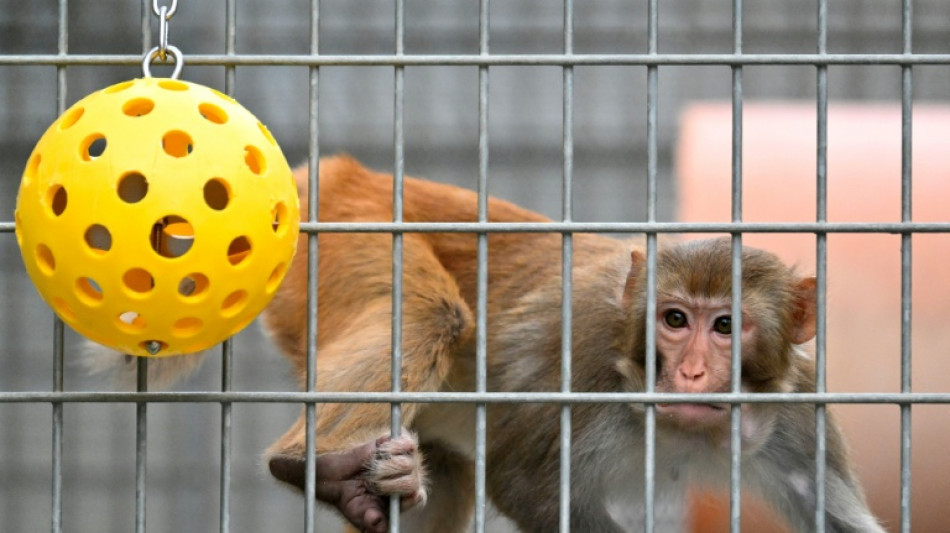
US medical agency will scale back testing on monkeys / Photo: Christophe SIMON - AFP/File

 US House faces test on sweeping Russia sanctions bill

 British PM says to make 'difficult decisions' as inflation rises

 Global fuel price demos: a round-up

 Leverate Launches MCP for Traders to Connect AI Assistants With Trading Platforms

 MEXC Launches $1M "Discover Your Wall Street DNA" Campaign to Help Traders Find Their Market Fit

 Stocks edge higher ahead of US Fed rate call

 BASIS.pro Expands On-Chain Infrastructure with XDC Network Partnership and Zypher DAO as Auto Earn Goes Live

 Pickle-flavoured tart? AI inspires Japan's convenience stores

 EU chief hosts Canada's Carney in push to 'deepen' alliance

 Meta chief pushes back on AI slowdown calls

 US Fed to deliver rate decision with markets betting on hike

 Sanders, Bannon warn of AI dangers in rare US left-right alignment

 Empty benches as schools reopen in Venezuela's quake-hit Guaira

 Tiny English village holds 'independence' vote over asylum seeker housing

 US Treasury chief says to meet Chinese counterpart at weekend

 BingX Evolves into a Multi-Asset Trading Platform, Connecting Users to Global Opportunities

 International Trading Institute Expands Professional Trader Development Beyond the Master’s in Trading

 Lake Energy Secures $80 Million for U.S. Renewable Energy Expansion

 Stocks drop, oil climbs and Treasury yields hit 19-year high

 SkySail Strategies Outperforms Wall Street's 30-Year Risk Standard With Proprietary AI Inference Model

 Just add fish: Scientists pursue more rice, less disease in Senegal paddies

 Belgium completes outer structure of offshore energy island

 China retail sales growth weakens further in August

 In Kashmir, lake weeds mix with traditional art

 'Widow's Bay' and 'The Pitt' take key Emmy awards

The United States will scale back certain drug-safety testing requirements on monkeys, federal regulators said Tuesday, marking the latest step by President Donald Trump's administration to limit the use of animals in research.
Under new draft guidance from the Food and Drug Administration, computer models, lab-grown mini-organs, and human studies will replace the use of non-human primates in testing monoclonal antibodies -- lab-engineered proteins used to treat cancers, autoimmune conditions and other diseases.
"We are delivering on our roadmap commitment to eliminate animal testing requirements in drug evaluation and our promise to accelerate cures and meaningful treatments for Americans," FDA Commissioner Marty Makary said in a statement.
The statement added that typical nonclinical programs involving monoclonal antibodies could include more than 100 macaque monkeys -- apes are no longer used in any invasive research in the US -- yet often do not yield human-approved treatments.
The move was welcomed by animal-advocacy groups.
Zaher Nahle, a former animal researcher who is now the senior scientific advisor for nonprofit Center for a Humane Economy, told AFP the move was an "important step."
"These primates are not reliable in terms of predicting the toxicity, so you can get at least equal or better results in terms of your accuracy in predicting toxicology using other approaches," he added.
What's more, he noted, studies show that more than 90 percent of drugs deemed safe and effective in animals fail to win approval for human use.
The FDA's announcement follows a report in the journal Science last month that the Centers for Disease Control and Prevention would close its primate labs.
It "moves us one step closer to wiping out the federal government's wasteful monkey business," Justin Goodman of White Coat Waste Project told AFP.
But the National Institutes of Health -- the country's primary biomedical research agency -- remains a notable "outlier," he added. According to public data, 7,700 primates are confined in federal government labs and breeding facilities, of which 6,700 are at NIH.
Advocates of animal research have pushed back.
"Poorly planned transitions -- including premature study termination -- can place animals at serious risk and may undermine years of scientific investment intended to strengthen public health preparedness and advance lifesaving medical progress," advocacy group Americans for Medical Progress said after the CDC news was reported.
Proponents of animal testing say the research has been indispensable for major medical advances, including vaccines for diphtheria, yellow fever, measles and Covid-19.
Critics counter that decades-old laws have created regulatory lock-in, that publication incentives reward animal studies in top journals, and that a lucrative "animal-industrial complex" has helped entrench the status quo.
J.Bondarev--CPN

