Naively brilliant: Serbia's world-famous village painters / Photo: Andrej ISAKOVIC - AFP

 Candidate for UN chief calls for AI regulation akin to nuclear weapons

 'We're losing control,' AI pioneer Yoshua Bengio tells AFP

 IR-MED and Dice Technologies Announce collaboration to Evaluate and Advance Pressure-Injury Prevention Platform in Japan

 Watts, Pitt, Cruz to light up Spain's top film festival

 Toogood Gold's Table Mountain Sits in the Shadow of a Nevada Gold Rush

 MEXC July–August Security Report: 38.66M USDT in Risk Funds Intercepted, Futures Insurance Fund Hits 792M USDT

 Emporio Armani names Dario Vitale new creative director

 EU to ban social media for under 13s, curb access until 15

 Wildfires push endangered Sumatran elephants to brink: Indonesian NGO

 Bank of Japan set to raise rates under pressure from inflation, US

 EU chief to unveil social media, gaming curbs for under-15s

 'Resident Evil' film brings video game's ethos to the big screen

 GA-ASI Mojave First UAS To Complete Battlefield Short Field Ops

 Sanders, Bannon warn of AI dangers in rare US left-right alignment

 Empty benches as schools reopen in Venezuela's quake-hit Guaira

 Tiny English village holds 'independence' vote over asylum seeker housing

 US Treasury chief says to meet Chinese counterpart at weekend

 BingX Evolves into a Multi-Asset Trading Platform, Connecting Users to Global Opportunities

 International Trading Institute Expands Professional Trader Development Beyond the Master’s in Trading

 Lake Energy Secures $80 Million for U.S. Renewable Energy Expansion

 Stocks drop, oil climbs and Treasury yields hit 19-year high

 SkySail Strategies Outperforms Wall Street's 30-Year Risk Standard With Proprietary AI Inference Model

 Just add fish: Scientists pursue more rice, less disease in Senegal paddies

 Belgium completes outer structure of offshore energy island

 China retail sales growth weakens further in August

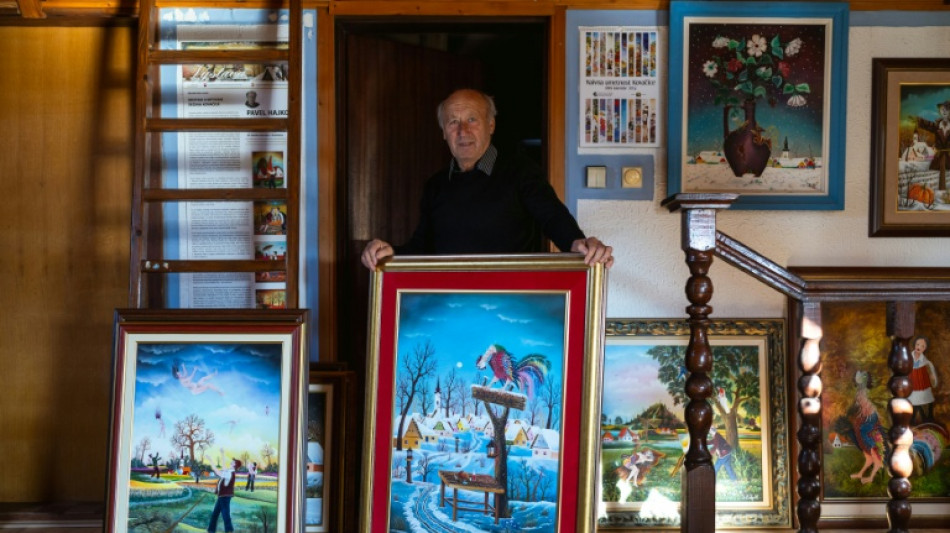
Pavel Hajko never tires of painting roosters. Inside his home studio in Kovacica -- a sleepy town in northern Serbia famous for its style of naive art -- the brightly coloured creatures cover the walls.
"From the beginning, even in elementary school, I painted only roosters," the 73-year-old artist told AFP, as he worked on an unfinished canvas in the afternoon light.
Outside, a cockerel obligingly crowed.
Hajko and his fellow artists have become world-famous for their childlike renderings of the traditional village life of the Slovak minority in the flatlands of the Banat region, north of the Danube.
"In naive painting, everything is done as you learn. It's not a school where the colour has to be this or that... we can put any colour," Hajko said.
The naive painting movement of self-taught artists first emerged in the 1930s, depicting everything from harvests to the traditional dress of the region.
Last year UNESCO recognised the Kovacica painters on its list of Intangible Cultural Heritage of Humanity, a milestone for a movement shaped by unschooled artists.
- Preserving identity -
In the leafy centre of town, Pavel Babka runs a gallery showing the art, which he said is key to preserving the traditions of the ethnic Slovaks who settled in the Vojvodina region more than two centuries ago.
"I think the Slovak minority preserves its identity in this way, by painting what the previous generation did," Babka said.
The style quickly spread to other Slovak communities, and the first major exhibitions of work began in the 1950s.
But Babka said its beginnings lie in the folk art of the region, from the decoration of everyday objects to the murals in homes, mostly painted by women.
A key figure in the foundation of the style is Zuzana Chalupova, who Babka credits with giving naive painting its bold colours.
"Today, more women paint than men. And what women paint is more authentic than men," he said.
Across the walls of his gallery, Babka traces the symbols and signature "handwriting" of each artist through the decades.
"They paint life here, but they have not forgotten where they come from," he said.
The curator sees a discernible style through the early days of peasant painters in the Austro-Hungarian empire through the movement's boom in 1970s Yugoslavia, and even in today's crop of artists.
"The youngest generation paints according to the stories of their grandparents," he said.
- 'There must be sincerity' -
But with UNESCO's recognition comes a new challenge -- the over-commercialisation of the art form, driven by tourists' tastes rather than authenticity.
"When we say Kovacica, it should evoke Kovacica," Babka said.
Since founding his gallery 35 years ago, he has helped promote the movement, and now urges painters to preserve their style and keep the region's Slovak culture at its core.
"There must be sincerity and no deception."
The Slovak minority accounted for less than one percent of Serbia's population in the 2022 census, with the vast majority living in the multiethnic northern Vojvodina region.
A 2024 study found the community has declined over the last three decades, partly due to its ageing population and migration to Slovakia.
- Global recognition -
For art historian Elenka Djuris, this makes preserving the paintings of the unique culture "tied to the area of Kovacica" all the more critical.
"In this way, we actually ensure the longevity of our identity, traditions and customs, especially in this time when traditions and customs are truly being lost, everything is becoming globalised," the 36-year-old academic said.
But Djuris hopes that global recognition of the movement's value will also spur renewed efforts to preserve it at home.
"Unfortunately, it often takes someone from outside to show us the wealth we have, and then we realise that our culture is truly valuable and worthy of attention."
C.Smith--CPN