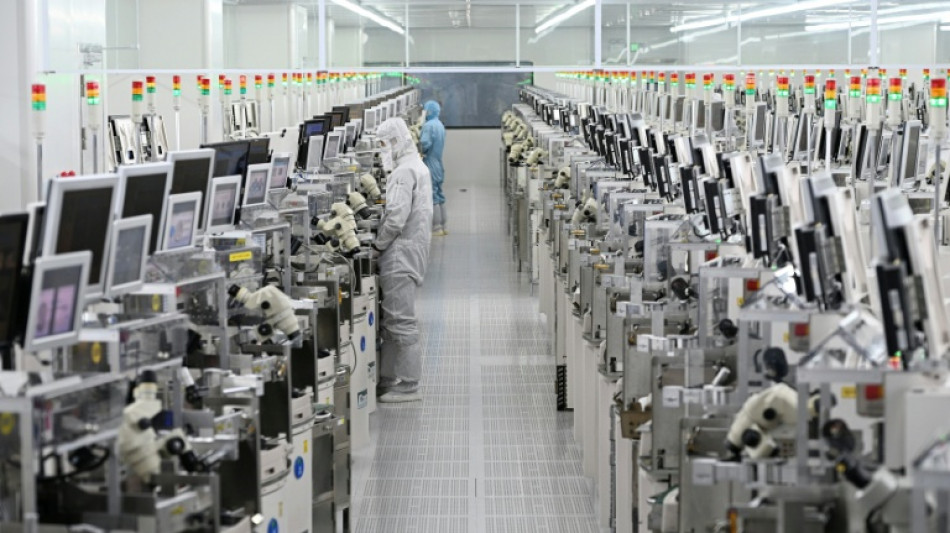
Memory chip crunch set to drive up smartphone prices / Photo: STR - AFP

 US House faces test on sweeping Russia sanctions bill

 British PM says to make 'difficult decisions' as inflation rises

 Global fuel price demos: a round-up

 Leverate Launches MCP for Traders to Connect AI Assistants With Trading Platforms

 MEXC Launches $1M "Discover Your Wall Street DNA" Campaign to Help Traders Find Their Market Fit

 Stocks edge higher ahead of US Fed rate call

 BASIS.pro Expands On-Chain Infrastructure with XDC Network Partnership and Zypher DAO as Auto Earn Goes Live

 Pickle-flavoured tart? AI inspires Japan's convenience stores

 EU chief hosts Canada's Carney in push to 'deepen' alliance

 Meta chief pushes back on AI slowdown calls

 US Fed to deliver rate decision with markets betting on hike

 Sanders, Bannon warn of AI dangers in rare US left-right alignment

 Empty benches as schools reopen in Venezuela's quake-hit Guaira

 Tiny English village holds 'independence' vote over asylum seeker housing

 US Treasury chief says to meet Chinese counterpart at weekend

 BingX Evolves into a Multi-Asset Trading Platform, Connecting Users to Global Opportunities

 International Trading Institute Expands Professional Trader Development Beyond the Master’s in Trading

 Lake Energy Secures $80 Million for U.S. Renewable Energy Expansion

 Stocks drop, oil climbs and Treasury yields hit 19-year high

 SkySail Strategies Outperforms Wall Street's 30-Year Risk Standard With Proprietary AI Inference Model

 Just add fish: Scientists pursue more rice, less disease in Senegal paddies

 Belgium completes outer structure of offshore energy island

 China retail sales growth weakens further in August

 In Kashmir, lake weeds mix with traditional art

 'Widow's Bay' and 'The Pitt' take key Emmy awards

Shoppers could face higher prices for phones, laptops and other gadgets next year, manufacturers and analysts warn, as AI data centres hoover up memory chips used in consumer electronics.
The world's biggest tech companies are ploughing head-spinningly huge sums into building the hardware that powers artificial intelligence tools like ChatGPT.
Their insatiable demand is snarling up a supply chain kept tight on purpose by chipmakers who are keen to avoid price drops that dent profits, experts say.
In 2026, supply chain pressure for memory chips "will be far greater than this year", Lu Weibing, president of Chinese electronics giant Xiaomi, said this week.
"Everyone will likely observe that retail prices for products will see a significant increase," he told an earnings call.
William Keating, head of semiconductor and tech consulting firm Ingenuity, expects the same.
"All companies that manufacture PCs, smartphones, servers etc will be impacted by the shortage," Keating told AFP.
"End result: consumers will pay more."
In high demand are key chips known as DRAM and storage components called NAND, which are found in everyday gadgets but are also needed to help process the vast amounts of data crunched by generative AI.
That's driving up memory chip prices, which in turn is turbocharging revenue for the firms that produce them such as South Korea's Samsung and SK hynix, and Micron and SanDisk in the United States.
"AI-related server demand keeps growing, and this demand significantly exceeds industry supply," Kim Jae-june of Samsung Electronics said last month.
- 'Keep prices high' -
Samsung said Sunday that it plans to build a new semiconductor plant in South Korea to meet the soaring demand, while SK hynix recently reported its best-ever quarterly performance, "driven by the full-scale rise in prices of DRAM and NAND".
Industry analysts TrendForce have lowered their 2026 global production forecasts for smartphones and notebook laptops.
"The memory industry has begun a robust upward pricing cycle," which "forces downstream brands to hike retail prices," TrendForce said.
Cars may also be affected, although Keating noted that a smaller portion of their tech relies on memory chips.
Last week China's largest contract chipmaker SMIC said customers were hesitant to place orders owing to uncertainty over how many phones, cars, or other products the memory chip industry can supply.
The cause of the shortage is two-fold.
AI-driven demand is greater than anticipated, but memory chip makers have also been "drastically cutting" spending on expanding capacity in recent years, Keating explained.
"Keep capacity tight, keep prices high is basically their mantra," he said.
"They've done this deliberately to ensure that there's no repeat of the most recent memory price collapse, which cost the memory makers tens of billions in losses."
Price jumps for memory chips "are huge and the trend is continuing", said Stephen Wu, founder of the Carthage Capital investment fund.
"Consumers and enterprises should expect higher memory prices, longer lead times, and more take-or-pay contracts through at least early 2026," Wu said.
burs-kaf/dan
P.Kolisnyk--CPN

