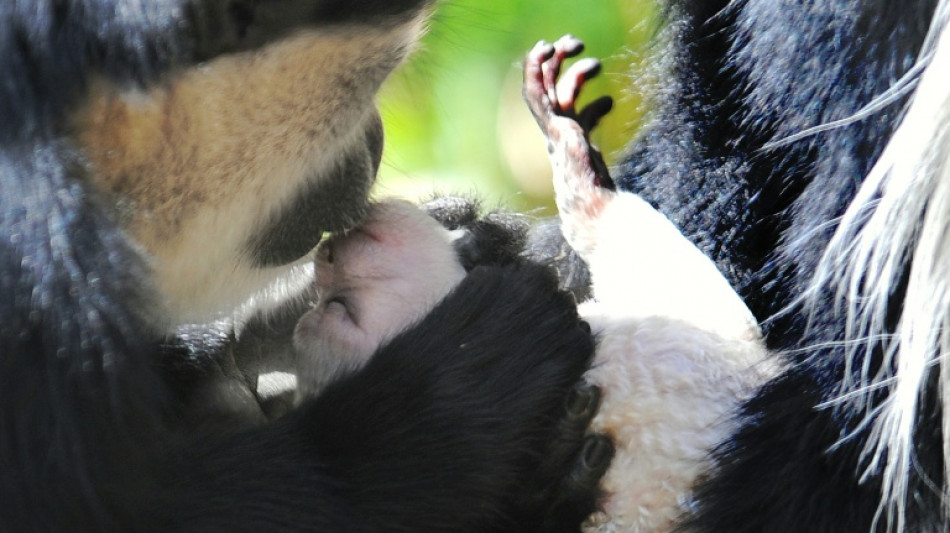
Monkey business: Neanderthals and ancient apes likely kissed too / Photo: WILLIAM WEST - AFP

 Candidate for UN chief calls for AI regulation akin to nuclear weapons

 'We're losing control,' AI pioneer Yoshua Bengio tells AFP

 IR-MED and Dice Technologies Announce collaboration to Evaluate and Advance Pressure-Injury Prevention Platform in Japan

 Watts, Pitt, Cruz to light up Spain's top film festival

 Toogood Gold's Table Mountain Sits in the Shadow of a Nevada Gold Rush

 MEXC July–August Security Report: 38.66M USDT in Risk Funds Intercepted, Futures Insurance Fund Hits 792M USDT

 Emporio Armani names Dario Vitale new creative director

 EU to ban social media for under 13s, curb access until 15

 Wildfires push endangered Sumatran elephants to brink: Indonesian NGO

 Bank of Japan set to raise rates under pressure from inflation, US

 EU chief to unveil social media, gaming curbs for under-15s

 'Resident Evil' film brings video game's ethos to the big screen

 GA-ASI Mojave First UAS To Complete Battlefield Short Field Ops

 Sanders, Bannon warn of AI dangers in rare US left-right alignment

 Empty benches as schools reopen in Venezuela's quake-hit Guaira

 Tiny English village holds 'independence' vote over asylum seeker housing

 US Treasury chief says to meet Chinese counterpart at weekend

 BingX Evolves into a Multi-Asset Trading Platform, Connecting Users to Global Opportunities

 International Trading Institute Expands Professional Trader Development Beyond the Master’s in Trading

 Lake Energy Secures $80 Million for U.S. Renewable Energy Expansion

 Stocks drop, oil climbs and Treasury yields hit 19-year high

 SkySail Strategies Outperforms Wall Street's 30-Year Risk Standard With Proprietary AI Inference Model

 Just add fish: Scientists pursue more rice, less disease in Senegal paddies

 Belgium completes outer structure of offshore energy island
 China retail sales growth weakens further in August
Scientists have found evidence suggesting that kissing dates back up to 21 million years and that our ape ancestors and Neanderthals likely locked lips, research published Wednesday said.
Kissing has long presented an evolutionary puzzle to scientists as it appears to carry high risks such as disease transmission while having no obvious reproductive or survival advantages.
But the new study found that the practice has evolved over millions of years, and that our extinct human relatives, the Neanderthals, could have shared a peck to stay warm in the ice age.
The research led by scientists at the University of Oxford was published in the journal "Evolution and Human Behaviour".
"This is the first time anyone has taken a broad evolutionary lens to examine kissing," said co-author Matilda Brindle, an evolutionary biologist at the University of Oxford.
"Our findings add to a growing body of work highlighting the remarkable diversity of sexual behaviours exhibited by our primate cousins."
For the purpose of the study, researchers defined kissing as a "non-aggressive, mouth-to-mouth contact that did not involve food transfer".
"The results indicate that kissing is an ancient trait in the large apes," evolving in primate ancestors from 17 to 21 million years ago, according to an Oxford University statement.
"Kissing was retained over the course of evolution and is still present in most of the large apes," it added.
The researchers first collected data about modern primates that have been observed kissing, including chimpanzees, bonobos and orangutans.
Then, treating kissing as a "trait", they mapped it to the family tree of primates. By stimulating different evolutionary scenarios, they estimated the probability that ancient ancestors also engaged in kissing.
Previous studies have found that humans and Neanderthals had shared oral microbes through saliva transfer, suggesting that the species had kissed each other.
H.Müller--CPN