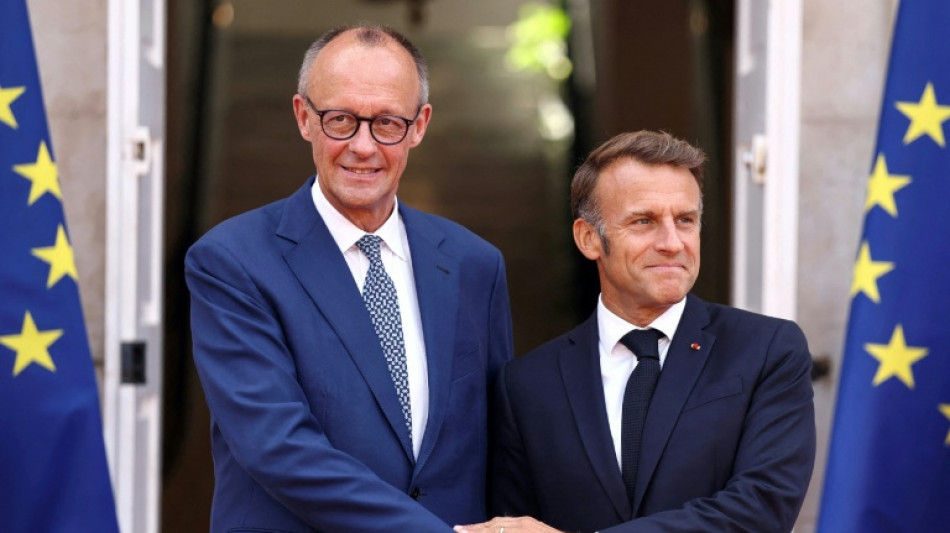
Europe looks to catch up with US in AI race at German digital summit / Photo: Manon Cruz - POOL/AFP

 Candidate for UN chief calls for AI regulation akin to nuclear weapons

 'We're losing control,' AI pioneer Yoshua Bengio tells AFP

 IR-MED and Dice Technologies Announce collaboration to Evaluate and Advance Pressure-Injury Prevention Platform in Japan

 Watts, Pitt, Cruz to light up Spain's top film festival

 Toogood Gold's Table Mountain Sits in the Shadow of a Nevada Gold Rush

 MEXC July–August Security Report: 38.66M USDT in Risk Funds Intercepted, Futures Insurance Fund Hits 792M USDT

 Emporio Armani names Dario Vitale new creative director

 EU to ban social media for under 13s, curb access until 15

 Wildfires push endangered Sumatran elephants to brink: Indonesian NGO

 Bank of Japan set to raise rates under pressure from inflation, US

 EU chief to unveil social media, gaming curbs for under-15s

 'Resident Evil' film brings video game's ethos to the big screen

 GA-ASI Mojave First UAS To Complete Battlefield Short Field Ops

 Sanders, Bannon warn of AI dangers in rare US left-right alignment

 Empty benches as schools reopen in Venezuela's quake-hit Guaira

 Tiny English village holds 'independence' vote over asylum seeker housing

 US Treasury chief says to meet Chinese counterpart at weekend

 BingX Evolves into a Multi-Asset Trading Platform, Connecting Users to Global Opportunities

 International Trading Institute Expands Professional Trader Development Beyond the Master’s in Trading

 Lake Energy Secures $80 Million for U.S. Renewable Energy Expansion

 Stocks drop, oil climbs and Treasury yields hit 19-year high

 SkySail Strategies Outperforms Wall Street's 30-Year Risk Standard With Proprietary AI Inference Model

 Just add fish: Scientists pursue more rice, less disease in Senegal paddies
 Belgium completes outer structure of offshore energy island

 China retail sales growth weakens further in August
Europe must strive to lead in the AI race, top officials urged Tuesday at a summit focused on propelling the region to the forefront of the digital era and reducing its reliance on US tech titans.
As the Berlin gathering got underway, the EU also announced that Amazon and Microsoft cloud services could face stricter competition rules in the bloc as Brussels probes their market power.
The summit brought together leaders from Europe's tech sector, and was to be addressed by German Chancellor Friedrich Merz and French President Emmanuel Macron later Tuesday.
"Europe's goal is very simple: we want to lead, not follow, on AI and frontier technologies," European Commission digital chief Henna Virkkunen told the opening of the event.
"We have the market, we have the talent, we have the ambition. Now we must deliver scale in investment, innovation and uptake."
Europe is responding to calls to blaze its own digital path and take steps to catch up in the AI race against China and the United States.
Concerns about US tech dominance have also grown as ties with Washington become increasingly uneasy under the "America First" administration of Donald Trump.
Despite the US-Europe tensions, a senior official from the French presidency said the summit was not about "confrontation" with the United States or even China.
Rather it is about "how we protect our core sovereignty and what rules need to be established, especially at the European level", said the official.
- 'Become a creator' -
Also speaking at the opening, German Digital Minister Karsten Wildberger said that "for too long, Europe has been mainly a customer and a bystander.
"Now we must become a creator".
But the continent is "not moving fast enough," he said, adding that "regulation is too complex and infrastructure is still behind".
His comments came a day before the EU was set to propose a rollback of its rules on AI and data protection -- a move welcomed by businesses, but criticised by privacy advocates.
Virkkunen also announced the move against Amazon and Microsoft cloud services in Berlin, saying that twin investigations aim to assess whether the tech giants "should be designated as the gatekeepers on cloud computing".
The European Commission, the bloc's digital regulator, said it will investigate whether Amazon Web Services (AWS) and Microsoft's Azure should come under the scope of the Digital Markets Act (DMA).
Efforts to build up "sovereign" EU cloud computing capabilities, which proponents argue would better protect Europeans' data, were also being discussed in Berlin.
Digital ministers from across Europe, as well as CEOs of tech firms like France's Mistral and Germany's SAP, were attending, and announcements on new digital initiatives were expected.
- 'Protect sovereignty' -
After giving their keynote addresses, Merz and Macron were to dine with British Prime Minister Keir Starmer.
As well as worrying about US dependence, Europe has long-standing concerns about reliance on firms in China and other parts of Asia for hardware, from semiconductors to laptop components.
But the continent faces an uphill battle to switch supply chains from foreign companies in the digital realm.
The region is struggling after a period of prolonged economic weakness and its tech firms remain far smaller than their US rivals.
As of last year, the continent's data centres -- crucial for AI -- had computing capacity of just 16 gigawatts, compared with 48 in the US and 38 in China, according to a recent study by German digital business association Bitkom.
And recent investment announcements in Germany -- billions of dollars from Google and a tie-up between US chip juggernaut Nvidia and Deutsche Telekom for an industrial AI hub -- have only highlighted the continued dependence on American tech, critics say.
J.Bondarev--CPN