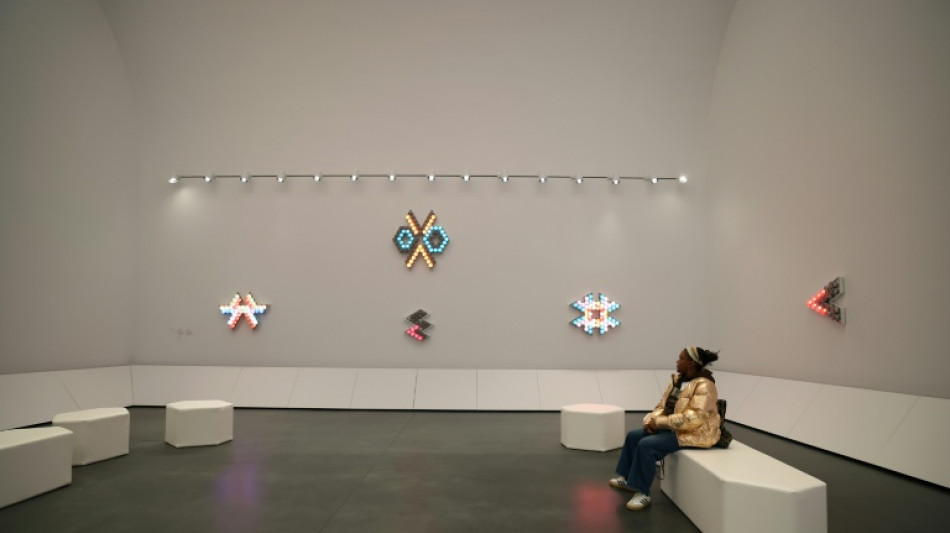
Rebooted Harlem museum celebrates rise of Black art / Photo: TIMOTHY A. CLARY - AFP

 Candidate for UN chief calls for AI regulation akin to nuclear weapons

 'We're losing control,' AI pioneer Yoshua Bengio tells AFP

 IR-MED and Dice Technologies Announce collaboration to Evaluate and Advance Pressure-Injury Prevention Platform in Japan

 Watts, Pitt, Cruz to light up Spain's top film festival

 Toogood Gold's Table Mountain Sits in the Shadow of a Nevada Gold Rush

 MEXC July–August Security Report: 38.66M USDT in Risk Funds Intercepted, Futures Insurance Fund Hits 792M USDT

 Emporio Armani names Dario Vitale new creative director

 EU to ban social media for under 13s, curb access until 15

 Wildfires push endangered Sumatran elephants to brink: Indonesian NGO

 Bank of Japan set to raise rates under pressure from inflation, US

 EU chief to unveil social media, gaming curbs for under-15s

 'Resident Evil' film brings video game's ethos to the big screen

 GA-ASI Mojave First UAS To Complete Battlefield Short Field Ops

 Sanders, Bannon warn of AI dangers in rare US left-right alignment

 Empty benches as schools reopen in Venezuela's quake-hit Guaira

 Tiny English village holds 'independence' vote over asylum seeker housing

 US Treasury chief says to meet Chinese counterpart at weekend

 BingX Evolves into a Multi-Asset Trading Platform, Connecting Users to Global Opportunities

 International Trading Institute Expands Professional Trader Development Beyond the Master’s in Trading

 Lake Energy Secures $80 Million for U.S. Renewable Energy Expansion

 Stocks drop, oil climbs and Treasury yields hit 19-year high

 SkySail Strategies Outperforms Wall Street's 30-Year Risk Standard With Proprietary AI Inference Model

 Just add fish: Scientists pursue more rice, less disease in Senegal paddies
 Belgium completes outer structure of offshore energy island

 China retail sales growth weakens further in August
As the Studio Museum reopens this weekend in its gleaming new building, New York's premier institution for Black art finds itself looking back and looking forward at the same time.
Colorful signs featuring permanent works have sprouted near the museum's home in Harlem, a center point in Black life and imagination in America for more than a century.
The museum, closed for the more than seven-year project, has commissioned new works to commemorate the reboot, which features expanded studios for the institution's artists-in-residence program.
But the 57-year-old museum is also hearkening back to its roots with a retrospective of the late Tom Lloyd, whose electronically programmed wall sculptures anticipated today's digital age.
Some of the same pieces were hung in the museum's inaugural 1968 show back when works by artists of African descent were mostly absent from New York's leading museums.
Today's art scene is very different.
Rashid Johnson, Amy Sherald and others are regularly showcased in shows at the Guggenheim, Whitney and other nameplate New York museums, which have also hosted retrospectives belatedly recognizing Black movements.
"In the time of the museum's life, we have seen this incredible trajectory and some of that is a result of the work that the museum did in its establishment and its early years," said Studio Museum director Thelma Golden, who oversaw a more than $300 million drive to finance a teardown and newbuild project that cements the museum's ties to Harlem.
"The aperture opens, but even with that, we still believe deeply in the work that continues to need to be done."
- 'Truly current work' -
The museum's history is laid out in photos of the 1968 groundbreaking, and there are posters of jazz nights, "Uptown Friday" gatherings, high school programs and of shows such as a retrospective of James Van Der Zee, a famed photographer during the Harlem Renaissance.
The founders' ambitions included creating a place distinct from New York establishments like the Museum of Modern Art.
The Studio Museum will present "truly current work," founders wrote in 1966. The work "could turn out to be a flash in the pan or could conceivably begin an entire new school or new direction in art."
Backers also sought to redefine Harlem, "which is all too often equated with slums, violence and other evils," and to deepen the commitment of supporters -- some white -- to "make New York City a united city rather than one which is currently divided by an invisible Berlin wall."
Key turning points included 1981, when the Studio Museum broke ground at its current address at 144 West 125th Street.
Another shift came after Golden joined in 2000, when the mission statement was expanded beyond US-born creators to artists of African descent "locally, nationally and internationally."
- Signature works -
That broadened scope is boldly expressed on the building's exterior with a red, black and green flag by David Hammons inspired by the Pan-African flag of the 1920s associated with activist Marcus Garvey.
Another signature work is Houston Conwill's "The Joyful Mysteries," containing statements by seven prominent Black Americans written for future generations. The time capsules will be opened in September 2034, 50 years after their creation.
The new edifice itself nods to Harlem's architectural vernacular, with a mass of geometries in gray concrete and glass. The building has received rapturous reviews, and this weekend offers the public a first look.
Golden described the site as aiming to "redefine what a museum can be in its space and content."
She credited her predecessors, not all of whom lived to see Black art achieve mainstream acceptance.
"I am well aware that they did not get to see the fruits of the labor," Golden told AFP. "The inheritance I have from them is that they believed so deeply that that belief carries from '68 to this moment."
Y.Uduike--CPN