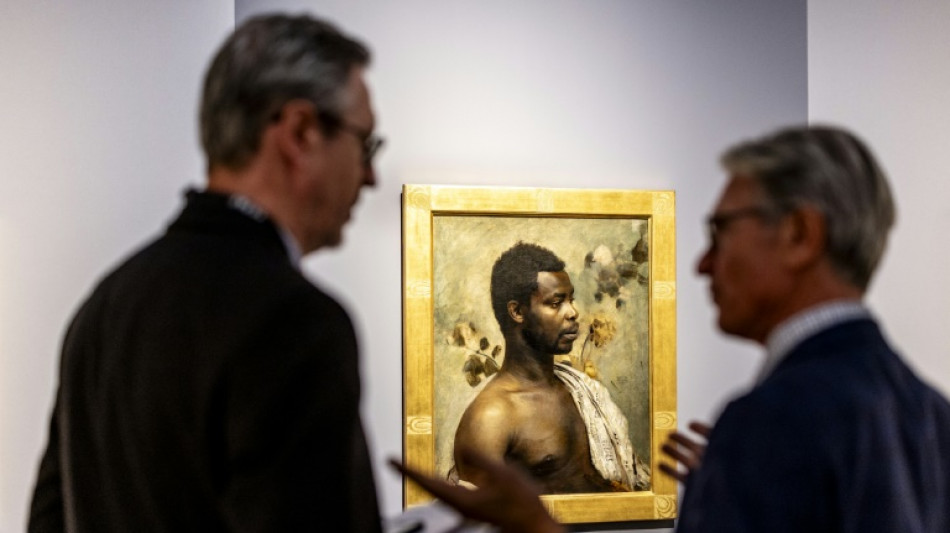
'Black Klimt' steps out of shadows and into political tug-of-war / Photo: Marcel van Hoorn - AFP

 Candidate for UN chief calls for AI regulation akin to nuclear weapons

 'We're losing control,' AI pioneer Yoshua Bengio tells AFP

 IR-MED and Dice Technologies Announce collaboration to Evaluate and Advance Pressure-Injury Prevention Platform in Japan

 Watts, Pitt, Cruz to light up Spain's top film festival

 Toogood Gold's Table Mountain Sits in the Shadow of a Nevada Gold Rush

 MEXC July–August Security Report: 38.66M USDT in Risk Funds Intercepted, Futures Insurance Fund Hits 792M USDT

 Emporio Armani names Dario Vitale new creative director

 EU to ban social media for under 13s, curb access until 15

 Wildfires push endangered Sumatran elephants to brink: Indonesian NGO

 Bank of Japan set to raise rates under pressure from inflation, US

 EU chief to unveil social media, gaming curbs for under-15s

 'Resident Evil' film brings video game's ethos to the big screen

 GA-ASI Mojave First UAS To Complete Battlefield Short Field Ops

 Sanders, Bannon warn of AI dangers in rare US left-right alignment

 Empty benches as schools reopen in Venezuela's quake-hit Guaira

 Tiny English village holds 'independence' vote over asylum seeker housing

 US Treasury chief says to meet Chinese counterpart at weekend

 BingX Evolves into a Multi-Asset Trading Platform, Connecting Users to Global Opportunities

 International Trading Institute Expands Professional Trader Development Beyond the Master’s in Trading

 Lake Energy Secures $80 Million for U.S. Renewable Energy Expansion

 Stocks drop, oil climbs and Treasury yields hit 19-year high

 SkySail Strategies Outperforms Wall Street's 30-Year Risk Standard With Proprietary AI Inference Model

 Just add fish: Scientists pursue more rice, less disease in Senegal paddies

 Belgium completes outer structure of offshore energy island

 China retail sales growth weakens further in August

A man walked into a Viennese gallery one day in the summer of 2023 looking to sell a Gustav Klimt painting. The person who greeted him thought it was a joke, and gently sent him on his way.
But when the owner of the W&K gallery was told what had happened, he ran down the street after the man.
Ebi Kohlbacher is an expert on the great Austrian symbolist artist and knew some Klimt paintings had been lost.
He caught up with the man, who showed him a photo of a canvas lost for eight decades -- a portrait of Prince William Nii Nortey Dowuona, an African aristocrat who is known to have met Klimt and posed for him.
It is "one of the rare paintings of a black person in European art created by a great artist", Kohlbacher told AFP.
Experts say Dowuona was the head of a group of the Ga people from near Accra in Ghana who were part of a notorious "human zoo" exhibition of African village life that drew huge crowds in Vienna in 1897.
The painting vanished after World War II, having been owned by a wealthy Jewish Austrian family, the Kleins.
"We had to determine where the work came from without a trace of doubt," Kohlbacher told AFP.
Another expert Alfred Weidinger helped confirm the portrait was genuine and mapped out its history.
The Kleins, who were wine dealers, acquired the painting after Klimt's death in 1918. They fled Austria after the Nazi annexation of in 1938, entrusting the painting to a woman, who later moved to Hungary.
But when the communists took power in Budapest in 1949, the woman ignored all the family's pleas to give it back and the painting vanished from the public eye.
It had four known owners in Hungary between 1988 and 2023, when it was taken back to Austria for expert analysis after Hungary granted an export licence.
- Klimt 'respected' him -
Klimt's work now sells for astronomical sums -- his "Lady with a Fan" sold for $108 million in 2023 -- and Weidinger hailed it as one of the artist's "prominent" works.
The oil painting's floral elements, which later became one of Klimt's characteristic traits, show "a key phase in the evolution of his artistic language", Weidinger said.
"This transition phase is defined in particular by the tension between the meticulously detailed and naturalist figure" of the prince and the "vibrant, almost expressionist rendering of the background", he added.
Kohlbacher said Klimt must have known and respected the prince.
"It is obvious that the painting radiates his admiration," he said.
The prince led a delegation of 120 Africans who travelled through the Austro-Hungarian empire and posed for six months in a show that was visited by up to 10,000 people a day.
The painting marked a turning point in the European perception of Africans, Weidinger said.
Despite problematic colonial prejudices and the obvious "voyeurism" of the show, the Africans "were no longer separated from the public", the expert said.
"The Viennese bourgeoisie took them to cafes and shopping, and showed them the local monuments," he added.
- Enter Viktor Orban's Hungary -
But the tale has another twist thanks to Hungary's new-found passion for the lost African prince.
The last owner of the painting is allowed to sell it under an agreement signed in line with the 1998 Washington Principles for the return of assets seized from Holocaust victims.
He has a confidential deal with the descendants of Ernestine Klein, the original owner who died in 1973.
But Budapest will have none of that as it insists the export licence was not valid, arguing that an item of such value should never have left the country.
While the W&K gallery hopes that Hungary will respect the Washington Principles, the Vienna prosecutor confirmed to AFP he has received a seizure order from Budapest, which wants the "Black Klimt" back.
Y.Tengku--CPN