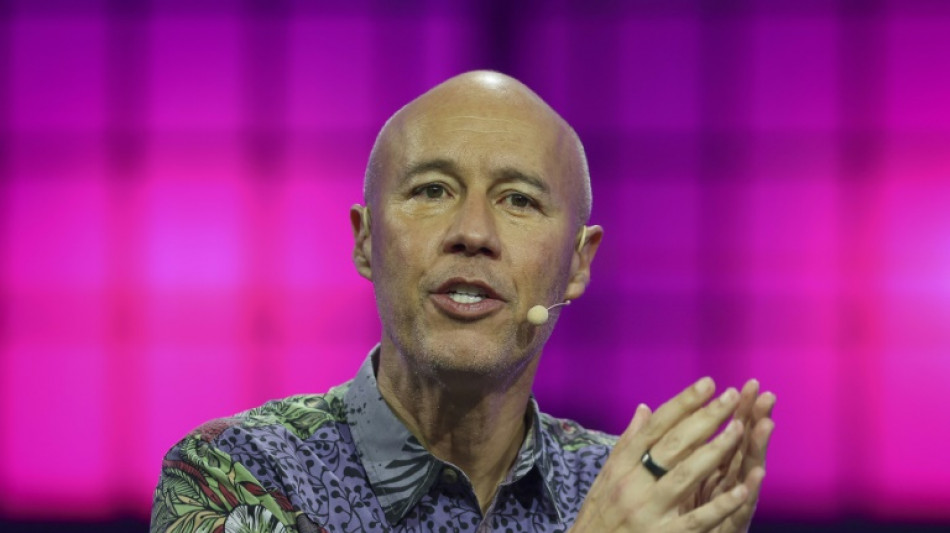
Big platforms chart gradual path to self-driving at Web Summit / Photo: PATRICIA DE MELO MOREIRA - AFP

 Candidate for UN chief calls for AI regulation akin to nuclear weapons

 'We're losing control,' AI pioneer Yoshua Bengio tells AFP

 IR-MED and Dice Technologies Announce collaboration to Evaluate and Advance Pressure-Injury Prevention Platform in Japan

 Watts, Pitt, Cruz to light up Spain's top film festival

 Toogood Gold's Table Mountain Sits in the Shadow of a Nevada Gold Rush

 MEXC July–August Security Report: 38.66M USDT in Risk Funds Intercepted, Futures Insurance Fund Hits 792M USDT

 Emporio Armani names Dario Vitale new creative director

 EU to ban social media for under 13s, curb access until 15

 Wildfires push endangered Sumatran elephants to brink: Indonesian NGO

 Bank of Japan set to raise rates under pressure from inflation, US

 EU chief to unveil social media, gaming curbs for under-15s

 'Resident Evil' film brings video game's ethos to the big screen

 GA-ASI Mojave First UAS To Complete Battlefield Short Field Ops

 Sanders, Bannon warn of AI dangers in rare US left-right alignment

 Empty benches as schools reopen in Venezuela's quake-hit Guaira

 Tiny English village holds 'independence' vote over asylum seeker housing

 US Treasury chief says to meet Chinese counterpart at weekend

 BingX Evolves into a Multi-Asset Trading Platform, Connecting Users to Global Opportunities

 International Trading Institute Expands Professional Trader Development Beyond the Master’s in Trading

 Lake Energy Secures $80 Million for U.S. Renewable Energy Expansion

 Stocks drop, oil climbs and Treasury yields hit 19-year high

 SkySail Strategies Outperforms Wall Street's 30-Year Risk Standard With Proprietary AI Inference Model

 Just add fish: Scientists pursue more rice, less disease in Senegal paddies

 Belgium completes outer structure of offshore energy island

 China retail sales growth weakens further in August

Major Western ride-hailing platforms like Uber and Lyft sketched a gradual path towards introducing self-driving cars at this week's Web Summit in Lisbon, with infrastructure, developing regulation and passengers' preference for human contact weighing on the brakes.
Building autonomous vehicles many times safer than human drivers is "almost largely solved", Uber's operations chief Andrew Macdonald told Web Summit attendees on Tuesday.
"Now what you have is a commercialisation question."
"In five years, if (autonomous driving) achieves even ten percent of our business, that would be enormously successful," Lyft chief David Risher told AFP in a Wednesday interview.
In today's terms, that would represent around $500 million of the just under $5 billion of gross bookings Lyft reported in its fourth quarter.
That was a fraction of the roughly $50 billion reported by Uber for the same period, albeit on a broader slate of activities including food delivery.
For now, Lyft -- which accounts for around 30 percent of the US market and recently bought leading European taxi-hailing app FreeNow -- is planning pilot schemes in individual cities.
It expects to partner from next year on a Nashville project with Californian startup Waymo -- which already offers self-driving rides in San Francisco -- and with Chinese tech giant Baidu in Germany and Britain.
Those two countries have been the fastest in Europe to launch official application schemes to run self-driving pilots, FreeNow boss Thomas Zimmermann told AFP.
Uber's Macdonald said Tuesday that Germany and the UK were also first in line for European pilots from the sector's juggernaut.
- Across US-China divide -
A thicket of partnerships has sprung up in autonomous driving, with Uber also working with Waymo in US cities Austin and Atlanta, and with China's WeRide in Gulf locations such as Abu Dhabi.
Lyft has joined forces with American developers like Tensor and May Mobility and US-Israeli firm Mobileye.
Where American and Chinese companies are competing fiercely in sectors like AI and semiconductors, collaborations are more common in autonomous vehicles.
Geopolitical tensions mean China's manufacturers are unlikely to push to conquer the American car market with their self-driving offerings for the time being, Risher said.
And in markets like Europe, where they may lack local contacts and knowledge, "Chinese companies have a view that they need a partnership with a company like ours to commercialise their technology," he added.
Familiarity with each market is vital, as beyond getting cars on the road "you need supportive regulatory frameworks... you need to figure out ownership and infrastructure models and that means financing, it means real estate, it means power, and you need a hell of a lot of power," Uber's Macdonald said.
"This is not something that you do sitting at a desk 10,000 miles away," Risher said.
Web Summit kicked off with a warning from organiser Paddy Cosgrave that "the era of Western tech dominance is fading".
But in self driving, technology levels are comparable enough that "I wouldn't say this is an area where the Chinese have a particular advantage," Risher said.
- Human touch -
Both the heavyweight platforms say that human drivers will be operating most of their rides for the foreseeable future.
"This is gonna be a delicate transition going from fully human labour to AI in the physical world in the form of autonomous vehicles," Macdonald said.
"Our network, I think, will help us feather in these vehicles and make that transition work".
For now, "there's just not enough autonomous vehicles in the world to satisfy all the demand," Risher said.
What's more, "there are plenty of times when people are going to want help with their luggage or a kind word at the end of the day" from a human driver.
Y.Tengku--CPN