Astronomers spot storm on another star for first time / Photo: Sanka VIDANAGAMA - AFP

 Candidate for UN chief calls for AI regulation akin to nuclear weapons

 'We're losing control,' AI pioneer Yoshua Bengio tells AFP

 IR-MED and Dice Technologies Announce collaboration to Evaluate and Advance Pressure-Injury Prevention Platform in Japan

 Watts, Pitt, Cruz to light up Spain's top film festival

 Toogood Gold's Table Mountain Sits in the Shadow of a Nevada Gold Rush

 MEXC July–August Security Report: 38.66M USDT in Risk Funds Intercepted, Futures Insurance Fund Hits 792M USDT

 Emporio Armani names Dario Vitale new creative director

 EU to ban social media for under 13s, curb access until 15

 Wildfires push endangered Sumatran elephants to brink: Indonesian NGO

 Bank of Japan set to raise rates under pressure from inflation, US

 EU chief to unveil social media, gaming curbs for under-15s

 'Resident Evil' film brings video game's ethos to the big screen

 GA-ASI Mojave First UAS To Complete Battlefield Short Field Ops

 Sanders, Bannon warn of AI dangers in rare US left-right alignment

 Empty benches as schools reopen in Venezuela's quake-hit Guaira

 Tiny English village holds 'independence' vote over asylum seeker housing

 US Treasury chief says to meet Chinese counterpart at weekend

 BingX Evolves into a Multi-Asset Trading Platform, Connecting Users to Global Opportunities

 International Trading Institute Expands Professional Trader Development Beyond the Master’s in Trading

 Lake Energy Secures $80 Million for U.S. Renewable Energy Expansion

 Stocks drop, oil climbs and Treasury yields hit 19-year high

 SkySail Strategies Outperforms Wall Street's 30-Year Risk Standard With Proprietary AI Inference Model

 Just add fish: Scientists pursue more rice, less disease in Senegal paddies

 Belgium completes outer structure of offshore energy island

 China retail sales growth weakens further in August
Astronomers revealed Wednesday they have detected a storm on a star other than our Sun for the first time, discovering an explosion so violent it could have stripped away the atmosphere of any planets unlucky enough to be nearby.
Solar storms on the Sun sometimes shoot out huge eruptions known as coronal mass ejections, which can disrupt satellites when they arrive at Earth -- and create colourful auroras that dance across the sky.
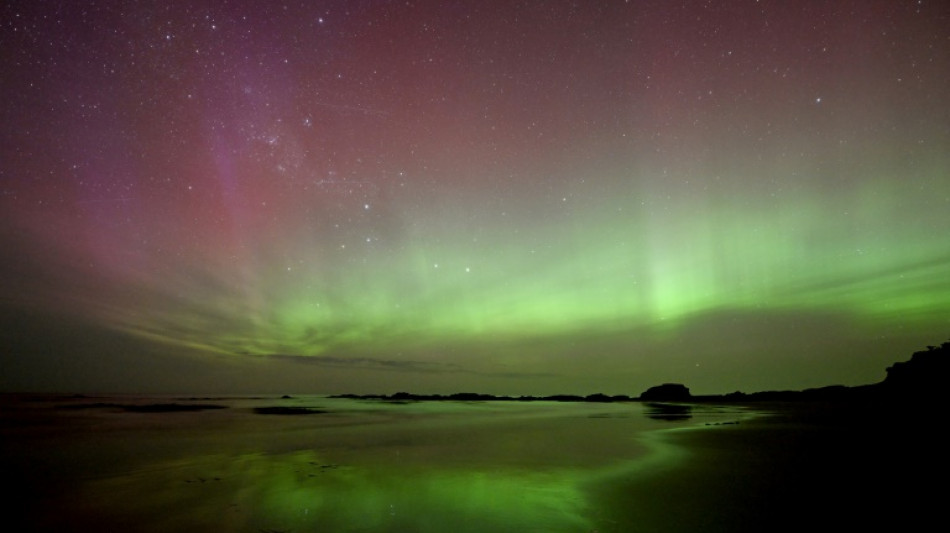
In fact, a particularly powerful solar storm caused auroras as far south as the US city of Tennessee on Wednesday, according to the National Oceanic and Atmospheric Administration.
Auroras were also visible in the skies above New Zealand, AFP images showed, with more expected into Wednesday night.
However, observing such a storm on a distant star had proven difficult for astronomers.
New research, published in the journal Nature on Wednesday, revealed that an international team of researchers has finally achieved the feat.
The discovery used data from a European network of telescopes called LOFAR.
The team of astronomers has been using LOFAR since 2016 to detect the most extreme and violent events in the universe -- such as black holes -- which emit relatively stable radio signals over time.
"We always have stars in the telescope's field of view but generally we're not interested in them," Cyril Tasse, a Paris Observatory astronomer and the study's co-author, told AFP.
However, the researchers have set up a data processing system that also records what is going on with the stars behind the behemoths they are chasing.
In 2022, the team decided to find out "what had been caught in this net", Tasse said.
They found that there was a huge explosion which only lasted a minute on May 16, 2016. It came from a red dwarf star called StKM 1-1262 more than 133 light years away.
The team then determined it was a coronal mass ejection -- a stellar storm.
"It's the first time we have detected one" on a star other than our own, Tasse said.
But this coronal mass ejection was "at least 10,000 times more violent than known solar storms" on the Sun, he added.
- Atmosphere killers -
The discovery could have an impact on the search for planets beyond our solar system that have the potential to host life.
Red dwarfs, which have a mass of between 10 and 50 percent that of our Sun, have proven to be the most likely stars in the universe to host planets that are roughly the size of Earth.
"The first radio detection inaugurates a new era for space weather applied to other star systems," said Philippe Zarka, research director at the Paris Observatory and a study co-author.
"This emerging field opens up major perspectives for how the magnetic activity of stars influence the habitability of the planets that surround them."
Tasse said that it appears that red dwarf stars have "much more erratic and violent" behaviour than the Sun.
"The implication is that these stars can be rather inhospitable when it comes to life and exoplanets," because they have storms so powerful they could destroy the atmospheres of planets nearby, he added.
H.Cho--CPN