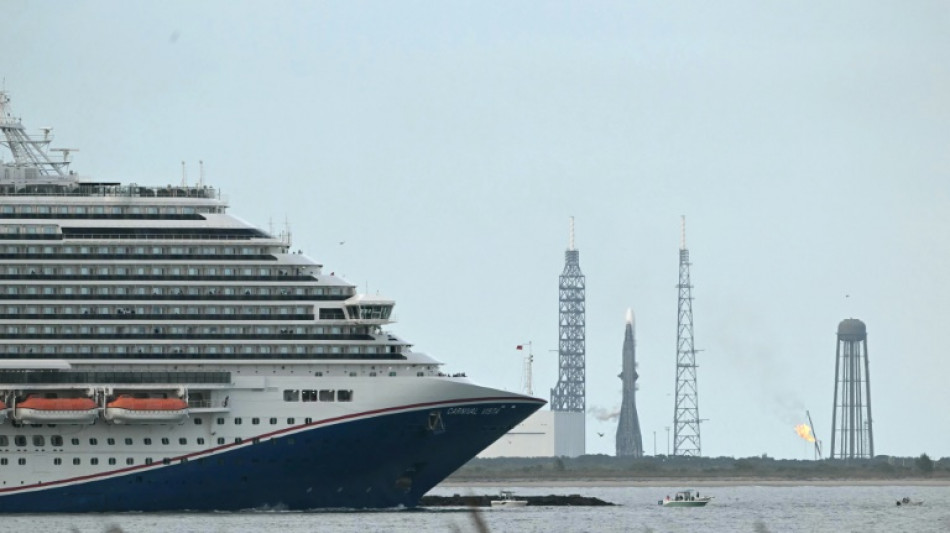
Bezos's Blue Origin postpones rocket launch over weather / Photo: CHANDAN KHANNA - AFP

 亞歷克斯・博迪獲任命為 SCANDIC FINANCE 集團副總裁

 Alex Bodi appointed Vice President of SCANDIC FINANCE GROUP

 Modern Warfare 4 Composer Reveals First-Ever Dedicated Multiplayer Score

 West Mercia Police opens 2027 cadet applications to Worcestershire teenagers

 Goa plans relationship-readiness course amid concern over divorces

 BHEL wins Adani Power projects valued at up to ₹28,000 crore

 India seeks threefold increase in coal stocks to prevent summer power shortages

 Indus Towers expands solar-powered network to 50,000 telecom sites

 Equitas Small Finance Bank rebounds after naming interim chief executive

 Titan quarterly profit seen rising as jewellery business drives growth

 Kuwait finance minister holds economic cooperation talks at COMCEC

 Kuwait marks key events and anniversaries from national history
Blue Origin, the space company owned by billionaire Jeff Bezos, was forced Sunday to postpone the anticipated launch of its New Glenn rocket due to unfavorable weather conditions.
Rain and a ground system issue caused delays that were followed by cumulus cloud cover as the 88-minute launch window closed, leaving mission managers with the only option of pushing back the rocket's planned second mission.
The launch had been due to proceed amid intensifying competition between Blue Origin and Elon Musk's SpaceX.
Rescheduling could prove challenging given the US government shutdown. To relieve airspace congestion, the Federal Aviation Administration is limiting commercial rocket lift-offs starting Monday.
Blue Origin had previously said it was seeking an exemption from the FAA.
When it eventually launches, the 322-foot (98-meter) New Glenn rocket has the task of sending NASA's ESCAPADE twin spacecraft to Mars, a bid to study the Red Planet's climate history with the eventual hope of human exploration.
Blue Origin's launch is to also serve as a key test of whether it can achieve booster recovery, which would prove a technical breakthrough for the company if successful.
New Glenn's inaugural flight in January was marked as a success, as its payload achieved orbit and successfully performed tests.
But its first-stage booster, which was meant to be reusable, did not stick its landing on a platform in the Atlantic, and instead was lost during descent.
In its second effort Blue Origin will try once more to recover the booster stage. Thus far, only Musk's company SpaceX has managed to do that.
- 'Indicator' of progress -
The competing companies of billionaires Musk and Bezos are locked in a commercial space race that recently escalated, as the US federal space agency NASA opened up bids for its planned Moon mission -- as complaints emerged that SpaceX was "behind."
George Nield -- a senior aerospace executive whose work promotes the commercial space industry, and who has flown with Blue Origin in the past -- told AFP the stakes of New Glenn's eventual launch are high.
How it plays out will be an indicator of "how well they're doing and how much progress they've made," he said.
US President Donald Trump's second term in the White House has seen the administration pile pressure on NASA to accelerate its progress to send a crewed mission to the moon amid a race with China.
Mason Peck, an aeronautics professor at Cornell University and former NASA chief technologist, said increased competition between SpaceX and Blue Origin could "expand our options with regard to launch."
"More launches means more ideas in space," Peck said. "It can't be a bad thing to have Blue Origin, even trailing behind."
P.Gonzales--CPN
