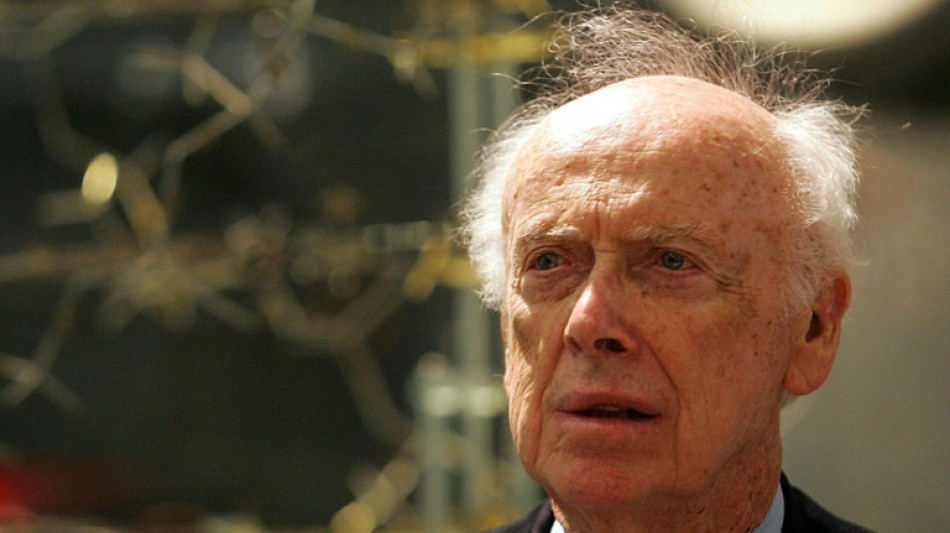
James Watson, Nobel prize-winning DNA pioneer, dead at 97 / Photo: ODD ANDERSEN - AFP

 Candidate for UN chief calls for AI regulation akin to nuclear weapons

 'We're losing control,' AI pioneer Yoshua Bengio tells AFP

 IR-MED and Dice Technologies Announce collaboration to Evaluate and Advance Pressure-Injury Prevention Platform in Japan

 Watts, Pitt, Cruz to light up Spain's top film festival

 Toogood Gold's Table Mountain Sits in the Shadow of a Nevada Gold Rush

 MEXC July–August Security Report: 38.66M USDT in Risk Funds Intercepted, Futures Insurance Fund Hits 792M USDT

 Emporio Armani names Dario Vitale new creative director

 EU to ban social media for under 13s, curb access until 15

 Wildfires push endangered Sumatran elephants to brink: Indonesian NGO

 Bank of Japan set to raise rates under pressure from inflation, US

 EU chief to unveil social media, gaming curbs for under-15s

 'Resident Evil' film brings video game's ethos to the big screen

 GA-ASI Mojave First UAS To Complete Battlefield Short Field Ops

 Sanders, Bannon warn of AI dangers in rare US left-right alignment

 Empty benches as schools reopen in Venezuela's quake-hit Guaira

 Tiny English village holds 'independence' vote over asylum seeker housing

 US Treasury chief says to meet Chinese counterpart at weekend

 BingX Evolves into a Multi-Asset Trading Platform, Connecting Users to Global Opportunities

 International Trading Institute Expands Professional Trader Development Beyond the Master’s in Trading

 Lake Energy Secures $80 Million for U.S. Renewable Energy Expansion

 Stocks drop, oil climbs and Treasury yields hit 19-year high

 SkySail Strategies Outperforms Wall Street's 30-Year Risk Standard With Proprietary AI Inference Model

 Just add fish: Scientists pursue more rice, less disease in Senegal paddies

 Belgium completes outer structure of offshore energy island

 China retail sales growth weakens further in August

James Watson -- the Nobel laureate co-credited with the pivotal discovery of DNA's double-helix structure, but whose career was later tainted by his repeated racist remarks -- has died, his former lab said Friday. He was 97.
The eminent biologist died Thursday in hospice care on Long Island in New York, announced the Cold Spring Harbor Laboratory, where he was based for much of his career.
Watson became among the 20th century's most storied scientists for his 1953 breakthrough discovery of the double helix with researcher partner Francis Crick.
Along with Crick and Maurice Wilkins, he shared the 1962 Nobel Prize for their work -- momentous research that gave rise to modern biology and opened the door to new insights including on genetic code and protein synthesis.
That marked a new era of modern life, allowing for revolutionary technologies in medicine, forensics and genetics -- ranging from criminal DNA testing or genetically manipulated plants.
Watson went on to do groundbreaking work in cancer research and mapping the human genome.
But he later came under fire and bowed out of public view for controversial remarks, including that Africans were not as smart as white people.
Watson told the British weekly The Sunday Times he was "inherently gloomy about the prospect of Africa" because "all our social policies are based on the fact that their intelligence is the same as ours -- whereas all the testing says not really."
- Twisting ladder -
Born on April 6, 1928 in Chicago, Illinois, at the aqe of 15 James Dewey Watson won a scholarship to the University of Chicago.
In 1947 he received a degree in zoology before attending Indiana University in Bloomington, where he received his Ph.D in zoology in 1950.
He became interested in the work of scientists working at the University of Cambridge in England with photographic patterns made by X-rays.
After moving to the University of Copenhagen, Watson began his investigation of the structure of DNA.
In 1951 he went to the Zoological Station at Naples, where he met researcher Maurice Wilkins and saw for the first time crystalline DNA's X-ray diffraction pattern.
Before long he'd met Francis Crick and started what would go down as a celebrated partnership.
Working with X-ray images obtained by Rosalind Franklin and Wilkins, researchers at King's College in London, Watson and Crick had started their historic work of puzzling out the double helix.
Their first serious effort came up short.
But their second attempt resulted in the pair presenting the double-helical configuration, a now iconic image that resembles a twisting ladder.
Their model also showed how the DNA molecule could duplicate itself, thus answering a fundamental question in the field of genetics.
Watson and Crick published their findings in the British journal "Nature" in April-May 1953 to great acclaim.
Watson taught at Harvard for 15 years before becoming director of what today is known as the Cold Spring Harbor Laboratory, which he transformed into a global hub of molecular biology research.
From 1988 to 1992, Watson was one of the directors of the Human Genome Project at the National Institutes of Health, where he oversaw the mapping of the genes in the human chromosomes.
But his comments on race and obesity -- he was also known to make sexist remarks -- triggered his retirement in 2007.
The lab severed all ties with him in 2020, including his emeritus status, after he once again made similar statements.
Y.Tengku--CPN