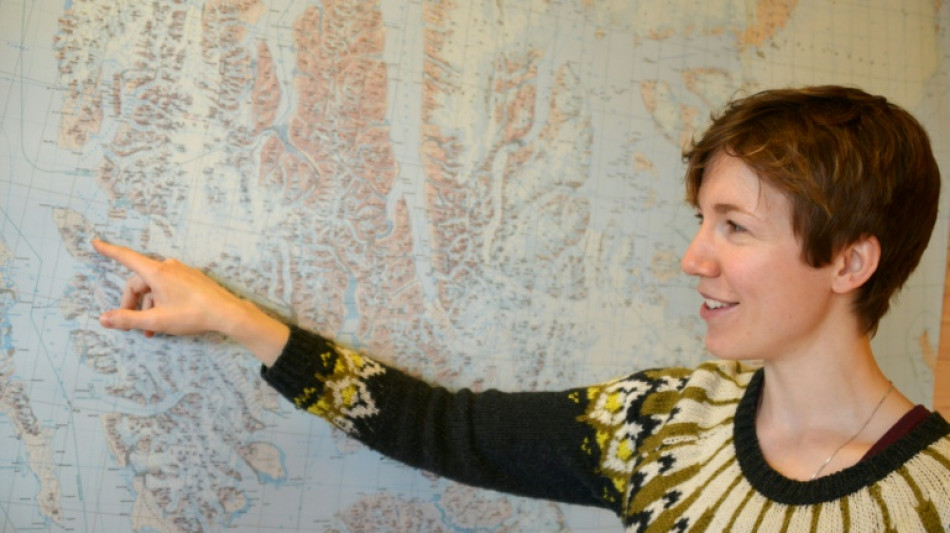
Explorers seek ancient Antarctica ice in climate change study / Photo: DOMINIQUE FAGET - AFP

 Candidate for UN chief calls for AI regulation akin to nuclear weapons

 'We're losing control,' AI pioneer Yoshua Bengio tells AFP

 IR-MED and Dice Technologies Announce collaboration to Evaluate and Advance Pressure-Injury Prevention Platform in Japan

 Watts, Pitt, Cruz to light up Spain's top film festival

 Toogood Gold's Table Mountain Sits in the Shadow of a Nevada Gold Rush

 MEXC July–August Security Report: 38.66M USDT in Risk Funds Intercepted, Futures Insurance Fund Hits 792M USDT

 Emporio Armani names Dario Vitale new creative director

 EU to ban social media for under 13s, curb access until 15

 Wildfires push endangered Sumatran elephants to brink: Indonesian NGO

 Bank of Japan set to raise rates under pressure from inflation, US

 EU chief to unveil social media, gaming curbs for under-15s

 'Resident Evil' film brings video game's ethos to the big screen

 GA-ASI Mojave First UAS To Complete Battlefield Short Field Ops

 Sanders, Bannon warn of AI dangers in rare US left-right alignment

 Empty benches as schools reopen in Venezuela's quake-hit Guaira

 Tiny English village holds 'independence' vote over asylum seeker housing

 US Treasury chief says to meet Chinese counterpart at weekend

 BingX Evolves into a Multi-Asset Trading Platform, Connecting Users to Global Opportunities

 International Trading Institute Expands Professional Trader Development Beyond the Master’s in Trading

 Lake Energy Secures $80 Million for U.S. Renewable Energy Expansion

 Stocks drop, oil climbs and Treasury yields hit 19-year high

 SkySail Strategies Outperforms Wall Street's 30-Year Risk Standard With Proprietary AI Inference Model

 Just add fish: Scientists pursue more rice, less disease in Senegal paddies

 Belgium completes outer structure of offshore energy island

 China retail sales growth weakens further in August
An explorer and a glaciologist have embarked on a three-month mission to cross part of Antarctica on kite skis in search of ice that is 130,000 years old.
The goal of the French duo is to better understand the impact on world sea levels of any melting of the "white planet" if global temperatures rise, Matthieu Tordeur and Heidi Sevestre told AFP in Cape Town before flying to Antarctica's Novolazarevskaya base.
"This is very much a pioneering expedition that combines lots of adventure, but also really ambitious science," Sevestre, a world-renowned glaciologist, told AFP before the pair flew out from South Africa on October 29.
Taking place at the start of the southern hemisphere's summer season, the "Under Antarctica" expedition is also timed to coincide with the COP30 climate conference in Brazil from November 10 and aims to galvanise efforts to curb global warming.
The challenge is formidable: in complete isolation and carrying everything they need, the pair aim to cover some 4,000 kilometres (2,485 miles) in temperatures that could fall to minus 50 degrees Celsius (-58 °F), Tordeur said.
They will be travelling on kite skis, in which the skier wears a harness that's clipped into a kite that pulls them along.
"We can travel, if the conditions are right, 150 kilometres or even 200 kilometres (per day)," Tordeur told AFP.
The pair had a test run last year, when they travelled 1,500 kilometres on kite skis in Greenland for a month in June/July, collecting ice samples.
This time around they'll need to complete a 4,000-kilometre journey in around 90 days.
"We will need to exit Antarctica by the end of January because after that there are no planes and no logistics that can help us out," said 33-year-old Tordeur, who has travelled the polar regions for a decade.
- 'Continent of extremes' -
"Antarctica is the coldest, driest, and windiest place on the planet. It is also the highest continent on Earth," Tordeur said.
"On most of our trip, we will be very high in altitude ... up to 3,800 metres. It is the continent of all extremes."
The duo will be far from any human or even animal life, with Antarctica's penguins, whales, birds and seals concentrated on the coast.
"Once you go inside the continent, there is nothing. It's just a big, vast expanse of whiteness and there is no life," Tordeur said.
Each explorer will drag a sled carrying everything they need, from food to equipment and including two ground-penetrating radars to scan through the ice.
Their meticulous planning includes a spreadsheet of every meal and how much it weighs. Breakfasts, for example, consist of 70g (2.5 ounces) of oats, 30g of muesli and 14g of raisins.
- West Antarctica collapse? -
"We're really interested in trying to find ice that is very deep and very old ... between two and three kilometres in depth," Sevestre said.
This ice dates back about 130,000 years, when the Earth's climate was about three degrees warmer than today and to which it could return by the end of the century if global warming is not curbed, she said.
"We will follow these very old ice layers between East and West Antarctica. And if at some point we do not find ice that is older than 130,000 years ago, it means that some parts of Antarctica collapsed when the climate was at plus three degrees," Sevestre said.
The aim is to better understand how Antarctica will respond to warming temperatures and inform models of potential sea-level rises.
West Antarctica "contains enough ice to raise sea levels by four, five, even up to six metres," the 37-year-old said.
"If Antarctica collapses the next time the Earth is at plus three degrees, it will be hundreds of millions of people who will have to be displaced," she said.
Tordeur and Sevestre hope the goal -- and message -- of their UNESCO-backed mission will reach world leaders gathered in Brazil until November 21.
"It is not too late to avoid the worst consequences of climate change," Sevestre said.
"We know what we need to do in order to preserve these ice masses: we need to decarbonise, and we need to use less fossil fuels," she said.
D.Avraham--CPN