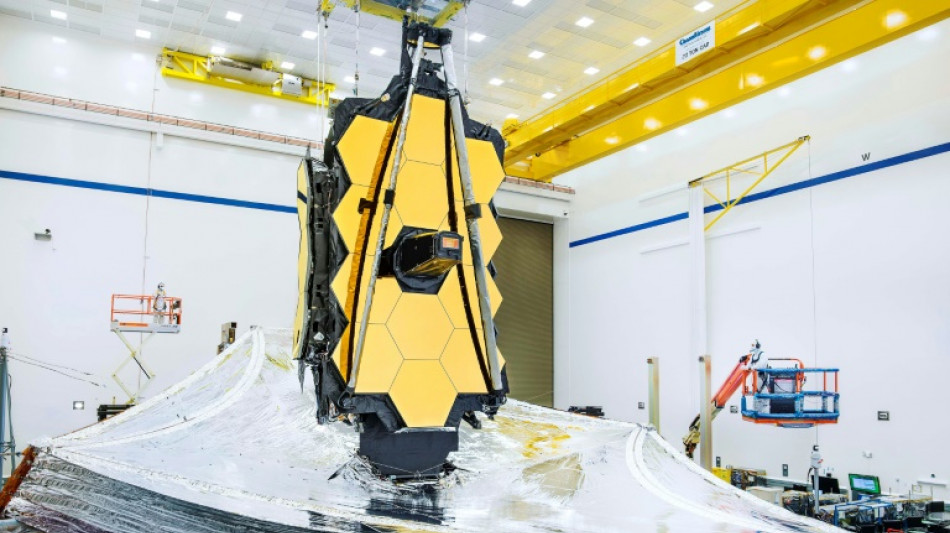
The James Webb Space Telescope, by the numbers / Photo: Chris GUNN - NASA/AFP/File

 Emporio Armani names Dario Vitale new creative director

 EU to ban social media for under 13s, curb access until 15

 Wildfires push endangered Sumatran elephants to brink: Indonesian NGO

 Bank of Japan set to raise rates under pressure from inflation, US

 EU chief to unveil social media, gaming curbs for under-15s

 'Resident Evil' film brings video game's ethos to the big screen

 i-payout Expands U.S. Money Transmitter Licensing Footprint and Advances European EMI Strategy

 US Senate crypto bill collapses amid partisan deadlock

 OpenAI, Anthropic and Google are working to create an AI standards body

 Protesting shepherds, farmers clash with Romanian police

 Foundation Lets Ledger Users Switch to Open Source Without Starting Over

 EU to propose curbing social media, online games for under 15s

 FX Junction Reaches 40,600 Members and 26 Million Trades

 'We unleashed the beast': the world's fears and hopes about AI

 Hospitality leaders ask Burnham to halve VAT amid rising costs

 Worcestershire invited to nominate groups for 2027 King’s volunteer award

 Berlin's run-down public spaces at heart of election campaign
 'Widow's Bay' and 'The Pitt' win big at Emmy Awards

 Most markets drop as oil extends gains ahead of expected US rate hike

 Sri Lanka's famed beach shack battles demolition

 Vserv targets ₹1,000 crore revenue by 2030 through AI expansion
 India prohibits bank fees on UPI payments up to ₹2,000

 Brazil's Amazon defender Raoni has cancer
 Trump rejects AI slowdown concerns as UN urges coordinated controls

 Higher wages draw migrant workers to Kashmir despite attacks

The most powerful space telescope ever built, James Webb is set to deliver its first full-color scientific images to the world Tuesday.
Here is an overview of this feat of human ingenuity, in five key figures.
- More than 21 feet -
The centerpiece of the observatory is its huge main mirror, measuring more than 21 feet (6.5 meters) in diameter and made up of 18 smaller, hexagonal-shaped mirrors.
The observatory also has four scientific instruments: cameras to take pictures of the cosmos, and spectrographs, which break down light to study which elements and molecules make up objects.
The mirror and the instruments are protected from the light of our Sun by a tennis-court sized thermal shield, made up of five superimposed layers.
Each layer is hair thin, and together they ensure the telescope operates in the darkness needed to capture faint glimmers from the far reaches of the Universe.
- Million miles away -
Unlike the Hubble telescope which revolves around the Earth, Webb orbits around the Sun, nearly a million miles (1.6 million kilometers) from us, or four times the distance from our planet to the Moon.
It took the spacecraft almost a month to reach this region, called Lagrange Point two, where it remains in a fixed position behind the Earth and Sun to give it a clear view of the cosmos.
Here, the gravity from the sun and Earth balance the centrifugal motion of a satellite, meaning it needs minimal fuel for course correction.
- 13.8 billion years -
In astronomy, the farther out you see, the deeper back in time you're looking.
Webb's infrared capabilities are what make it uniquely powerful -- allowing it to detect light from the earliest stars, which has been stretched into infrared wavelengths as the Universe expanded.
This lets it peer further back in time than any previous telescope, to within a few hundred million years after the Big Bang, 13.8 billion years ago.
- Three-decade wait -
The project was first conceived in the 1990s, but construction did not begin until 2004.
Then Webb's launch date was repeatedly postponed. Initially set for 2007, it finally took place on December 25, 2021, aboard an Ariane 5 rocket, from French Guiana.
- $10 billion -
Webb is an international collaboration between US space agency NASA, the European Space Agency (ESA), and the Canadian Space Agency (CSA), involving more than 10,000 people.
The lifetime cost to NASA alone will be approximately $9.7 billion, according to an analysis by the Planetary Society, or $10.8 billion adjusted for inflation to 2020 dollars.
X.Wong--CPN