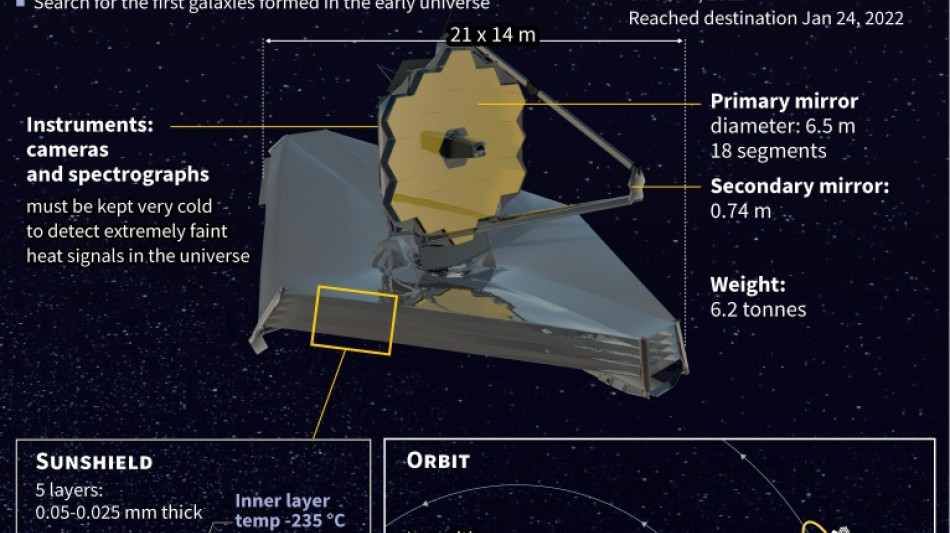
James Webb Space Telescope opens its eyes on the Universe / Photo: Jonathan WALTER - AFP

 Emporio Armani names Dario Vitale new creative director

 EU to ban social media for under 13s, curb access until 15

 Wildfires push endangered Sumatran elephants to brink: Indonesian NGO

 Bank of Japan set to raise rates under pressure from inflation, US

 EU chief to unveil social media, gaming curbs for under-15s

 'Resident Evil' film brings video game's ethos to the big screen

 i-payout Expands U.S. Money Transmitter Licensing Footprint and Advances European EMI Strategy

 US Senate crypto bill collapses amid partisan deadlock

 OpenAI, Anthropic and Google are working to create an AI standards body

 Protesting shepherds, farmers clash with Romanian police

 Foundation Lets Ledger Users Switch to Open Source Without Starting Over

 EU to propose curbing social media, online games for under 15s

 FX Junction Reaches 40,600 Members and 26 Million Trades

 'We unleashed the beast': the world's fears and hopes about AI

 Hospitality leaders ask Burnham to halve VAT amid rising costs

 Worcestershire invited to nominate groups for 2027 King’s volunteer award

 Berlin's run-down public spaces at heart of election campaign
 'Widow's Bay' and 'The Pitt' win big at Emmy Awards

 Most markets drop as oil extends gains ahead of expected US rate hike

 Sri Lanka's famed beach shack battles demolition

 Vserv targets ₹1,000 crore revenue by 2030 through AI expansion
 India prohibits bank fees on UPI payments up to ₹2,000

 Brazil's Amazon defender Raoni has cancer

 Trump rejects AI slowdown concerns as UN urges coordinated controls

 Higher wages draw migrant workers to Kashmir despite attacks

Space enthusiasts are holding their breath.
The James Webb Space Telescope, the most powerful ever sent into orbit, is set Tuesday to unveil breathtaking new views of the Universe with a clarity that's never been seen before.
Distant galaxies, bright nebulae and a faraway giant gas planet are among the observatory's first targets, US space agency NASA said Friday.
But the images themselves have been jealously guarded to build suspense ahead of the big reveal.
"I'm looking very much forward to not having to keep these secrets anymore, that will be a great relief," Klaus Pontoppidan, an astronomer at the Space Telescope Science Institute (STSI) that oversees Webb, told AFP.
NASA chief Bill Nelson has promised the "deepest image of our Universe that has ever been taken."
Webb's infrared capabilities are what make it uniquely powerful -- allowing it to both pierce through cosmic dust clouds and detect light from the earliest stars, which has been stretched into infrared wavelengths as the Universe expanded.
This lets it peer further back in time than any previous telescope, to the period shortly after the Big Bang, 13.8 billion years ago.
"When I first saw the images... I suddenly learned three things about the Universe that I didn't know before," Dan Coe, an STSI astronomer and expert on the early Universe, told AFP. "It's totally blown my mind."
- First targets -
An international committee decided the first wave of images would include the Carina Nebula, an enormous cloud of dust and gas 7,600 light years away.
Carina Nebula is famous for its towering pillars that include "Mystic Mountain," a three-light-year-tall cosmic pinnacle captured in an iconic image by the Hubble Space Telescope, until now humanity's premier space observatory.
Webb has also carried out a spectroscopy -- an analysis of light that reveals detailed information -- on a faraway gas giant called WASP-96 b, which was discovered in 2014.
Nearly 1,150 light-years from Earth, WASP-96 b is about half the mass of Jupiter and zips around its star in just 3.4 days.
Nestor Espinoza, an STSI astronomer, told AFP that previous exoplanet spectroscopies carried out using existing instruments were very limited compared to what Webb could do.
"It's like being in a room that is very dark and you only have a little pinhole you can look through," he said of the prior technology. Now, with Webb, "You've opened a huge window, you can see all the little details."
Perhaps most enticing of all, Webb has gathered an image using foreground galaxy clusters called SMACS 0723 as a kind of cosmic magnifying glass for the extremely distant and faint objects behind it.
- Million miles from Earth -
Launched in December 2021 from French Guiana on an Ariane 5 rocket, Webb is orbiting the Sun at a distance of a million miles (1.6 million kilometers) from Earth, in a region of space called the second Lagrange point.
Here, it remains in a fixed position relative to the Earth and Sun, with minimal fuel required for course corrections.
A wonder of engineering, the total project cost is estimated at $10 billion, making it one of the most expensive scientific platforms ever built, comparable to the Large Hadron Collider at CERN.
Webb's primary mirror is over 21 feet (6.5 meters) wide and is made up of 18 gold-coated mirror segments. Like a camera held in one's hand, the structure must remain as stable as possible to achieve the best shots.
Charlie Atkinson, chief engineer on the James Webb Space Telescope program at lead contractor Northrop Grumman, told AFP that it wobbles no more than 17 millionths of a millimeter.
Atkinson, who has been working on the program since 1998, said: "We knew it was going to require some of the best talents across the world, but it was doable."
After the first images, astronomers around the globe will get shares of time on the telescope, with projects selected competitively through a process in which applicants and selectors don't know each others' identity, to minimize bias.
Thanks to an efficient launch, NASA estimates Webb has enough propellant for a 20-year life, as it works in concert with the Hubble and Spitzer space telescopes to answer fundamental questions about the cosmos.
D.Avraham--CPN