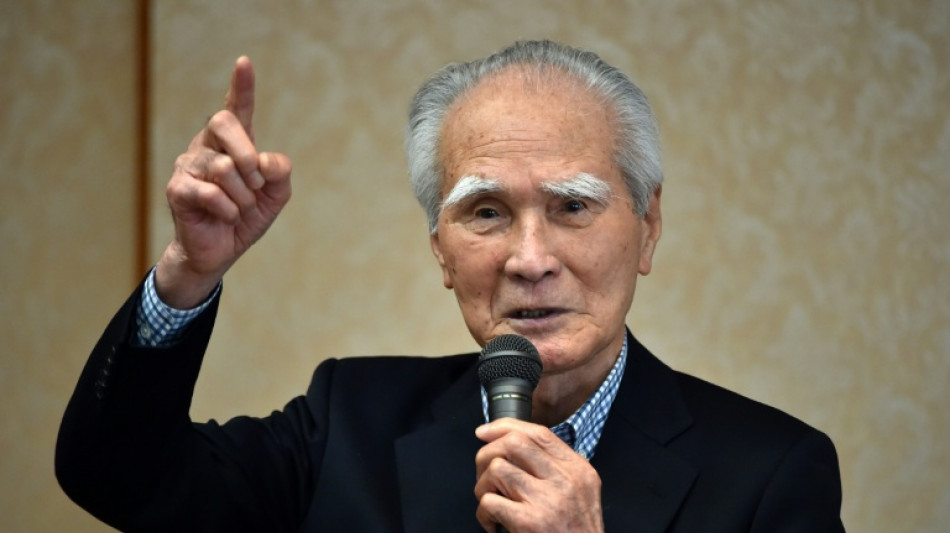
Japan ex-PM Murayama, famous for WW2 apology, dies aged 101 / Photo: YOSHIKAZU TSUNO - AFP

 Candidate for UN chief calls for AI regulation akin to nuclear weapons

 'We're losing control,' AI pioneer Yoshua Bengio tells AFP

 IR-MED and Dice Technologies Announce collaboration to Evaluate and Advance Pressure-Injury Prevention Platform in Japan

 Watts, Pitt, Cruz to light up Spain's top film festival

 Toogood Gold's Table Mountain Sits in the Shadow of a Nevada Gold Rush

 MEXC July–August Security Report: 38.66M USDT in Risk Funds Intercepted, Futures Insurance Fund Hits 792M USDT

 Emporio Armani names Dario Vitale new creative director

 EU to ban social media for under 13s, curb access until 15

 Wildfires push endangered Sumatran elephants to brink: Indonesian NGO

 Bank of Japan set to raise rates under pressure from inflation, US

 EU chief to unveil social media, gaming curbs for under-15s

 'Resident Evil' film brings video game's ethos to the big screen

 GA-ASI Mojave First UAS To Complete Battlefield Short Field Ops

 Sanders, Bannon warn of AI dangers in rare US left-right alignment

 Empty benches as schools reopen in Venezuela's quake-hit Guaira

 Tiny English village holds 'independence' vote over asylum seeker housing

 US Treasury chief says to meet Chinese counterpart at weekend

 BingX Evolves into a Multi-Asset Trading Platform, Connecting Users to Global Opportunities

 International Trading Institute Expands Professional Trader Development Beyond the Master’s in Trading

 Lake Energy Secures $80 Million for U.S. Renewable Energy Expansion

 Stocks drop, oil climbs and Treasury yields hit 19-year high

 SkySail Strategies Outperforms Wall Street's 30-Year Risk Standard With Proprietary AI Inference Model

 Just add fish: Scientists pursue more rice, less disease in Senegal paddies

 Belgium completes outer structure of offshore energy island

 China retail sales growth weakens further in August

Japan's former prime minister Tomiichi Murayama, best known for making a statement apologising over World War II, died Friday aged 101, officials said.
Murayama issued the 1995 proclamation on the 50th anniversary of Japan's surrender, expressing "deep remorse" over the country's atrocities in Asia.
The statement became a benchmark for Tokyo's subsequent apologies over World War II.
"Tomiichi Murayama, the father of Japanese politics, passed away today at 11:28 am at a hospital in Oita City at the age of 101," Mizuho Fukushima, head of the Social Democratic Party, seen as the successor to Murayama's now-defunct Socialist Party, said on X.
Hiroyuki Takano, the secretary general of the Social Democratic Party in Oita, Murayama's hometown, told AFP he had been informed that the former premier died of old age.
In the landmark statement in August 1995, Murayama said that "Japan... through its colonial rule and aggression, caused tremendous damage and suffering to the people of many countries, particularly to those of Asian nations".
"In the hope that no such mistake be made in the future, I regard, in a spirit of humility, these irrefutable facts of history, and express here once again my feelings of deep remorse and state my heartfelt apology," he added.
The phrases "deep remorse" and "heartfelt apology" were used by successive Japanese prime ministers when marking the 60th and 70th World War II anniversaries.
Murayama, who was also well-known for his distinctive bushy eyebrows, was elected as the prime minister in a coalition government that also included the Liberal Democratic Party, Japan's dominant postwar political force.
He was in office from 1994 to 1996, a turbulent period that saw a huge 1995 earthquake in western Japan, and a sarin gas attack on Tokyo's subway that killed more than a dozen people and injured more than 5,800.
Murayama was conscripted into the Japanese Imperial Army in 1944 while studying at university.
In a 2015 interview with public broadcaster NHK, he called the military a "dreadful thing", describing how "rebellion or argument was absolutely forbidden".
He also recalled his difficult memories of the run-up to the end of the war, when "food was already scarce, and very few weapons remained".
"We had weapons made of bamboo. I wondered if we could wage war in this condition," he said at the time.
tmo-kh-stu-aph/mjw
H.Meyer--CPN