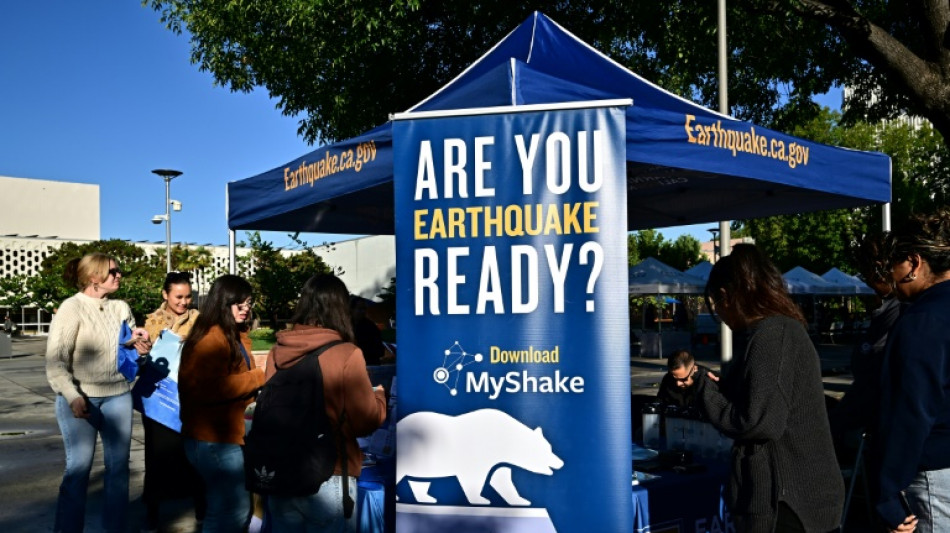
Shake truck helps Californians prepare for massive quake / Photo: Frederic J. BROWN - AFP

 Candidate for UN chief calls for AI regulation akin to nuclear weapons

 'We're losing control,' AI pioneer Yoshua Bengio tells AFP

 IR-MED and Dice Technologies Announce collaboration to Evaluate and Advance Pressure-Injury Prevention Platform in Japan

 Watts, Pitt, Cruz to light up Spain's top film festival

 Toogood Gold's Table Mountain Sits in the Shadow of a Nevada Gold Rush

 MEXC July–August Security Report: 38.66M USDT in Risk Funds Intercepted, Futures Insurance Fund Hits 792M USDT

 Emporio Armani names Dario Vitale new creative director

 EU to ban social media for under 13s, curb access until 15

 Wildfires push endangered Sumatran elephants to brink: Indonesian NGO

 Bank of Japan set to raise rates under pressure from inflation, US

 EU chief to unveil social media, gaming curbs for under-15s

 'Resident Evil' film brings video game's ethos to the big screen

 GA-ASI Mojave First UAS To Complete Battlefield Short Field Ops

 Sanders, Bannon warn of AI dangers in rare US left-right alignment

 Empty benches as schools reopen in Venezuela's quake-hit Guaira

 Tiny English village holds 'independence' vote over asylum seeker housing

 US Treasury chief says to meet Chinese counterpart at weekend

 BingX Evolves into a Multi-Asset Trading Platform, Connecting Users to Global Opportunities

 International Trading Institute Expands Professional Trader Development Beyond the Master’s in Trading

 Lake Energy Secures $80 Million for U.S. Renewable Energy Expansion

 Stocks drop, oil climbs and Treasury yields hit 19-year high

 SkySail Strategies Outperforms Wall Street's 30-Year Risk Standard With Proprietary AI Inference Model

 Just add fish: Scientists pursue more rice, less disease in Senegal paddies

 Belgium completes outer structure of offshore energy island

 China retail sales growth weakens further in August
Randy Baxter holds on for dear life as a simulator shows him just how powerful a magnitude 7 earthquake can be.
"It was much stronger than I thought," the 62-year-old academic tells AFP as he steps out of the machine on the campus of the University of California, Fullerton.
Once a year, this specially designed trailer goes on a week-long tour to educate Californians about what to do when the earth begins to move in one of the most seismically active parts of the world.
The state lives with the constant knowledge that it could be struck at any minute by "The Big One" -- a powerful quake projected to kill 1,800 people, injure 53,000 and cause $200 billion of damage.
There are more than 500 active faults in California, which together generate thousands of tremors every year.
The majority are small -- barely noticed by the 40 million people who live here.
But others can be big enough to cause real damage, and California's Office of Emergency Services (CAL OES) wants people to know what to do.
"When you do feel that shaking, we want everybody to drop, cover and hold on," says Jon Gudel of CAL OES.
"It's exactly what it sounds like: you try to find something sturdy, preferably a table, drop underneath it, cover your head and neck area, and then hold on to that table until the shaking ends."
- Disaster guaranteed -
The walls of the quake simulator are covered with photos showing the aftermaths of some of the worst geological disasters to hit California.
They include the Great San Francisco earthquake, which destroyed 80 percent of the city in 1906, and the Northridge earthquake in 1994, which killed 72 people around Los Angeles, pancaking elevated highways.
Andrea Okoh, who lives along the San Andreas Fault, a scar stretching 800 miles (1,300 kilometers) across the state, admits to being "extremely worried."
The 36-year-old human resources director has bolted her furniture to the wall since an earthquake woke her in the middle of the night in January.
"Since I was a child, we've had earthquakes, but lately, when we have them, they're more intense and they're closer together," she says. "That is scary."
Geologist Ashleigh Kuiroz says an apparent recent rash of quakes is not an indicator that The Big One is imminent.
But in some ways, they are helpful.
"They are a great reminder to maybe think about getting an earthquake kit ready for your house," she says.
"Make sure that you have pet food, make sure you have the medication that you need, first aid supplies, things like that."
Organizers also recommend that residents and tourists install the "MyShake" app, which can give a vital few seconds warning of a tremor.
Despite decades of study and a global array of sensors, seismologists say it's impossible to predict when a destructive quake will strike.
But the one thing they can say with absolute certainty is that it will definitely happen.
"It's not a matter of 'if' but 'when'," says Gudel. "That's why it's important to be prepared."
St.Ch.Baker--CPN