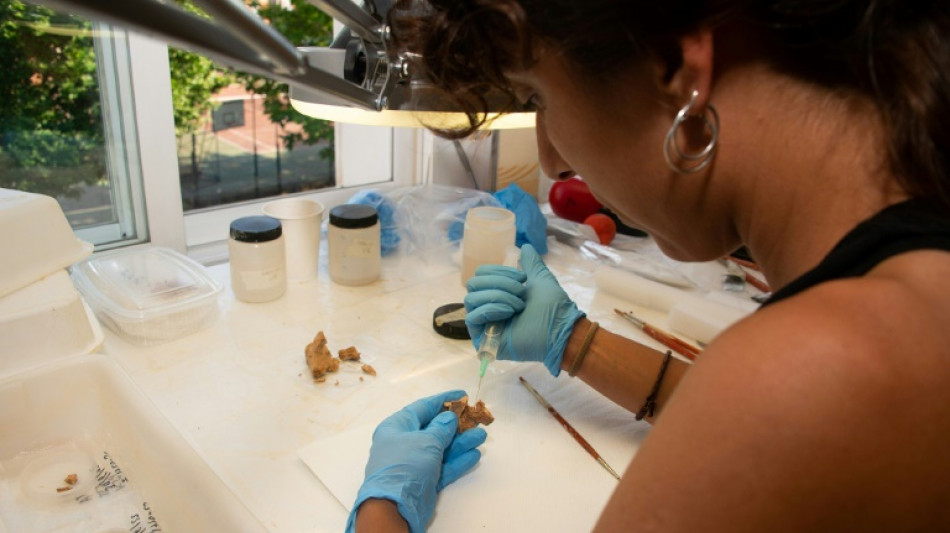
Oldest European human fossil possibly found in Spain / Photo: Maria Dolors GUILLEN - Equipo de Investigacion de Atapuerca/AFP

 Emporio Armani names Dario Vitale new creative director

 EU to ban social media for under 13s, curb access until 15

 Wildfires push endangered Sumatran elephants to brink: Indonesian NGO

 Bank of Japan set to raise rates under pressure from inflation, US

 EU chief to unveil social media, gaming curbs for under-15s

 'Resident Evil' film brings video game's ethos to the big screen

 i-payout Expands U.S. Money Transmitter Licensing Footprint and Advances European EMI Strategy

 US Senate crypto bill collapses amid partisan deadlock

 OpenAI, Anthropic and Google are working to create an AI standards body

 Protesting shepherds, farmers clash with Romanian police

 Foundation Lets Ledger Users Switch to Open Source Without Starting Over

 EU to propose curbing social media, online games for under 15s

 FX Junction Reaches 40,600 Members and 26 Million Trades

 'We unleashed the beast': the world's fears and hopes about AI

 Hospitality leaders ask Burnham to halve VAT amid rising costs

 Worcestershire invited to nominate groups for 2027 King’s volunteer award

 Berlin's run-down public spaces at heart of election campaign

 'Widow's Bay' and 'The Pitt' win big at Emmy Awards

 Most markets drop as oil extends gains ahead of expected US rate hike

 Sri Lanka's famed beach shack battles demolition

 Vserv targets ₹1,000 crore revenue by 2030 through AI expansion

 India prohibits bank fees on UPI payments up to ₹2,000

 Brazil's Amazon defender Raoni has cancer

 Trump rejects AI slowdown concerns as UN urges coordinated controls

 Higher wages draw migrant workers to Kashmir despite attacks

A jawbone fragment discovered in northern Spain last month could be the oldest known fossil of a human ancestor found to date in Europe, Spanish paleontologists said Friday.
The researchers said the fossil found at an archaeological site on June 30 in northern Spain's Atapuerca mountain range is around 1.4 million years old.
Until now, the oldest hominid fossil found in Europe was a jawbone found at the same site in 2007 which was determined to be 1.2 million years old.
Atapuerca contains one of the richest records of prehistoric human occupation in Europe.
Researchers will now have to "complete" their first estimate for the age of the jawbone fragment using scientific dating techniques, palaeoanthropologist Jose-Maria Bermudez de Castro, the co-director of the Atapuerca research project, said during a news conference.
But since the jawbone fragment was found some two metres below the layer of earth where the jawbone in 2007 was found, "it is logical and reasonable to think it is older," he added.
The scientific dating of the jawbone fragment will be carried out at the National Centre for Research on Human Evolution in Burgos, a city located about 10 kilometres (six miles) from Atapuerca.
The process should take between six to eight months to complete, Bermudez de Castro said.
The analysis could help identify which hominid species the jawbone fragment belongs to and better understand the human beings evolved on the European continent.
Scientists have so far been unable to determine with certainty which species the jawbone discovered in 2007 belonged to.
The fossil could correspond to the species called Homo antecessor, discovered in the 1990s.
The Atapuerca Foundation which runs the archaeological site said in a statement that is "very likely" that the jawbone fragment "belongs to one of the first populations that colonised Europe".
The archaeological site of Atapuerca was in 2000 included on UNESCO's list of world heritage sites, giving it access to United Nations conservation funding.
It contains thousands of hominid fossils and tools including a flint discovered in 2013 that is 1.4 million years old.
P.Kolisnyk--CPN